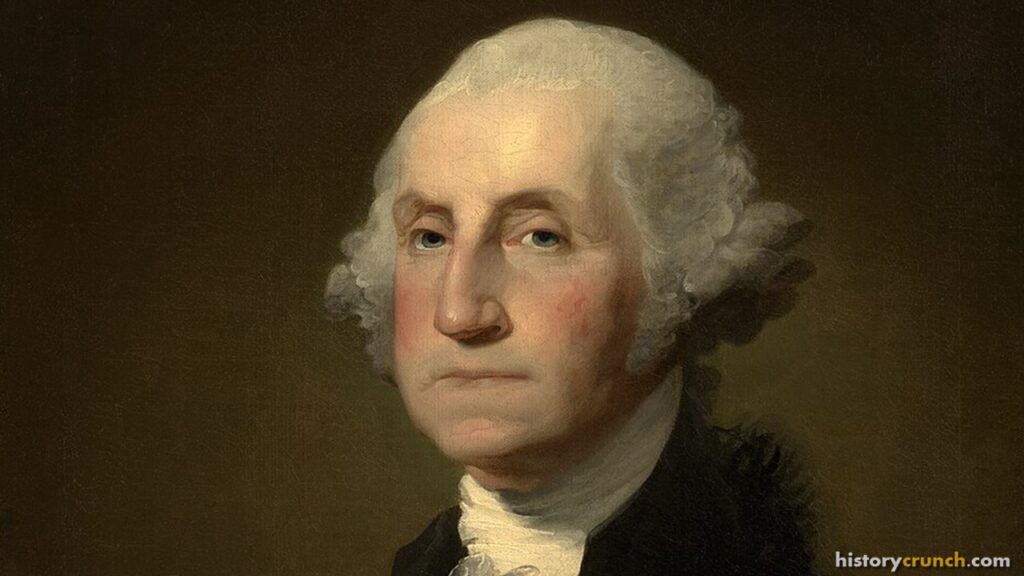
George Washington was a Virginia planter, soldier, and statesman who served as Commander-in-Chief of the Continental Army during the American Revolutionary War and as the first President of the United States. Born on February 22nd, 1732, and dying on December 14th, 1799, Washington spent his life at the center of the most important events in the founding of the United States. He is remembered today as the Father of His Country, a figure whose leadership, judgment, and willingness to give up power at critical moments helped shape the nation he helped create.
Early Life and Education
George Washington was born on February 22nd, 1732, at Pope’s Creek plantation in Westmoreland County, in the British colony of Virginia. His father, Augustine Washington, was a planter and justice of the peace of moderate wealth. When George was just eleven years old, his father died. His older half-brother Lawrence, who had been educated in England and served in the British military, became his primary mentor and took him to live at the family estate on the Potomac River, which Lawrence named Mount Vernon after the British admiral under whom he had served.
Washington received a basic education in reading, writing, and mathematics, but unlike many of Virginia’s elite he never attended college or traveled to England for schooling. What he lacked in formal education he made up for through practical experience. In his mid-teens he trained as a land surveyor and spent long months on the Virginia frontier surveying the landholdings of Lord Fairfax, one of the most powerful men in the colony. The experience toughened him physically, sharpened his ability to read terrain, and gave him connections to Virginia’s political elite through the Fairfax family. In 1752, Lawrence died of tuberculosis, and Washington eventually inherited Mount Vernon and the land that came with it.
The French and Indian War
Washington’s military career began at the age of 21, when Virginia’s governor Robert Dinwiddie sent him to the Ohio Valley to deliver a message to French commanders demanding they withdraw from territory Virginia claimed. The French refused. In the spring of 1754, Dinwiddie sent Washington back with a small force of about 150 soldiers. On May 28th, 1754, Washington and his men, accompanied by Mingo warriors, ambushed a French scouting party at Jumonville Glen, killing several men including the French commander. The skirmish is considered the opening engagement of the French and Indian War.
Washington retreated and built a makeshift fortification called Fort Necessity. A larger French force attacked on July 3rd, and Washington was forced to surrender, negotiating a withdrawal under arms. The defeat was humiliating, but Washington emerged from the experience with his reputation for personal courage largely intact. The following year he served as a volunteer aide to British General Edward Braddock on an ill-fated expedition to capture Fort Duquesne. During the catastrophic ambush at the Battle of the Monongahela in July of 1755, Braddock was mortally wounded and the British force was routed. Washington had two horses shot out from under him and four bullet holes in his coat, but escaped unharmed. His role in organizing the retreat earned him considerable recognition throughout the colonies. He was subsequently given command of all Virginia’s military forces, a position he held until 1758.
By 1759, Washington had resigned his commission and returned to Mount Vernon. On January 6th, 1759, he married Martha Dandridge Custis, a wealthy widow with two young children, John and Martha. The marriage brought Washington considerable property and elevated his social standing significantly. He had no biological children of his own but raised Martha’s children and later her grandchildren as his own. In the years that followed, Washington expanded Mount Vernon from roughly 2,000 acres to more than 8,000, diversifying its operations to include wheat farming, fishing, distilling, and milling. He was elected to the Virginia House of Burgesses in 1758 and served there until 1774, developing the political skills and contacts that would serve him throughout his public career.
Growing Opposition to British Rule
Through the 1760s, Washington grew increasingly resistant to British policies toward the colonies. He was not among the most radical voices in the early resistance movement, but he followed the debates closely and developed firm convictions about the rights of colonists as British subjects. As the Stamp Act and Townshend Acts generated controversy, Washington signed non-importation agreements and publicly voiced his opposition to taxation without representation. He was among the first prominent Virginians to suggest that armed resistance might ultimately be necessary if Britain did not change course.
Washington served as a delegate from Virginia to the First Continental Congress in September of 1774 and the Second Continental Congress beginning in May of 1775. By the time the Second Congress convened, fighting had already broken out at Lexington and Concord. Washington attended the meetings in his military uniform, a quiet signal that he was prepared for war.
Commander-in-Chief of the Continental Army
On June 15th, 1775, the Second Continental Congress unanimously elected Washington as Commander-in-Chief of the newly established Continental Army. The choice was both practical and political. Washington had more military experience than almost any other candidate, and his selection helped bind Virginia, the largest and wealthiest colony, to the common cause. He accepted the position with characteristic humility, telling Congress he did not think himself equal to the task, and announced he would serve without pay, asking only that his expenses be covered.
Washington took command of the roughly 14,000 militia gathered around Boston in early July of 1775. The force he inherited was disorganized, poorly disciplined, and dangerously short of supplies, ammunition, and experienced officers. His first great challenge was simply to turn it into an army. In March of 1776, he solved the strategic problem of the Siege of Boston by having the cannon captured at Fort Ticonderoga dragged hundreds of miles through the wilderness by Henry Knox and placed on Dorchester Heights overlooking the city. The British, their fleet suddenly under the muzzles of dozens of cannon, evacuated Boston on March 17th, 1776, Washington’s first major victory.
The success was short-lived. Through the summer and autumn of 1776, the British drove Washington’s army out of New York in a series of defeats, capturing Long Island and Manhattan and forcing a long retreat across New Jersey. By December of 1776, the army had shrunk to roughly 3,000 exhausted men, with thousands of enlistments about to expire. Washington later wrote privately that he thought the game was “pretty near up.” In a moment of extraordinary boldness, he crossed the ice-filled Delaware River on the night of December 25th, 1776, and launched a surprise attack on a Hessian garrison at Trenton, New Jersey. The victory, followed days later by another at Princeton, saved the American Revolution at its most desperate moment and restored confidence in Washington as a commander.
Washington’s strategic approach throughout the war was shaped by a clear-eyed assessment of what his army could and could not do. He understood that he could not match the British in pitched battles on open ground with professional troops and that his primary objective was to keep the Continental Army in existence until Britain’s will to fight gave out. He described his strategy as one of avoiding a decisive general engagement unless forced into one, relying instead on mobility, attrition, and the willingness of the American people to sustain the struggle. The approach frustrated politicians who wanted quick, decisive victories, but it proved to be correct.
The winter encampment at Valley Forge from December of 1777 to June of 1778 was the darkest period of Washington’s command. The army arrived battered after defeats at Brandywine and Germantown, and roughly 2,000 men died from disease, starvation, and exposure over the following months. Washington remained in camp with his men, writing urgently to Congress for supplies, and worked closely with the Prussian officer Baron von Steuben, whose rigorous training transformed the army’s discipline and battlefield performance. The army that left Valley Forge in June of 1778 was measurably stronger than the one that had arrived.
The American victory at Saratoga in October of 1777, under General Horatio Gates, secured the French alliance that Washington had long believed was essential to winning the war. The entry of France in 1778, followed by Spain in 1779 and the Dutch Republic in 1780, changed the entire character of the conflict. The final campaign of the war came in September and October of 1781. Washington and French General Rochambeau marched their combined force south to Virginia in a brilliantly executed strategic deception, while the French fleet under Admiral de Grasse sealed the Chesapeake Bay and cut off British General Cornwallis at Yorktown. After three weeks of siege, Cornwallis surrendered on October 19th, 1781. The war was effectively over.
Resignation of His Commission
In the months after Yorktown, Washington faced one of the most serious tests of his character. At Newburgh, New York, in March of 1783, a group of Continental Army officers, frustrated by Congress’s failure to pay them, circulated anonymous letters suggesting the army should refuse to disband and use its military power to force the issue. Washington intervened personally, calling a meeting of officers and delivering a brief, unplanned speech in which he put on reading glasses for the first time in front of his men, saying that he had grown gray in their service and was now going blind. The moment broke the tension in the room, and the Newburgh conspiracy collapsed.
On December 23rd, 1783, Washington appeared before Congress in Annapolis, Maryland, and formally resigned his commission as Commander-in-Chief. The act stunned observers in Europe and America alike. King George III, upon hearing what Washington intended to do, reportedly said that if he resigned his command, he would be the greatest man in the world. Washington shook hands with his officers at Fraunces Tavern in New York, bade farewell to his men, and returned to Mount Vernon, fully intending to live out his days as a farmer.
The Constitutional Convention
Washington’s retirement lasted only a few years. The weakness of the Articles of Confederation was becoming increasingly apparent, and after Shays’ Rebellion in 1786 to 1787 highlighted the inability of the national government to maintain order, leaders called a Constitutional Convention in Philadelphia. Washington, whose support was seen as essential to the convention’s success and to the public’s acceptance of whatever it produced, reluctantly agreed to attend and was unanimously elected president of the convention in May of 1787.
Washington presided over the convention’s deliberations through the summer of 1787 without playing a prominent role in the debates themselves, but his steady presence gave the proceedings legitimacy. The Constitution the convention produced was ratified by the states in 1788, and Washington’s public endorsement was widely credited with persuading skeptical citizens to support it.
The Presidency
Washington was unanimously elected president by the Electoral College in early 1789, the only president in American history to receive every electoral vote. He was inaugurated on April 30th, 1789, at Federal Hall in New York City. He served two terms, from 1789 to 1797, and in doing so established virtually every precedent and practice that would define the American presidency for generations.
He organized the executive branch by creating a cabinet, appointing Thomas Jefferson as Secretary of State and Alexander Hamilton as Secretary of the Treasury. He worked closely with Hamilton to establish the national bank and a system of public credit that stabilized the new nation’s finances, over the fierce objections of Jefferson and James Madison. He used federal military force to suppress the Whiskey Rebellion of 1794, a tax protest in western Pennsylvania, demonstrating that the federal government had both the authority and the will to enforce its laws. In foreign policy, he issued a proclamation of neutrality in 1793 when war broke out between France and Britain, establishing the principle that the United States would stay out of European conflicts. The Jay Treaty of 1794, which normalized trade relations with Britain, was deeply controversial but avoided a war the young nation was not ready to fight.
Washington was unanimously reelected in 1792. As his second term neared its end, he chose not to seek a third, despite having the support to win one easily. His Farewell Address of 1796, written with the help of Alexander Hamilton, warned future Americans against the dangers of permanent foreign alliances, excessive debt, and above all the destructive influence of political parties and regional factionalism. The address became one of the most influential documents in American political history and was read aloud in Congress each year for generations.
Later Life and Death
Washington retired to Mount Vernon in March of 1797 at the age of 65. He spent his final years farming, entertaining visitors including his old friend the Marquis de Lafayette, and managing the plantation he had spent his life building. He also quietly arranged his affairs in ways that reflected his evolved views on slavery. Over the course of his life Washington had enslaved more than 300 people. His will, written in July of 1799, stipulated that the 123 enslaved people he owned outright should be freed upon Martha’s death, the only Founding Father to make such a provision.
On December 12th, 1799, Washington rode out in cold, wet weather to inspect his farms. He developed a severe throat infection, most likely epiglottitis, and died two days later on December 14th, 1799, at Mount Vernon. He was 67 years old. His last recorded words were “Tis well.” Martha Washington survived him by two and a half years, dying in May of 1802.
Significance of George Washington
George Washington’s significance in American history is difficult to overstate. At every critical moment in the founding of the United States, his presence, his judgment, and his willingness to subordinate personal ambition to the public good made the difference between success and failure. He led an outmatched army through eight years of war without losing sight of the strategic objective. He presided over the creation of the Constitution. He established the precedents of the presidency, including the peaceful transfer of power, that have shaped American democracy ever since.
Washington was not without flaws. He enslaved hundreds of people throughout his life and was only able to begin rectifying that wrong in death. His military record included significant defeats alongside his victories. And his desire to maintain harmony often led him to avoid difficult conflicts longer than was wise. But the qualities that defined him, his physical courage, his personal integrity, his ability to inspire loyalty, and above all his consistent willingness to put down power when others would have seized it, made him one of the most important and admired leaders in the history of the modern world. Virginia Governor Henry Lee’s eulogy captured the national sentiment when he described Washington as “first in war, first in peace, and first in the hearts of his countrymen.”