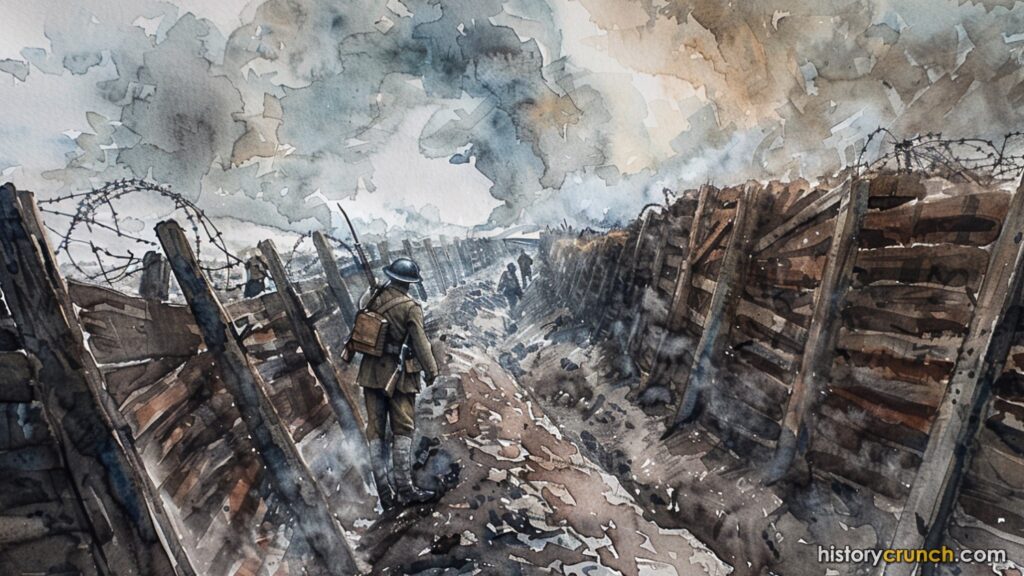
World War I first began in 1914 from a series of important causes that included the assassination of Austrian Archduke Franz Ferdinand. The fighting continued until 1918 and saw the Allied Powers face off against the Central Powers in battlefields across Europe, Africa and the Middle East. Many of the most notable battles of World War I involved the soldiers fighting in trenches. The daily life of the soldiers in these trenches was complex and interesting. Click the links above to read more information about each topic. Use the image and information below to learn more about life in the trenches of World War I.
MAIN PARTS OF THE WORLD WAR I TRENCHES – DIAGRAM

MAIN PARTS OF THE WORLD WAR I TRENCHES – LIST
- Duckboard – Wooden boards used in the bottom of the World War I trenches in order help soldiers avoid standing in water or mud. The trenches of World War I often became filled with mud and led to soldiers suffering from ‘Trench Foot‘. This was a medical condition that resulted from wet conditions and led to infections in the feet of the soldiers.
- Dugout – Holes that were ‘dug out’ of the side of the trench, which soldiers used to rest or sleep. Sometimes they were formal structures made out of wood, scrap metal, etc. Other times the dugouts were just makeshift holes in the side of the trench. They allowed World War I soldiers the opportunity to hide from enemy shelling and artillery fire. As stated above, soldiers used dugouts as a place for rest. During these times, soldiers often ate, wrote letters, played cards or other types of games.
- Trench Ladder – Used by World War I soldiers when they were ordered ‘over the top’. Gave soldiers access to no man’s land, which was the area between the two front-line trenches. They entered no man’s land in order to attack the enemy trench or to repair their own defences.
- Fire Step – A step that was either made out of wood or the soil in the side of the trench. It allowed soldiers to step up and look over the sandbags at the font of the trench and see into no man’s land. Soldiers often used fire step’s when defending against an enemy attack. However, they also had to keep an eye out for enemy snipers!
- Fire Bay – A cutout in the side of the trench facing no man’s land, which was used to defend against enemy attacks. These positions gave soldiers room to line up beside each other and defend their position. Ammunition was often stored in the fire bays for easy access.
- Parapet – The front of the trench, which was generally made out of sandbags. Although sometimes, soldiers used whatever materials they could find. The parapet gave the soldiers protection from enemy fire in no man’s land or the enemy front-line trench. The back wall of the trench was referred to as the ‘parados’.
- No Man’s Land – The area between the two front-line trenches. It was called ‘no man’s land‘ due to symbolizing the likelihood of advancing soldiers dying in this region. Soldiers attempting to cross ‘no man’s land’ were met with barbed wire, mines, artillery fire, enemy machine gun fire and deep mud.