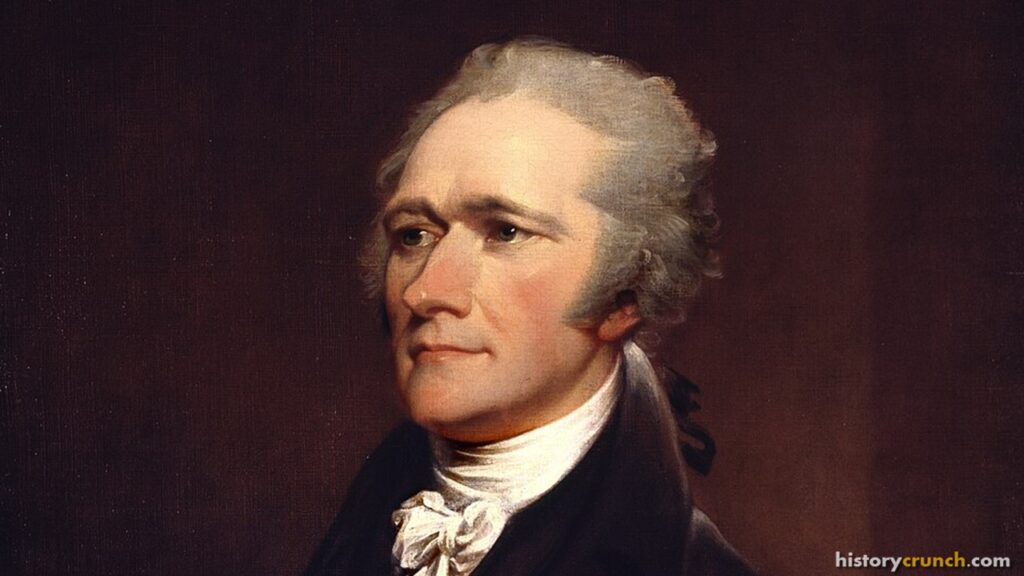
Alexander Hamilton was a soldier, lawyer, statesman, and Founding Father who rose from poverty in the Caribbean to become one of the most important figures in the founding of the United States. Born on the island of Nevis in the British West Indies, likely on January 11th, 1755, Hamilton arrived in the American colonies as a teenager with little money and no connections. He fought in the Revolutionary War, helped shape the United States Constitution, wrote the majority of the Federalist Papers, and served as the first Secretary of the Treasury, building the financial system that supported American economic growth for generations. He died on July 12th, 1804, from wounds received in a duel with Vice President Aaron Burr.
Alexander Hamilton – Early Life
Alexander Hamilton was born in Charlestown, on the island of Nevis, in the British West Indies. He was born out of wedlock to Rachel Faucette and James Hamilton, a Scottish trader who left the family when Alexander was around ten years old. His mother died of yellow fever in 1768, leaving Hamilton on his own at thirteen. He found work as a clerk at a merchant trading house on the island of St. Croix, where he proved so capable that the owner left him in charge of the entire business for five months during a voyage abroad.
His intelligence caught the attention of local community leaders after he wrote a detailed and well-crafted letter describing a hurricane that struck the island in 1772. The letter was published in a local newspaper and impressed readers so much that community members collected funds to send Hamilton to the American colonies for an education. He arrived in New York in late 1772 at around fifteen years of age.
Alexander Hamilton – Education and Early Political Writing
Hamilton enrolled at a preparatory school in Elizabethtown, New Jersey, then entered King’s College, now Columbia University, in New York in 1774. He was a hard-working and curious student who also began writing political pamphlets defending the Patriot cause in 1774. When the Revolutionary War began in 1775, he left college and joined a volunteer militia unit. In March of 1776, he was made a captain of an artillery company he helped organize and equip largely on his own.
Alexander Hamilton – The Revolutionary War
Hamilton fought with the Continental Army at the battles of Long Island, White Plains, Trenton, and Princeton, and his performance caught the attention of senior officers. In January of 1777, General George Washington invited Hamilton to join his staff as an aide-de-camp with the rank of lieutenant colonel. Hamilton served as Washington’s most trusted aide for four years, drafting much of his correspondence and managing relationships with Congress and foreign officers. He wanted badly to command troops in battle and eventually left the staff in early 1781 over a minor disagreement with Washington.
At the Siege of Yorktown in October of 1781, Washington gave Hamilton his chance. He commanded a force of 400 light infantry in a night assault on British Redoubt 10, moving silently through the dark with bayonets fixed and muskets unloaded. The force stormed and captured the position in under thirty minutes, one of the most important actions of the battle and of the entire war.
Alexander Hamilton – Law, Politics, and the Constitution
After Yorktown, Hamilton studied law largely on his own, passing the bar exam in 1782 after roughly six months of study. He set up a law practice in New York City, where he had married Elizabeth Schuyler in 1780, the daughter of a powerful New York general and landowner. He served a term in the Continental Congress in 1782 and became more and more convinced that the Articles of Confederation were too weak to hold the country together.
Hamilton was a key organizer of the Annapolis Convention in 1786, which called for a broader Constitutional Convention, and attended the Philadelphia Convention in 1787 as a New York delegate. His biggest contribution came after the convention ended. He, James Madison, and John Jay wrote the Federalist Papers, a series of 85 essays arguing for ratification of the Constitution. Hamilton wrote 51 of the 85, covering some of the most important questions about how the new government would work. The Federalist Papers are still used by the Supreme Court today to understand the original meaning of the Constitution. Hamilton was also the only New York delegate to sign the finished document, and his work was largely responsible for New York eventually ratifying it.
Alexander Hamilton – Secretary of the Treasury
Washington appointed Hamilton as the first Secretary of the Treasury in 1789. Hamilton had a clear plan for the new nation’s finances and moved quickly to put it into action. He proposed that the federal government take on all the debts the states had built up during the Revolutionary War, turning them into a single national debt. This was controversial, since states that had already paid their debts did not want to help cover the debts of others. Jefferson and Madison opposed the plan, but Hamilton worked out a deal, agreeing to support placing the permanent national capital on the Potomac River in exchange for their votes.
Hamilton also proposed a national bank modeled on the Bank of England, which would hold government money, issue currency, and provide loans. Jefferson argued the Constitution did not give Congress the right to create one. Hamilton countered that the Constitution’s power to do what was “necessary and proper” to carry out the government’s duties gave Congress that authority. Washington agreed with Hamilton, and the First Bank of the United States was created in 1791. This argument about the meaning of “necessary and proper,” known as the doctrine of implied powers, has shaped how Americans have read the Constitution ever since. By the time Hamilton left the Treasury in 1795, the United States had a working financial system with stable credit and a reliable currency.
Alexander Hamilton – Later Career and Personal Life
Hamilton returned to his law practice in New York after leaving the Treasury and remained a leading figure in Federalist politics. His later years were difficult. In 1797, he publicly admitted to an affair in order to defend himself against unrelated accusations of financial wrongdoing. The admission damaged his reputation badly. His decision to work against John Adams within the Federalist Party helped divide the party and contributed to its defeat in 1800.
When that election ended in a tie between Jefferson and Aaron Burr in the Electoral College, Hamilton used his influence to help Jefferson win, telling fellow Federalists that Burr could not be trusted. Hamilton also founded the New York Evening Post in 1801, a newspaper that survives today as the New York Post. That same year, his eldest son Philip was killed in a duel. Hamilton and his wife Elizabeth were devastated, and many historians believe the loss made Hamilton less willing to defend himself fully during his own duel three years later.
Alexander Hamilton – The Duel and Death
The bad feeling between Hamilton and Aaron Burr had been building for years. Hamilton had worked to block Burr’s political goals on more than one occasion. When insulting comments Hamilton had made about Burr at a private dinner became public, Burr demanded a formal duel. The two men met on the heights of Weehawken, New Jersey, at seven in the morning on July 11th, 1804. Hamilton had told close friends he planned to hold his fire. He shot first, but his bullet went into the trees above Burr’s head. Burr fired and hit Hamilton in the lower abdomen. Hamilton was carried back to Manhattan and died the following afternoon, July 12th, 1804, at the age of forty-nine. Burr was charged with murder in both New York and New Jersey, though neither charge was ever prosecuted.
Hamilton was buried at Trinity Church in lower Manhattan. His wife Elizabeth survived him by fifty years and spent much of her remaining life working to protect and share his legacy.
Significance of Alexander Hamilton
Alexander Hamilton’s place in American history rests above all on the financial and government foundations he helped build. He arrived in the colonies as a teenager from the Caribbean with nothing but his drive and intelligence, and within twenty-five years had helped win a revolution, shaped the government of a new nation, and built the economic system that supported American growth for generations.
His Federalist Papers remain the most important set of writings about the meaning and intent of the Constitution, and his belief in a strong central government has largely won out over time against the competing view of Jefferson and Madison. That argument between the two sides has shaped American politics ever since. Hamilton never lived to see which side history would favor, but he made his case clearly enough that it has never been forgotten.