The Continental Army was the official military force of the American colonies during the Revolutionary War. It was established on June 14th, 1775, by the Second Continental Congress, and it served as the primary fighting force against the British Army for the entire eight years of the conflict. Led by General George Washington from beginning to end, the Continental Army grew from a disorganized collection of colonial militias into a disciplined fighting force that ultimately secured American independence.
What Was the American Revolution?
The American Revolution was the political and military struggle through which the Thirteen Colonies broke free from British rule and established the United States of America. The conflict grew out of decades of tension over taxation, trade restrictions, and the colonists’ belief that they were being governed without fair representation in the British Parliament. Open fighting broke out in April of 1775, and the colonies formally declared their independence on July 4th, 1776. The war that followed lasted until 1783, when Britain recognized American independence in the Treaty of Paris. The Continental Army was the backbone of that military effort, fighting the British across the length and breadth of the eastern seaboard, and its survival through years of hardship was essential to the Revolution’s success.
Background – Colonial Militias Before the Continental Army
Before the Continental Army existed, each of the thirteen colonies relied on its own local militia for defense. These militias were made up of ordinary citizens, farmers, tradespeople, and laborers who trained part-time and could be called up in times of danger. They were not professional soldiers, and their levels of training, equipment, and discipline varied widely from colony to colony.
As tensions with Britain grew in the early 1770s, some colonies began reorganizing and improving their militias. After the passage of the Intolerable Acts in 1774, training increased significantly. Groups known as Minutemen formed in New England, ready to respond to threats at a moment’s notice. When fighting broke out at Lexington and Concord on April 19th, 1775, it was these local militia forces that fired first. It quickly became clear, however, that a loose collection of separate colonial militias would not be enough to fight the most powerful army in the world. A unified national force was needed.
The Founding of the Continental Army
The Second Continental Congress, meeting in Philadelphia, took action quickly after the fighting at Lexington and Concord. On June 14th, 1775, Congress passed a resolution formally establishing the Continental Army. The new army initially absorbed the approximately 22,000 militia troops already gathered outside Boston, who were besieging British forces there, and added new companies of riflemen from Pennsylvania, Maryland, and Virginia.
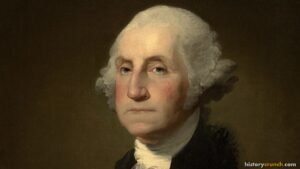
The following day, on June 15, 1775, Congress unanimously elected George Washington of Virginia as Commander-in-Chief. Washington was a well-respected figure who had served in the French and Indian War, and he was seen as a leader who could unite the colonies behind a single military effort. He accepted the position and agreed to serve without pay, asking only that his expenses be reimbursed. Washington traveled to Cambridge, Massachusetts, where he formally took command of the army in July of 1775.
The Continental Army was organized into regiments assigned by state, with each state required to fill a set quota of troops. A private in the army was paid $6.25 per month, though pay was often delayed or withheld due to the Congress’s limited finances. Soldiers had to be at least 16 years of age to enlist on their own, though younger boys sometimes served as well.
Challenges Facing the Army
From the very beginning, the Continental Army faced enormous difficulties. Unlike the British Army, which was a professional standing force with experienced officers, trained soldiers, and reliable supply lines, the Continental Army was built largely from scratch. Most of its soldiers had little or no formal military training, and there was no standardized system of drill or battlefield tactics in the early years of the war.
Supply shortages were a constant problem throughout the conflict. The army frequently lacked sufficient food, clothing, shoes, ammunition, and weapons. Congress, which had limited power to raise money, struggled to fund the war effort adequately. Soldiers sometimes went without pay for months at a time, and the value of Continental currency fell sharply as the war dragged on. Enlistments were another serious issue, as many soldiers signed up for short terms of service and then returned home, forcing the army to constantly recruit and train new men. At any given time, the active force rarely exceeded 20,000 soldiers, even though an estimated 230,000 men served at some point over the course of the war.
Desertion was also a persistent challenge. Men who had farms and families to care for found it difficult to remain away for long stretches. Washington repeatedly wrote to Congress pleading for more men, better supplies, and longer enlistment terms. In the winter of 1777 to 1778, Congress introduced a draft to address the shortage of soldiers, though many regiments remained well below their authorized strength.
Valley Forge – A Turning Point
The winter encampment at Valley Forge, Pennsylvania, from December of 1777 to June of 1778, was one of the most difficult and most important periods in the army’s history. Washington chose the site, roughly 18 miles (29 km) northwest of Philadelphia, because it was close enough to watch the British forces occupying Philadelphia while being far enough away to avoid a surprise attack.
The conditions at Valley Forge were brutal. Soldiers arrived exhausted after a string of defeats, including the Battle of Brandywine in September of 1777. They lacked adequate food, clothing, and shelter. Washington reported to Congress that nearly 3,000 of his men were unfit for duty because they had no shoes. Disease, including typhus, dysentery, and pneumonia, killed thousands. Of the roughly 12,000 soldiers who entered the camp that December, approximately 2,000 to 3,000 died during the winter from illness and starvation rather than from enemy fire.
The army that emerged from Valley Forge in the spring of 1778, however, was a transformed force. A major reason for this transformation was the arrival of Baron Friedrich Wilhelm von Steuben, a former Prussian military officer, in February of 1778. Von Steuben spoke almost no English, but he understood military training better than almost anyone in the American camp. Washington appointed him as temporary Inspector General and gave him the task of drilling the troops.
Von Steuben selected a model company of 120 men and personally drilled them each day, teaching them how to march in formation, handle their muskets properly, and use the bayonet as a weapon rather than a cooking tool. He standardized drill practices across the entire army for the first time. Those men then trained others, spreading the new methods regiment by regiment. The results were dramatic. The army that marched out of Valley Forge in June of 1778 was, by almost every measure, a far more disciplined and capable fighting force than the one that had shuffled in six months earlier. Von Steuben later compiled his training methods into a manual called Regulations for the Order and Discipline of the Troops of the United States, known as the “Blue Book,” which the U.S. Army used until 1814.
Key Battles and the Role of France
The Continental Army fought in dozens of major engagements over the course of the war, winning slightly more than half of them. Some of its earliest significant victories came at Trenton and Princeton in late 1776 and early 1777, when Washington led surprise attacks on British and Hessian forces that boosted morale at a critical point in the war.
The most important victory of the war’s middle phase came at the Battle of Saratoga in October of 1777, where American forces under General Horatio Gates defeated a British army commanded by General John Burgoyne. More than 6,000 British and Hessian troops surrendered, making it a stunning American victory. Saratoga had consequences far beyond the battlefield. It convinced France that the Americans could actually win the war. France formally entered the conflict as an American ally in 1778, providing vital military support, supplies, and naval power that the Continental Army desperately needed.
Spain and the Dutch Republic also declared war against Britain in the years that followed, stretching British military resources across multiple theaters. The French alliance proved decisive. In September of 1781, the French navy defeated British forces in the Chesapeake Bay, cutting off a large British army under General Charles Cornwallis on the Virginia peninsula. Washington moved his army south and, combined with French forces, laid siege to Cornwallis at Yorktown, Virginia. Cornwallis surrendered on October 19, 1781, effectively ending major combat operations in the war.
Composition and Diversity of the Army
The Continental Army reflected the diversity of colonial American society. Soldiers came from all thirteen colonies and included native-born Americans, recent immigrants from across Europe, free African Americans, and in some cases enslaved men who were promised freedom in exchange for their service. It is estimated that approximately 6,600 enslaved men served in the Continental Army during the war.
Women also played a role, with some following the army as camp followers who cooked, washed clothes, and cared for the wounded. A small number of women disguised themselves as men to fight directly. Foreign-born officers made significant contributions beyond von Steuben, including the Marquis de Lafayette from France, who became one of Washington’s most trusted generals, and Thaddeus Kosciuszko from Poland, who served as a military engineer.
Disbanding of the Army
Following the British surrender at Yorktown and the signing of the Treaty of Paris in September of 1783, the Continental Army was no longer needed. Most of its soldiers were discharged and sent home by late 1783. A small force of about 80 men remained briefly on active duty to guard key military posts. The last units serving under a Continental designation were formally mustered out on June 20, 1784.
The following year, Congress established the First American Infantry Regiment as a new peacetime military force. The traditions, structure, and institutional knowledge built by the Continental Army formed the foundation on which the United States Army was eventually built.
Significance of the Continental Army
The Continental Army was the instrument through which the American colonies won their independence. Without it, the Revolution almost certainly would have failed. The army survived years of near-impossible conditions, including: inadequate supplies, unreliable funding, short enlistments, and a professional enemy far better equipped and trained. This was possible through several aspects, including: through a combination of Washington’s determined leadership, the loyalty of its soldiers, and the crucial support of France in the war’s later years.
The army’s willingness to keep fighting, even through the darkest periods of the war, gave the Revolution the time it needed to succeed diplomatically as well as militarily. June 14, the date of the army’s founding, is still celebrated each year as the birthday of the United States Army. The principles of citizen service, unified command, and professional discipline that Washington and von Steuben instilled in the Continental Army became the foundation of American military tradition.