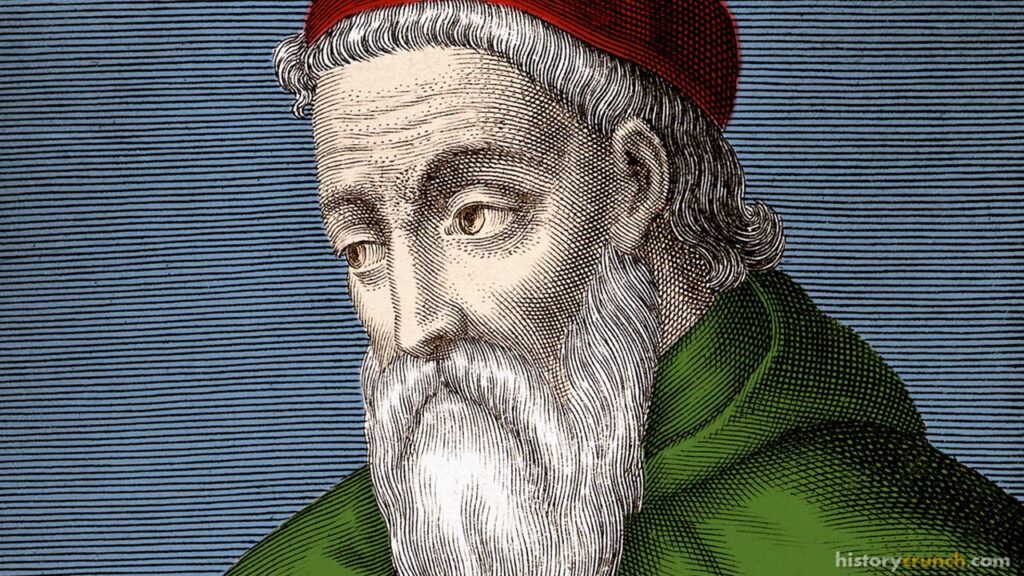
Amerigo Vespucci played an important role in the Age of Exploration. He was an Italian navigator, explorer, and cartographer. Today, he is best remembered for recognizing that the lands ‘discovered’ by European explorers in the Americas, was not part of Asia, as initially thought, but rather a ‘New World’. This was significant because it fundamentally changed the European understanding of the world. As a result, the American continents were named after him.
AMERIGO VESPUCCI – EARLY LIFE
Amerigo Vespucci was born in Florence, Italy on the 9th of March, 1454. Vespucci had a privileged upbringing, and was taught by his uncle, Fra Giorgio Antonio Vespucci, who was a Dominican friar. Furthermore, he was raised during the height of the Renaissance, surrounded by thinkers, artists, and scientists. He received a humanist education and studied navigation, astronomy, and geography. These were skills that would later prove important to his contributions during the Age of Exploration.
Unlike his brothers, Amerigo did not go to university, instead he became a clerk at a local commercial house. In the role Vespucci was well liked and trusted by Lorenzo Medici, who became the business owner. As a result, Vespucci was sent as a confidential agent to the Spanish office in Cadiz where he assessed the manager’s dealings. Upon returning to Italy, Medici was impressed with Vespucci’s work.
It was in Seville, Spain, that Vespucci became involved with Spanish expeditions and caught the attention of those organizing voyages to the New World. His background in navigation and mapmaking soon transitioned into direct involvement with voyages of exploration. In fact, in 1495, navigator licences were approved for the West Indies and Vespucci was hired as a provision contractor. Vespucci was important in this role, and is known to have provided beef supplies for at least one of Christopher Columbus’ voyages.
AMERIGO VESPUCCI – VOYAGES
Between the years of 1497 and 1504, Vespucci participated in a series of voyages under both Spanish and Portuguese flags. Although it should be noted that the exact details and chronology of these journeys remain debated by historians.
During his role as a provision contractor, Vespucci was invited to observe on a number of voyages. Vespucci enjoyed the travels very much and as a result went on many more. On one of Vespucci’s voyages, his team discovered that there was more land beyond Brazil and the West Indies. In fact, there was much more. Before the Vespucci voyage, it was thought that Brazil was Asia’s most easterly landmass, however, he discovered that there was another supercontinent beyond and it was called America, after Amerigo himself.
In 1503, a letter supposedly written by Vespucci, titled Mundus Novus (‘New World’), was published and widely spread across Europe. It detailed his observations and argued that the discovered lands were not part of Asia but an entirely separate continent. This claim shook the foundations of European geographical understanding and inspired new maps and models of the world. It is likely the greatest achievement that Vespucci made to the Age of Exploration. In fact, German cartographer Martin Waldseemüller published a world map in 1507 labeled the new continent ‘America’, in honor of Amerigo Vespucci, whom he credited as the first to recognize it as a separate landmass. Ironically, Christopher Columbus, who had made the first voyage to the New World in 1492, died believing he had reached Asia and was not widely credited with discovering a new continent until later.
AMERIGO VESPUCCI – DEATH AND SIGNIFICANCE
On his travels across the world Vespucci developed navigational skills which helped later explorers, and he drew up maps allowing people to discover more about the unknown world. It is thanks largely to Vespucci’s travels that the world map that we have today could be drawn up so completely. Additionally, Vespucci wrote many letters on his voyages and it could be argued that these writings are of more historical importance than the discoveries themselves. This is because thanks to the letters the people back in Europe learnt about the new continent of America for the first time. This opened up new possibilities for trade and improving geographical understanding.
In 1508, King Ferdinand of Spain appointed Vespucci as the chief navigator ‘Piloto Mayor’ in Seville, Spain. In this role, he was responsible for training pilots and overseeing navigational standards for Spanish expeditions. His influence helped professionalize exploration and standardized the use of updated maps and instruments.
Vespucci died in Spain on February 22nd, 1512. He may not have been the first to reach the New World, but he was the first to understand that it was a new landmass that had previously been unknown to Europeans.