Gladiators were trained fighters in Ancient Rome who fought in public arenas for the entertainment of large crowds. The word gladiator comes from the Latin word gladius, which was the short sword carried by Roman soldiers and used by some types of gladiators in the arena. For more than six centuries, gladiatorial contests were one of the most popular forms of entertainment in the Roman world, drawing enormous crowds to amphitheaters across the empire. Although gladiators are often portrayed as heroic warriors in popular culture, most of them were slaves, prisoners of war, or convicted criminals who had very little choice about entering the arena.
WHAT WAS ANCIENT ROME?
Ancient Rome was one of the most powerful civilizations in world history. It began as a small city-state on the Italian peninsula and grew over many centuries into a vast empire that stretched from Britain in the northwest to Egypt in the southeast. At its height, the Roman Empire controlled much of Europe, North Africa, and parts of the Middle East. Roman civilization is remembered for its contributions to law, government, architecture, engineering, language, and culture, many of which continue to influence the modern world. Gladiatorial combat was one of the most famous and distinctive features of Roman public life, and it tells us a great deal about Roman values, society, and the role of entertainment in the ancient world.
GLADIATORS IN ANCIENT ROME – ORIGINS
Gladiatorial combat did not begin as a form of entertainment. Its roots lay in ancient funeral ceremonies. The practice is believed to have come originally from the Etruscans, a people who lived in central Italy before the rise of Rome, who held fights between slaves as part of the burial rituals for important men. The Romans adopted and expanded this tradition. The first recorded gladiatorial contest in Rome took place in 264 BCE, when the sons of a Roman aristocrat named Junius Brutus organized a fight between three pairs of slaves to honor their father’s memory. These early contests were called munera, meaning gifts or obligations, and were seen as offerings to the spirit of the deceased.
Over time, gladiatorial games grew far beyond their funeral origins. As Rome expanded and became wealthier, ambitious politicians and wealthy citizens began organizing larger and more elaborate games to win the favor of the public. By the first century BCE, gladiatorial contests had become regular public events that drew tens of thousands of spectators. In 105 BCE, the Roman state itself sponsored gladiatorial games for the first time, marking the beginning of their transformation into a central institution of Roman public life.
GLADIATORS IN ANCIENT ROME – WHO WERE THEY?
Most gladiators were slaves, prisoners of war, or criminals who were given no choice about entering the arena. When Rome defeated an enemy in battle, large numbers of prisoners were often sold into slavery or condemned to fight as gladiators. Slaves could also be purchased specifically to be trained as fighters. Criminals convicted of serious crimes were sometimes sentenced to the arena as a form of punishment.
However, not all gladiators were forced into the profession. A significant number of free men voluntarily chose to become gladiators, drawn by the promise of money, food, housing, medical care, and the possibility of fame. By the end of the Roman Republic, historians estimate that as many as half of all gladiators may have been volunteers, known as auctorati. These men signed contracts agreeing to be treated as slaves for a set period of time in exchange for the benefits the profession offered. A small number of women also fought as gladiators, particularly during large imperial spectacles, though this was relatively rare and was eventually banned by Emperor Septimius Severus around 200 CE.
Gladiators held an interesting place in Roman society. They were legally classified among the lowest members of society and were considered to have given up their honor and freedom. At the same time, successful gladiators could become enormously popular public figures. Their images appeared on pottery, lamps, and mosaics. Graffiti praising famous fighters has been found on the walls of Pompeii. Some gladiators attracted devoted fans and even romantic admirers among wealthy Roman women.
GLADIATORS IN ANCIENT ROME – TRAINING AND SCHOOLS
Gladiators trained in special schools called ludi. These schools were found throughout the Roman Empire wherever there were amphitheaters to fill. In Rome itself there were four gladiatorial schools. The largest and most important was the Ludus Magnus, built by Emperor Domitian in the late first century CE just east of the Colosseum. The Ludus Magnus was connected to the Colosseum by an underground tunnel so that gladiators could move directly from their barracks to the arena floor. The school had its own training arena surrounded by seating for around 3,000 spectators, who could watch the gladiators practice. Another famous school was located at Capua, about 120 miles (190 km) south of Rome, and it was there that the famous slave revolt led by Spartacus began in 73 BCE.
Life inside a gladiatorial school was strictly controlled. Gladiators lived in barracks with small individual cells, ate carefully managed diets designed to build strength, and trained every day under the supervision of instructors known as doctores. These instructors were usually former gladiators themselves, experienced in specific fighting styles. New recruits first trained with wooden swords and practice shields so they could develop technique without injuring each other. Only once they had reached a sufficient level of skill would they begin training with real weapons.
Medical care in gladiatorial schools was notably good by ancient standards. Gladiators were expensive investments, and their owners wanted them kept in good condition. The famous ancient physician Galen worked for a time as a doctor at a gladiatorial school in Pergamon in the second century CE, and his observations there significantly advanced his understanding of anatomy and medicine.
GLADIATORS IN ANCIENT ROME – TYPES OF GLADIATORS
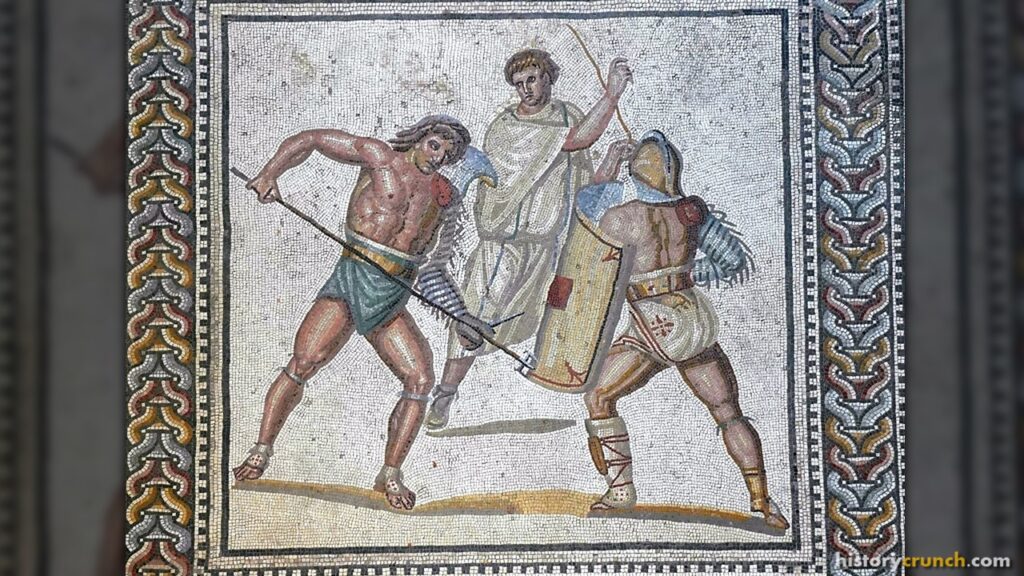
One of the most distinctive features of gladiatorial combat was the existence of many different types of fighters, each with their own specific weapons, armor, and fighting style. Gladiators were almost never matched against fighters of the same type. Instead, contests were typically set up between fighters whose different equipment and styles created an interesting contrast for the crowd.
The Secutor was a heavily armored fighter who wore a smooth, rounded helmet and typically carried a large shield and a short sword. The Retiarius, or net-fighter, wore very little armor and no helmet, relying on speed and agility. His weapons were a large net used to entangle opponents, a long three-pronged spear called a trident, and a short dagger. The Retiarius was most often matched against the heavily armored Secutor, making the contrast between the two a key part of the spectacle. The Thraex, or Thracian, fought with a small curved sword called a sica and a small round shield. The Murmillo was a heavily armored fighter who wore a helmet decorated with a fish crest and carried a large shield.
GLADIATORS IN ANCIENT ROME – THE GAMES
Gladiatorial games, known as munera, were large public events organized and paid for by wealthy individuals or, during the imperial period, by the emperors themselves. A day of games in the arena typically followed a set pattern. The morning was often given over to venationes, or animal hunts, in which trained fighters battled exotic wild animals brought to Rome from across the empire, including lions, tigers, bears, leopards, elephants, and crocodiles. The main gladiatorial contests took place in the afternoon and were the most anticipated part of the day.
Before the fights began, gladiators paraded around the arena in a ceremony called the pompa. Fights were conducted under the supervision of referees who enforced the rules and could stop a contest if needed. Most individual bouts lasted between ten and fifteen minutes, though a full day of games could include many separate fights involving dozens of gladiators.
Contrary to popular belief, not every gladiatorial fight ended in the death of the loser. Gladiators were expensive to train and maintain, and their owners had a financial interest in keeping them alive. When a fighter was beaten and could no longer continue, he could appeal to the crowd and the editor of the games by raising a finger or dropping his shield. The crowd would then signal their verdict, and the editor made the final decision on whether the defeated fighter lived or died. A gladiator who had fought bravely was more likely to be spared. A gladiator who had disappointed the crowd was more likely to be killed.
A gladiator who won enough fights over a sufficient period of time could be awarded the rudis, a wooden sword that symbolized his freedom and retirement from the arena.
GLADIATORS IN ANCIENT ROME – THE COLOSSEUM
The most famous venue for gladiatorial combat was the Colosseum in Rome, officially known as the Flavian Amphitheater. Construction began under Emperor Vespasian around 72 CE and was completed under his son Titus, who opened it in 80 CE with games that reportedly lasted one hundred days. The Colosseum could hold up to 50,000 spectators, who were seated according to their social rank. Senators sat closest to the arena floor, followed by equestrians, then ordinary Roman citizens, with women and the poorest citizens seated at the top. Tickets to the games were often provided free of charge by emperors and other organizers as a way of winning public favor.
Beneath the arena floor, a complex network of tunnels and rooms called the hypogeum housed gladiators, animals, and equipment before they were needed. Animals were kept in cages and raised to the arena floor through trapdoors. Gladiators moved through the underground passages from the Ludus Magnus to the arena, emerging through gates into the noise and light of the crowd above.
GLADIATORS IN ANCIENT ROME – SPARTACUS
The most famous gladiator in history was Spartacus, a Thracian who had been captured and sold into slavery and trained at the gladiatorial school in Capua. In 73 BCE, Spartacus led a rebellion of approximately 70 gladiators who fought their way out of the school using kitchen tools as weapons. The group fled to the slopes of Mount Vesuvius, where they were joined by thousands of escaped slaves from across the region. At its peak, the revolt involved an estimated 70,000 to 120,000 people and posed a serious military threat to Rome.
The rebellion was eventually crushed in 71 BCE by the Roman general Marcus Licinius Crassus. Spartacus was believed to have been killed in the final battle, though his body was never identified. As a warning to other slaves, Crassus ordered the crucifixion of approximately 6,000 captured rebels along the Appian Way, the main road leading from Capua to Rome.
GLADIATORS IN ANCIENT ROME – DECLINE AND END
As the Roman Empire weakened in its later centuries and Christianity became increasingly dominant, opposition to gladiatorial combat grew. Christian leaders condemned the games as cruel and morally wrong. Emperor Constantine I issued a decree banning gladiatorial combat in 325 CE, though the games continued in practice for many decades after. The last recorded gladiatorial contest in the city of Rome took place on January 1st, 404 CE, and gladiatorial combat as a regular institution appears to have died out by the middle of the fifth century.
SIGNIFICANCE OF GLADIATORS IN ANCIENT ROME
Gladiators were one of the most recognizable features of Ancient Roman civilization and reveal a great deal about Roman society, values, and culture. The games served multiple purposes beyond simple entertainment. They demonstrated the power and wealth of those who organized them, provided a way for emperors and politicians to win the loyalty of the Roman public, and reflected Roman attitudes toward violence, death, courage, and social class.
The story of gladiators is not simply one of brutality. It is also a story about skill, survival, the possibility of fame, and occasionally freedom for people who had almost none. Their legacy has continued to capture the imagination of people around the world long after the last arena fell silent.