Concrete was one of the most important building materials in Ancient Rome and one of the most significant technological developments in the history of construction. The Romans called their concrete opus caementicium, and it allowed them to build structures of a size, durability, and complexity that no earlier civilization had achieved. Roman concrete was used in everything from harbor walls and aqueducts to the famous domes of the Pantheon and the massive walls of the Colosseum. Many of these structures still stand today, nearly two thousand years after they were built, a testament to how effective the Roman formula truly was.
WHAT WAS ANCIENT ROME?
Ancient Rome was one of the most powerful civilizations in world history. It began as a small city-state on the Italian peninsula and grew over many centuries into a vast empire that stretched from Britain in the northwest to Egypt in the southeast. At its height, the Roman Empire controlled much of Europe, North Africa, and parts of the Middle East. Roman civilization is remembered for its contributions to law, government, architecture, language, and culture. Concrete was central to many of Rome’s greatest architectural achievements and played a key role in how the empire was built, literally and figuratively.
CONCRETE IN ANCIENT ROME – ORIGINS AND DEVELOPMENT
The Romans did not invent the concept of concrete from scratch. Earlier civilizations, including peoples in ancient Greece and the Near East, had experimented with lime-based mortars mixed with rubble to create a simple form of concrete. However, these earlier versions were relatively weak and limited in their uses. The Romans developed a far superior formula that transformed construction across the ancient world.
The key to Roman concrete was the discovery of pozzolana, a fine volcanic ash found in large quantities around the Bay of Naples, particularly near the town of Pozzuoli. When pozzolana was mixed with lime and water, it produced a mortar that was far stronger and more durable than any mixture made without it. The resulting material could harden even underwater, which made it uniquely useful for building harbor walls, piers, and other marine structures. Evidence of hydraulic Roman concrete being used in harbor works near Puteoli dates to around 199 BCE, and by 150 BCE the use of opus caementicium had spread widely across the growing empire.
The basic recipe for Roman concrete involved three components. The first was a mortar made by mixing lime, water, and pozzolanic ash, usually in a ratio of one part lime to three parts ash for structures above water, or one part lime to two parts ash for underwater construction. The second was an aggregate of stones, broken bricks, ceramic tiles, or rubble mixed into the mortar to add bulk and strength. The third was a facing of brick, stone, or cut blocks applied to the exterior surface, since bare concrete was not considered attractive and was almost always covered with a more decorative material.
CONCRETE IN ANCIENT ROME – WHY IT WAS SO EFFECTIVE
Roman concrete had several properties that made it exceptional by ancient standards. Its strength improved over time rather than declining, as the pozzolanic minerals in the ash continued to react chemically with the lime even after the concrete had hardened.
Roman concrete was also highly adaptable. Unlike stone or brick, which required skilled cutting and precise fitting, concrete could be poured into wooden molds of almost any shape and left to harden. This freed Roman architects from the rectangular forms that stone construction imposed and allowed them to build curved walls, domes, vaults, and complex interior spaces that would have been extremely difficult or impossible using traditional materials. The result was an architectural revolution that transformed what buildings could look like and how large they could be.
CONCRETE IN ANCIENT ROME – KEY BUILDINGS AND USES
Roman concrete was used in a remarkable range of construction projects across the empire. Some of the most impressive uses included the following.
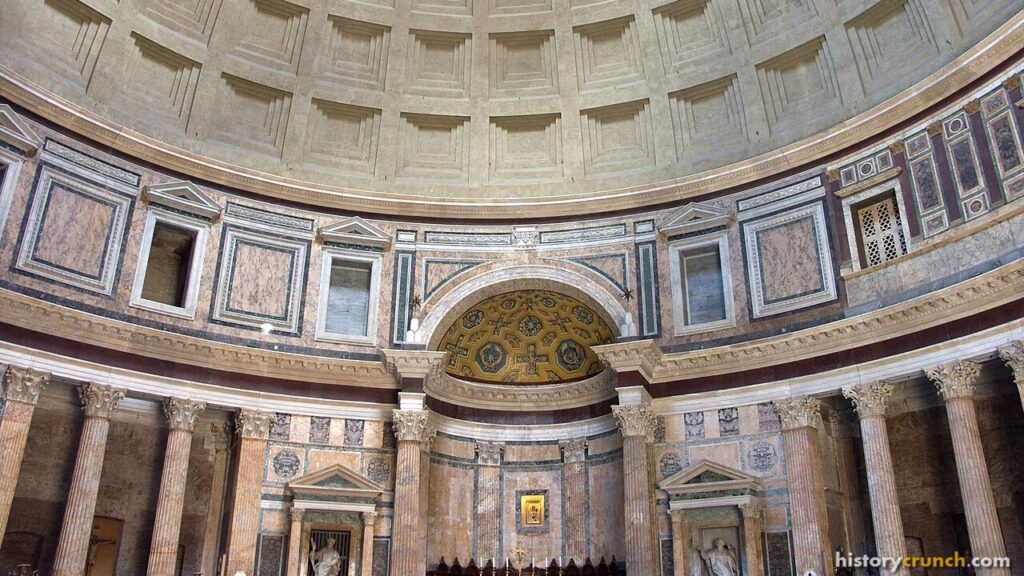
The Pantheon in Rome, rebuilt by Emperor Hadrian around 125 CE, features a concrete dome 43.3 meters (142 feet) in diameter, which remained the largest dome in the world for more than 1,300 years. The dome was constructed using a carefully calculated mixture of lighter volcanic rock at the top and heavier aggregate near the base to reduce the weight pressing down on the walls. The Pantheon’s dome still stands completely intact today.
The Colosseum, built between 72 and 80 CE, used concrete extensively in its foundations, walls, and barrel-vaulted corridors. The sheer scale of the structure, which could hold up to 80,000 spectators, would not have been possible without concrete’s ability to fill large spaces quickly and bear enormous loads.
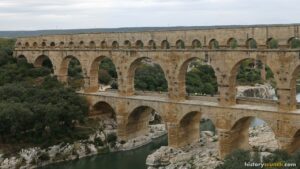
Roman aqueducts relied on concrete to create watertight channels that carried fresh water over long distances without leaking. The concrete linings of aqueduct channels were mixed to resist the constant presence of water and remained effective for centuries. Similarly, Roman harbors and sea walls were built using hydraulic concrete that set and hardened even while submerged, a capability that allowed Rome to construct port facilities across the entire Mediterranean coastline.
The Baths of Caracalla, built in Rome between 212 and 217 CE, used concrete vaulted halls to create vast interior spaces covering more than 120,000 square meters, with walls and ceilings that soared to extraordinary heights.
CONCRETE IN ANCIENT ROME – PRODUCTION AND WORKFORCE
Producing Roman concrete on the scale the empire required was itself a significant logistical achievement. Lime was made by burning limestone in large kilns, a process that required enormous amounts of wood fuel. Pozzolanic ash was quarried in the volcanic regions of southern Italy and shipped across the empire wherever it was needed. The aggregate materials, stones, broken bricks, and rubble, were often sourced locally or recycled from demolished buildings.
The actual mixing and laying of concrete was largely performed by enslaved workers and soldiers, supervised by skilled engineers and architects. One of the key advantages of concrete was that it did not require the same level of skill as cutting and placing stone. Workers could be trained relatively quickly to mix and pour concrete, which made it possible to build at a much faster pace than traditional masonry methods allowed.
CONCRETE IN ANCIENT ROME – DECLINE AND REDISCOVERY
As the Roman Empire weakened in its later centuries, the production and use of high-quality concrete declined. The organizational infrastructure needed to quarry and transport pozzolanic ash on a large scale fell apart as trade networks broke down and resources became harder to manage. By the early medieval period, the knowledge of how to produce Roman-quality concrete had largely been lost in western Europe, and builders returned to simpler methods of stone and brick construction.
The rediscovery of Roman concrete as a subject of serious scientific study has intensified in the 21st century. Researchers studying harbor structures, aqueducts, and buildings have found that Roman concrete often outperforms modern cement concrete in terms of long-term durability and resistance to cracking. Modern concrete is stronger in the short term and has better tensile strength, but Roman concrete appears to grow stronger and more resistant to damage over decades and centuries rather than degrading. These findings have generated significant interest among engineers looking for more sustainable building materials.
SIGNIFICANCE OF CONCRETE IN ANCIENT ROME
Roman concrete was one of the most transformative technologies of the ancient world. It allowed Rome to build faster, larger, and more durably than any previous civilization, and it directly enabled many of the most famous achievements of Roman architecture, from the Pantheon’s dome to the Colosseum’s vast tiers of seating. Without concrete, the Roman Empire’s program of road building, aqueduct construction, harbor works, and monumental public building would have been far more limited in scale and speed.
The legacy of Roman concrete extends into the present day, not only through the structures that still stand but through the renewed scientific interest in understanding how and why it worked so well. As modern engineers search for building materials that are more durable and more environmentally sustainable, Roman concrete is proving to be not just an ancient curiosity but a source of genuine inspiration for the future.