The Battle of Agincourt was a decisive English victory over the French that took place on October 25th, 1415, during the Hundred Years War. The battle was fought near the village of Agincourt in northern France and saw the English army under King Henry V defeat a much larger French force against what seemed like impossible odds. It is one of the most famous battles of the Middle Ages and remains one of the most celebrated events in English history.
What Was the Hundred Years War?
The Hundred Years War was a long series of conflicts fought between England and France from 1337 to 1453. It grew out of disputes over who had the right to rule France and which territories in France belonged to England. Despite its name, the war actually lasted approximately 116 years and involved five different English kings and five different French kings over the course of its duration. The Battle of Agincourt took place during the later stages of this conflict and was one of its most dramatic and significant moments. For example, the battle is often studied alongside earlier English victories such as the Battle of Crécy in 1346 and the Battle of Poitiers in 1356, which had also shown the effectiveness of the English longbow against the French.
Battle of Agincourt – Background
King Henry V came to the throne of England in 1413 and quickly turned his attention to reviving the English claim to the French throne, which had been the central dispute of the Hundred Years War. Negotiations with France broke down, and in August of 1415 Henry crossed the English Channel with an army of approximately 11,000 men and landed in Normandy in northern France. His first objective was the capture of the port town of Harfleur, which he besieged and eventually captured on September 22nd, 1415. With that said, the siege had taken longer than expected and cost Henry dearly. Disease, particularly dysentery, had cut his army roughly in half by the time Harfleur fell. As such, Henry found himself deep in French territory with a weakened army as the campaigning season drew to a close.
Rather than returning directly to England by sea, Henry made the bold and risky decision to march his reduced army of approximately 6,000 men northeast toward the English-held port of Calais on the northern coast. This march of approximately 260 miles (418 kilometers) through enemy territory was dangerous, and the French quickly assembled a large army to intercept him. Henry’s men were exhausted, hungry, and outnumbered as they made their way north, and by late October a massive French force had cut off their route to Calais near the village of Agincourt.
Battle of Agincourt – Major Events
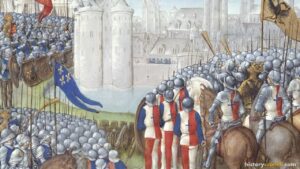
On the morning of October 25th, 1415, the two armies faced each other across a recently plowed field bounded on both sides by woodland. The French force is estimated by historians to have numbered between 20,000 and 30,000 men, compared to Henry’s army of approximately 6,000, of whom around 5,000 were English and Welsh longbowmen. The narrow battlefield between the two woods worked in Henry’s favor, as it prevented the larger French army from spreading out and using its full numerical advantage.
Henry positioned his archers on the flanks and in front, protected by pointed wooden stakes driven into the ground to stop cavalry charges. When the French advance began, the muddy, freshly plowed field slowed the heavily armored French knights considerably. For example, many French knights were wearing full plate armor weighing upward of 50 pounds (23 kilograms), which became extraordinarily difficult to move through thick mud. The English longbowmen unleashed a devastating barrage of arrows at close range, cutting down the advancing French knights in large numbers. As the French reached the English lines, hand-to-hand combat broke out, and the lighter English soldiers, including many of the archers who waded in with swords and axes, proved far more mobile than the exhausted and mud-caked French knights.
The battle was over in a matter of hours. The French suffered catastrophic losses, with historians estimating that over 6,000 French soldiers were killed, including many of the most powerful nobles in France. Among the dead was the Constable of France, Charles d’Albret, who had commanded the French army. The English losses, by contrast, were remarkably small, with estimates of fewer than 450 men killed. It was one of the most lopsided victories of the entire Middle Ages.
Battle of Agincourt – Aftermath
Following the victory at Agincourt, Henry continued his march to Calais and returned to England in November 1415, where he was received as a great national hero. Contemporary accounts describe the extraordinary welcome he received in London, with processions, choirs, and elaborate celebrations marking his passage through the city. The victory had an enormous impact on English morale, coming after a long period of limited success in the Hundred Years War.
As well, the victory opened the door for Henry to launch a second and even more ambitious campaign in France. Between 1417 and 1419, Henry’s armies conquered Normandy and by 1420 had advanced as far as Paris. This success eventually led to the Treaty of Troyes in 1420, in which King Charles VI of France recognized Henry V as his regent and heir to the French throne, and Henry married Charles’s daughter Catherine of Valois. With that said, Henry died suddenly in 1422 before he could claim the French crown, and the war continued under his successors.
Battle of Agincourt – Significance
The Battle of Agincourt is significant for several reasons. For example, it demonstrated once again the extraordinary effectiveness of the English longbow in medieval warfare. The longbow had been the decisive weapon at Crécy in 1346 and Poitiers in 1356, and Agincourt confirmed its dominance over the traditional tactics of heavily armored French cavalry. As well, the battle had a major effect on the course of the Hundred Years War, giving England a period of dominance that lasted until the emergence of Joan of Arc and the French recovery in the late 1420s.
In general, the Battle of Agincourt became one of the most famous military victories in English history and has been celebrated in art, literature, and popular culture ever since. For instance, the battle was immortalized by the playwright William Shakespeare in his play Henry V, written in 1599, which gave the world the famous speech in which Henry rallies his troops before the battle. The battle remains a powerful example of how discipline, tactics, and effective use of terrain and weapons can overcome a significant numerical disadvantage, and it is studied to this day as one of the great battles of the Middle Ages.