England in the Middle Ages was a period of major political, social and cultural change that shaped the country into the nation it would eventually become. Throughout the medieval period, England experienced events that had a profound and lasting impact on its history, including the Norman Conquest, the signing of the Magna Carta, the Hundred Years War and the Wars of the Roses. In general, the history of England in the Middle Ages was defined by the struggle for political power, the influence of the Catholic Church and the development of key institutions that would go on to shape modern English society.
What Were the Middle Ages?
The Middle Ages, also known as the Medieval Period, refers to the period of European history that stretched from the 5th century to the 15th century. More specifically, historians generally place the beginning of the Middle Ages at 476 CE, with the fall of the Western Roman Empire, and its end at approximately 1500 CE, with the start of the Renaissance. Due to its length, the Middle Ages is divided into three smaller periods, including: the Early Middle Ages, the High Middle Ages and the Late Middle Ages. England was an important part of the history of the Middle Ages throughout all three of these periods, and many of the most significant events in English history took place during the medieval period.
England in the Early Middle Ages
Following the collapse of the Western Roman Empire in the 5th century, the Roman presence in Britain came to an end and the island was left without a central governing power. In the centuries that followed, various Germanic groups, including the Angles, Saxons and Jutes, migrated to Britain from continental Europe and gradually established their own kingdoms across the island. These groups are collectively known as the Anglo-Saxons, and the period of their dominance in England is often referred to as the Anglo-Saxon period of the Early Middle Ages.
During the Early Middle Ages, England was not yet a unified kingdom but was instead divided into several smaller Anglo-Saxon kingdoms, including: Northumbria, Mercia, East Anglia and Wessex. These kingdoms frequently came into conflict with one another as their rulers competed for dominance. As well, England faced significant pressure from outside invaders during this period, most notably from the Vikings, who began raiding the coasts of England in the late 8th century and eventually settled in large parts of the north and east of the country in a region known as the Danelaw. One of the most important rulers of the Early Middle Ages in England was Alfred the Great, King of Wessex, who successfully resisted Viking expansion and is remembered as one of the greatest kings in English history. It was Alfred who began the process of unifying the Anglo-Saxon kingdoms under a single ruler, a process that was completed by his grandson Athelstan, who is generally considered to be the first King of England.
Norman Conquest
The most significant event in the history of England in the Middle Ages was the Norman Conquest of 1066 CE. The Norman Conquest refers to the invasion and takeover of England by William, Duke of Normandy, a region in northern France, following the death of the English King Edward the Confessor in January of 1066. The central issue was a dispute over who had the right to become King of England. William claimed that Edward had promised him the throne, while the English Earl Harold Godwinson claimed that Edward had granted him the kingdom on his deathbed and was crowned King Harold II on January 6th, 1066.
William responded by assembling an invasion force and crossing the English Channel. The two sides met at the Battle of Hastings on October 14th, 1066, one of the most famous battles in English history. Harold’s army held a strong defensive position on a ridge but was eventually defeated after a long day of fighting. Harold was killed in the battle, reportedly struck by an arrow, and with his death the English army collapsed. William was crowned King of England at Westminster Abbey on Christmas Day, 1066, becoming King William I, later known as William the Conqueror.
The Norman Conquest had an enormous and lasting impact on England. For instance, William replaced the old Anglo-Saxon nobility almost entirely with a new Norman ruling class, distributing the lands of defeated English lords to his Norman followers. As well, the conquest had a profound effect on the English language, as French became the language of the royal court and government, while Old English continued to be spoken by the common people. Over time these languages blended together to form Middle English, which is much closer to the modern English spoken today. Furthermore, the Normans introduced a more rigidly organized form of feudalism to England, transforming the social and political structure of the country in fundamental ways.
Magna Carta
One of the most important political developments in the history of England in the Middle Ages was the signing of the Magna Carta in 1215 CE. The Magna Carta, which means Great Charter in Latin, was a document that placed limits on the power of the king and established certain rights for the nobility and the Church. It was signed by King John of England under pressure from a group of powerful barons who were angry at his heavy taxation, arbitrary use of royal power and military failures in France.
The Magna Carta is considered to be one of the most important documents in the history of government and law. For instance, it established the principle that even the king was subject to the law and could not act in an arbitrary or tyrannical manner. As well, it included protections for the rights of free men, including the right to a fair trial and protection from unlawful imprisonment. While the Magna Carta was originally intended as a practical solution to a specific political crisis, its principles had a lasting influence on the development of constitutional government not only in England but across the world. As such, the Magna Carta is one of the most significant legacies of England in the Middle Ages.
Hundred Years War
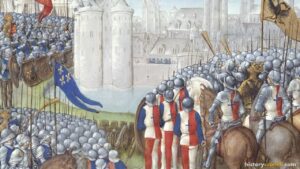
Another major event in the history of England in the Middle Ages was the Hundred Years War, which was a long series of conflicts fought between England and France from 1337 to 1453 CE. The Hundred Years War was caused by a dispute over the right to rule France, as English kings held significant territories on French soil and had long claimed the right to the French throne. The conflict involved many famous battles and produced some of the most celebrated figures of the Middle Ages, including the English king Henry V and the French heroine Joan of Arc.
England experienced significant early success in the Hundred Years War, winning famous victories such as the Battle of Crecy in 1346 and the Battle of Agincourt in 1415, where Henry V led a heavily outnumbered English army to a decisive victory over the French. However, the tide of the war eventually turned against England, partly due to the leadership of Joan of Arc, who inspired a French revival in the 1420s. By 1453, England had lost almost all of its territories in France, retaining only the port of Calais. The end of the Hundred Years War was a major blow to England and contributed to the political instability that led directly to the Wars of the Roses.
Wars of the Roses
The Wars of the Roses were a series of civil wars fought in England between 1455 and 1487 for control of the English throne. The conflict was fought between two rival branches of the royal House of Plantagenet, known as the House of Lancaster and the House of York. The Lancastrians used a red rose as their emblem and the Yorkists used a white rose, which is where the wars got their famous name. The Wars of the Roses were one of the most dramatic and violent episodes in the history of England in the Middle Ages.
The main trigger for the outbreak of the wars was the weak and troubled reign of the Lancastrian king Henry VI, who suffered from serious bouts of mental illness and was considered an ineffective ruler. The combination of a weak king, the humiliating loss of English territories in France at the end of the Hundred Years War and a long-running dispute over the royal succession created the conditions for civil war. The Wars of the Roses went through several phases of conflict before finally ending at the Battle of Bosworth Field in 1485, where the Yorkist king Richard III was defeated and killed by the forces of Henry Tudor. Henry Tudor was crowned King Henry VII and established the Tudor dynasty, which would rule England for over a century. As such, the Wars of the Roses brought the medieval period in England to a close and marked the beginning of a new era in English history.
The Catholic Church in Medieval England
Throughout the Middle Ages, the Catholic Church played a central role in the life of England. The Church held enormous influence over both the religious and political life of the country, and the relationship between the English monarchy and the papacy was one of the most important and often contentious aspects of medieval English history. For instance, one of the most dramatic conflicts between the English crown and the Church occurred during the reign of King Henry II in the 12th century. Henry II came into conflict with Thomas Becket, the Archbishop of Canterbury, over the question of whether the Church or the crown had authority over clergy accused of crimes. The conflict ended in the murder of Becket in Canterbury Cathedral in 1170 CE, which shocked Christian Europe and led to Becket being declared a saint by the Pope.
As well, the Church was the most important provider of education and social services in medieval England. Monasteries and cathedral schools provided instruction in reading, writing and Latin, and the great cathedrals of medieval England, including Canterbury Cathedral and York Minster, were among the most significant architectural achievements of the period. As such, the Catholic Church was an inseparable part of the history of England in the Middle Ages and its influence shaped English society in profound and lasting ways.
Significance of England in the Middle Ages
In conclusion, the history of England in the Middle Ages was shaped by a series of major events and developments that had a lasting impact on the country and the wider world. From the Norman Conquest and the Magna Carta to the Hundred Years War and the Wars of the Roses, the medieval period was one of the most important and eventful chapters in English history. As such, understanding England in the Middle Ages is important for gaining a complete picture of how the country developed and how many of the key institutions and traditions of modern English society came into being.