France in the Middle Ages was one of the most important kingdoms in medieval Europe. Throughout the medieval period, France played a central role in many of the most significant events of the Middle Ages, including the Crusades, the Hundred Years War and the development of Gothic architecture. In general, the history of France in the Middle Ages was defined by the growth of royal power, the influence of the Catholic Church and a series of major conflicts that shaped the country and its relationship with the rest of Europe.
What Were the Middle Ages?
The Middle Ages, also known as the Medieval Period, refers to the period of European history that stretched from the 5th century to the 15th century. More specifically, historians generally place the beginning of the Middle Ages at 476 CE, with the fall of the Western Roman Empire, and its end at approximately 1500 CE, with the start of the Renaissance. Due to its length, the Middle Ages is divided into three smaller periods, including: the Early Middle Ages, the High Middle Ages and the Late Middle Ages. France was involved in many of the most significant events of the Middle Ages across all three of these periods.
The Franks and Charlemagne
Following the fall of the Western Roman Empire in 476 CE, the territory that would eventually become France was controlled by the Franks. The Franks were a Germanic people who had settled in the region during the decline of Roman power and established a kingdom known as Francia. One of the most important early Frankish rulers was Clovis I, who ruled from 481 to 511 CE. Clovis united the Frankish tribes under his rule and converted to Christianity, which had a profound impact on the future religious character of France and western Europe.
The most significant ruler of Francia during the Middle Ages was Charlemagne, also known as Charles the Great, who ruled from 768 to 814 CE. Charlemagne united much of western Europe under his rule, with his kingdom stretching from modern-day France and Germany into parts of Italy and Spain. In 800 CE, Pope Leo III crowned Charlemagne as Emperor of the Romans in a ceremony in Rome, which was one of the most significant events of the Early Middle Ages. Charlemagne is considered one of the founding figures of European civilization and his reign is often seen as a high point of the Early Middle Ages. Following his death in 814 CE, his empire was divided among his three grandsons under the Treaty of Verdun in 843 CE, which created the foundations of what would eventually become the modern nations of France and Germany.
Feudalism in Medieval France
Throughout the Middle Ages, France was organized around the feudal system. Under feudalism, the king granted land to powerful nobles in exchange for loyalty and military service. These nobles in turn granted portions of their land to lower lords and knights, who were expected to provide soldiers for the king’s armies when called upon. Peasants and serfs worked the land under the Manor System in exchange for protection from their local lord. As such, the feudal system shaped the social, political and economic life of France throughout the Middle Ages.
With that said, the feudal system in France also created significant challenges for French kings. Because powerful nobles controlled vast territories and armies of their own, the authority of the French king was often limited in practice. For instance, during the Early and High Middle Ages, many French nobles were effectively independent rulers within their own territories. As a result, one of the central themes of the history of France in the Middle Ages was the gradual effort of French kings to extend and consolidate royal power at the expense of the nobility. This process was long and difficult but ultimately successful, and by the end of the Middle Ages France had developed into one of the most powerful centralized monarchies in Europe.
France and the Crusades
France played a central role in the Crusades, which were one of the most significant events of the Middle Ages. The Crusades were a series of religious wars carried out by Christian crusaders from Europe during the timeframe of the Middle Ages. Beginning in 1095 CE, the Crusades saw European knights and noblemen travel to the Middle East in an attempt to capture the Holy Land away from Muslim people that had controlled the region for the previous centuries. France was one of the most important sources of crusaders throughout the history of the Crusades, and several French kings and nobles led major crusading expeditions to the Holy Land.
For instance, the call for the First Crusade was made by Pope Urban II at the Council of Clermont in France on November 27th, 1095 CE. This speech is considered the event that sparked the First Crusade and began the movement of European Christians into the Middle East. French crusaders played a major role in the First Crusade and were among the first to arrive in the Holy Land. As well, French King Louis VII participated in the Second Crusade in 1147 CE and French king Louis IX, also known as Saint Louis, led both the Seventh Crusade in 1248 CE and the Eighth Crusade in 1270 CE. Louis IX died of disease during the Eighth Crusade, which ended without achieving its goals. As such, France was deeply involved in the Crusades throughout their history and French kings and nobles were among the most committed participants in the effort to capture and hold the Holy Land.
Gothic Architecture in Medieval France
One of the most significant cultural contributions of France in the Middle Ages was the development of Gothic architecture. Gothic architecture emerged in France in the 12th century and quickly became the dominant style of church building throughout medieval Europe. It was characterized by its tall pointed arches, large stained glass windows, elaborate stone carvings and the use of flying buttresses, which were external stone supports that allowed builders to construct much taller and more slender structures than had been possible with earlier styles of architecture.
Some of the most famous examples of Gothic architecture in the world were built in France during the Middle Ages. For instance, Notre-Dame Cathedral in Paris, construction of which began in 1163 CE, is one of the most celebrated Gothic cathedrals in the world and remains a powerful symbol of French culture and history. Chartres Cathedral, located southwest of Paris, is another famous example of Gothic architecture and is particularly celebrated for its extraordinary stained glass windows, which are among the finest surviving examples of medieval stained glass. As such, France made an enormous contribution to the art and architecture of the Middle Ages through the development and spread of Gothic architecture, which went on to influence church building across Europe for centuries.
Hundred Years War
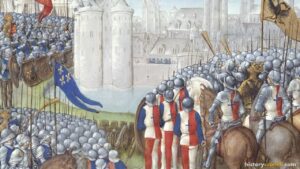
One of the most significant events in the history of France in the Middle Ages was the Hundred Years War, which was a long series of conflicts fought between England and France from 1337 to 1453 CE. The Hundred Years War was caused by a dispute over the right to rule France, as English kings held significant territories on French soil and had long claimed the right to the French throne. The conflict was one of the longest and most destructive wars of the Middle Ages and had a profound impact on the people and society of France.
England experienced significant early success in the Hundred Years War, winning famous victories at the Battle of Crecy in 1346 CE and the Battle of Agincourt in 1415 CE. However, the tide of the war eventually turned in France’s favor, partly due to the remarkable leadership of Joan of Arc. Joan of Arc was a young French peasant girl who claimed to have received visions from God instructing her to help drive the English out of France. In 1429 CE, Joan led French forces to a significant victory at the Siege of Orleans, which proved to be a major turning point in the war. Although Joan was later captured by the English and burned at the stake in 1431 CE, her leadership had inspired a French revival that eventually led to the expulsion of the English from almost all of French territory by 1453 CE. As such, the Hundred Years War was a defining event in the history of France in the Middle Ages and played an important role in shaping French national identity.
The Catholic Church in Medieval France
Throughout the Middle Ages, the Catholic Church played a central role in the life of France. The Church held enormous influence over both the religious and political life of the country and was the most important provider of education and social services in medieval French society. For instance, the great Gothic cathedrals of France were built under the patronage of the Church and were among the most significant architectural achievements of the medieval period. As well, monasteries and cathedral schools across France provided instruction in reading, writing and Latin and helped preserve the knowledge of ancient Greece and Rome throughout the difficult centuries of the Early Middle Ages.
The relationship between the French crown and the papacy was one of the most important aspects of political life in medieval France. For instance, France played a central role in one of the most dramatic episodes in the history of the medieval Church, known as the Avignon Papacy. From 1309 to 1377 CE, the seat of the papacy was moved from Rome to the city of Avignon in southern France, largely under the influence of the French crown. During this period, a series of French popes governed the Catholic Church from Avignon rather than from Rome, which caused significant controversy and criticism across Europe. As such, the relationship between France and the Catholic Church was one of the most important and complex aspects of the history of France in the Middle Ages.
Significance of France in the Middle Ages
In conclusion, France in the Middle Ages was a central and powerful force in medieval European history. From the reign of Charlemagne and the development of feudalism to the Crusades, the Hundred Years War and the extraordinary contributions of Gothic architecture, France played a major role in shaping the events and culture of the Middle Ages. As such, understanding France in the Middle Ages is important for gaining a complete picture of medieval European society and for understanding how many of the key institutions and traditions of modern France and Europe came into being.