The High Middle Ages was the second period of the Middle Ages in European history, beginning at the start of the 11th century and lasting until approximately the end of the 13th century. It followed the Early Middle Ages and preceded the Late Middle Ages, which ended with the beginning of the Renaissance in the 14th century. The High Middle Ages was a time of tremendous growth and change across Europe, including a major increase in population, the growth of towns and cities, the rise of powerful kingdoms, the peak of the Catholic Church’s power, and the major religious wars known as the Crusades.
What Were the Middle Ages?
The Middle Ages, also known as the Medieval Period, lasted for approximately 1000 years from the 5th century to the 15th century. Due to its timeframe, the Middle Ages in Europe is divided into three smaller periods referred to as the Early, High, and Late Middle Ages. The Early Middle Ages began in the 5th century during the decline of the Roman Empire and lasted until approximately the end of the 10th century. The High Middle Ages began at the start of the 11th century and is considered to have lasted until approximately the end of the 13th century. The final period of the Middle Ages is called the Late Middle Ages and is considered to have occurred from the start of the 14th century to the end of the 15th century. As such, the High Middle Ages represents the middle and in many ways most significant period of the medieval era, during which European civilization reached its highest point before the difficulties of the Late Middle Ages.
Population Growth and Economic Change
One of the most important features of the High Middle Ages was a dramatic increase in the population of Europe. During the Early Middle Ages, Europe had suffered from invasions, disease, and political instability that kept the population relatively low and economic life limited. As stated above, the Early Middle Ages had been a difficult period of transition following the collapse of the Western Roman Empire. By the start of the 11th century, however, conditions in Europe were improving. The threat of Viking, Magyar, and Muslim invasions had largely been dealt with, and Europe began to experience a period of greater stability and prosperity.
As well, improvements in agricultural technology helped farmers grow more food and support larger populations. For example, the widespread adoption of the heavy plow, the three-field system of crop rotation, and improved water mills allowed farmers to produce significantly more food than had been possible in earlier centuries. This increased food supply supported a rapidly growing population across Europe. Historians estimate that the population of Europe roughly doubled between 1000 CE and 1300 CE, growing from approximately 35 million to 80 million people. This population growth had major consequences for European society, driving the growth of towns and cities, the expansion of trade, and the development of new political and social institutions.
Growth of Towns and Trade
The High Middle Ages was also a period of significant growth in towns and cities across Europe. As the population grew and agricultural production increased, more people were able to move away from the countryside and settle in towns, where they worked as craftsmen, merchants, and traders. Towns grew up around castles, cathedrals, and important trade routes, and many of the major cities of modern Europe, including London, Paris, and Cologne, experienced significant growth during this period.
Trade also expanded greatly during the High Middle Ages. As well, the growth of trade routes across Europe and into the Middle East helped to create a more connected and economically active continent. For instance, the Crusades, which will be discussed in more detail below, helped to open up new trade routes between Europe and the Middle East and exposed European merchants to new goods such as spices, silk, and other luxury items. The growth of trade also led to the rise of a merchant class in many European towns, which gradually began to challenge the dominance of the traditional feudal nobility. As such, the economic changes of the High Middle Ages helped to lay the groundwork for the more dramatic social changes of the Renaissance that followed.
Feudalism and the Role of the Church
Life in the High Middle Ages was characterized by religious faith in the Catholic Church and the social structure of feudalism. Feudalism was a form of government common during medieval Europe that involved society being structured in a very rigid and hierarchical way. It was popular in European society from the 9th century until the 15th century and was the form of government in which the country was dominated by an absolute monarch, in which all power was held within a single king. The monarch would rule over the country while the rest of the people were bound by a hierarchical system in which people were placed into classes in which they were born. For example, under feudalism, most people were peasants who worked tirelessly on farms of local lords.
The Catholic Church reached the peak of its political power during the High Middle Ages. The Pope in Rome was considered to be the most powerful religious authority in the western world, and the Church had enormous influence over the lives of kings, nobles, and ordinary people alike. For instance, the Pope could place entire kingdoms under a religious ban called an interdict, which meant that no religious services could be held in that kingdom until the king submitted to the Church’s authority. As well, the Church controlled vast amounts of land and wealth across Europe and ran the most important schools and universities of the period. The relationship between the Church and the political rulers of Europe was sometimes cooperative and sometimes deeply conflicted, and disputes between popes and kings were a major feature of the political history of the High Middle Ages.
The Crusades
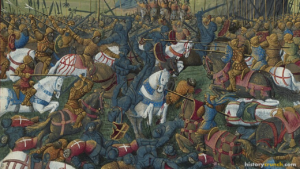
One of the most significant events of the High Middle Ages was the series of religious wars known as the Crusades. The Crusades are one of the most significant events in the history of Europe and the Middle East. They were a series of religious wars carried out by Christian crusaders from Europe during the timeframe of the Middle Ages. Beginning in 1095 CE, the Crusades saw European knights and noblemen travel to the Middle East in an attempt to capture the Holy Land away from Muslim people that had controlled the region for the previous centuries. The Crusades display the importance of religious faith in the lives of people during the High Middle Ages.
The First Crusade was called by Pope Urban II in 1095 CE at the Council of Clermont, in which he urged Christian knights and nobles to travel to the Holy Land and reclaim it from Muslim control. Over the next two centuries, a total of nine major Crusades were launched, with varying degrees of success. For example, the First Crusade succeeded in capturing the city of Jerusalem in 1099 CE and establishing a series of Christian kingdoms in the Holy Land known as the Crusader States. With that said, later Crusades were largely unsuccessful in maintaining Christian control of the region, and the last Crusader stronghold in the Holy Land fell in 1291 CE. The Crusades had a major impact on both Europe and the Middle East, increasing trade and contact between different cultures and helping to eventually contribute to the cultural revival of the Renaissance.
Learning and the Rise of Universities
The High Middle Ages was also an important period for education and intellectual life in Europe. One of the most significant developments of the period was the founding of the first universities. Prior to the High Middle Ages, education in Europe had been almost entirely controlled by the Catholic Church and was conducted mainly in monasteries and cathedral schools. During the High Middle Ages, however, a new type of institution called the university began to develop in major European cities. For example, the University of Bologna, founded in Italy in 1088 CE, is considered to be the oldest university in the western world. The University of Paris was founded around 1150 CE, and the University of Oxford in England was established around the same time.
These universities taught a wide range of subjects, including philosophy, theology, law, and medicine. As well, scholars during the High Middle Ages rediscovered and studied many ancient Greek texts that had been preserved in the Islamic world, which brought new ideas into European intellectual life. The most important thinker of the High Middle Ages was Thomas Aquinas, an Italian philosopher and theologian who lived from approximately 1225 to 1274 CE and worked to combine the ideas of the ancient Greek philosopher Aristotle with the teachings of the Catholic Church. His major work, the Summa Theologica, was one of the most important intellectual achievements of the entire Middle Ages and had a lasting influence on Christian thought.
Significance of the High Middle Ages
In conclusion, the High Middle Ages was the most dynamic and prosperous period of the entire Middle Ages. Life during this time was shaped by the growth of towns and trade, the power of the Catholic Church, the feudal system, the Crusades, and the rise of universities and new intellectual ideas. The High Middle Ages saw Europe develop from the smaller and more fragmented world of the Early Middle Ages into a more connected, populous, and culturally active civilization. The developments of the High Middle Ages, including the growth of trade, the expansion of learning, and the exposure to new ideas through contact with the Islamic world, were important causes of the Renaissance that emerged at the end of the Middle Ages. As such, the High Middle Ages is a vital period for students to understand in order to make sense of how European history developed from the ancient world to the modern one.