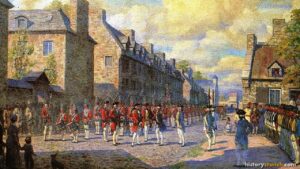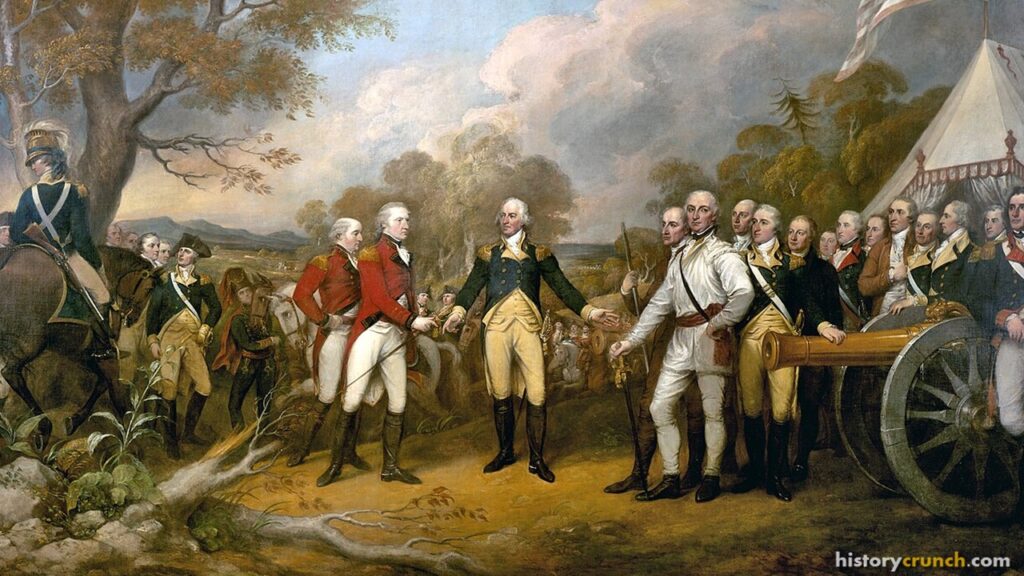
The Battle of Saratoga was fought in two engagements on September 19th and October 7th, 1777, near the town of Saratoga in upstate New York, during the American Revolutionary War. American forces under General Horatio Gates defeated a British army under General John Burgoyne, ultimately forcing Burgoyne to surrender his entire force of nearly 6,000 soldiers on October 17th, 1777. The victory at Saratoga is widely regarded as the turning point of the Revolutionary War, as it convinced France to enter the conflict as an American ally, transforming a colonial rebellion into a global war that Britain could not win alone.
What Was the American Revolution?
The American Revolution was the political and military struggle through which the Thirteen Colonies broke free from British rule and established the United States of America. By the autumn of 1777, the war had been going on for more than two years without either side achieving a decisive result. Britain held New York City and had recently captured Philadelphia, but could not deliver the knockout blow needed to end the rebellion. The American forces remained in the field despite constant shortages of supplies, men, and money. The outcome at Saratoga changed the entire calculation of the war, not just militarily but diplomatically, by bringing in the French alliance that ultimately made American victory possible.
Background – The British Plan for 1777
The British strategy for 1777 was to divide the American colonies in two by seizing control of the Hudson River Valley. The plan called for three British forces to converge on Albany, New York. General John Burgoyne would lead the main army south from Canada through the Champlain Valley. A smaller British and Loyalist force under Colonel Barry St. Leger would advance eastward through the Mohawk River Valley from Lake Ontario. And General William Howe’s army in New York City would push north up the Hudson to meet them.
The plan was ambitious and, as it turned out, fatally flawed in its execution. Howe, for reasons that have puzzled historians ever since, instead took his army south by sea to capture Philadelphia, leaving Burgoyne to advance without the support of the main British army in North America. St. Leger’s expedition was stopped at the Siege of Fort Stanwix and turned back in August. Burgoyne pressed on alone, not yet knowing that the two other prongs of his planned three-part attack had failed.
Burgoyne’s Advance and Growing Difficulties
Burgoyne led an army of roughly 7,000 to 8,000 soldiers out of Canada in June of 1777. He captured Fort Ticonderoga on July 6th, a significant early success, but the campaign grew steadily more difficult as he pushed south. The terrain of upstate New York was rugged and heavily forested, slowing his progress. His supply lines stretched dangerously thin. In August, a detachment of roughly 1,000 soldiers he had sent to forage for supplies in Vermont was ambushed and largely destroyed at the Battle of Bennington by American militia under Colonel John Stark. The loss cost Burgoyne nearly a thousand men he could not replace, stripped him of many of his Native American and Loyalist auxiliaries who drifted away after the defeat, and seriously depleted his supplies and artillery horses.
By mid-September, Burgoyne’s army had been reduced to roughly 6,000 effectives. He crossed the Hudson River and moved toward the American defensive position on Bemis Heights, a line of bluffs overlooking both the river and the road south to Albany. Waiting for him was General Horatio Gates with approximately 8,500 American soldiers, a force that would grow considerably in the weeks ahead as militia poured in from across New England and New York. Gates had positioned his army on Bemis Heights under the supervision of the Polish military engineer Thaddeus Kosciuszko, whose fortifications turned the position into a formidable defensive line.
The First Battle of Saratoga – Freeman’s Farm
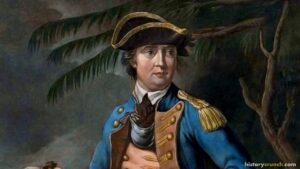
On September 19th, 1777, Burgoyne advanced his army in three columns toward the American position. General Benedict Arnold, serving under Gates as his most aggressive field commander, argued for sending troops forward to attack the British rather than waiting passively behind the fortifications. Gates reluctantly agreed. Arnold led a force out to a clearing known as Freeman’s Farm, about a mile north of the American lines, supported by Colonel Daniel Morgan’s corps of crack Virginia riflemen.
The fighting at Freeman’s Farm was intense and lasted several hours. Morgan’s sharpshooters, concealed in the woods at the edge of the clearing, targeted British officers with devastating accuracy. As the British advance began to waver, German reinforcements arrived from the river road and steadied the line. At dusk, the Americans withdrew. The British technically held the field when the fighting ended, but the cost had been enormous: roughly 600 British casualties compared to about 320 American. The Americans had demonstrated that they could hold their own against Burgoyne’s regulars and inflict far greater losses than they suffered.
A bitter dispute erupted between Arnold and Gates after the battle. Gates refused to send reinforcements to Arnold during the fighting and gave Arnold no credit for the action in his official report. The two men quarreled furiously, and Arnold threatened to leave the army. His officers persuaded him to stay, but Gates relieved him of his command and Arnold spent the next two weeks fuming in his tent, officially removed from any role in the army.
The Pause and Burgoyne’s Situation
After Freeman’s Farm, Burgoyne dug in and waited, hoping that a relief force under General Henry Clinton would advance up the Hudson from New York City. Clinton did make some limited moves against American forts in the Hudson Highlands in early October, but he was too late and with too few men to change the outcome at Saratoga. Burgoyne’s situation grew increasingly desperate as the days passed. Food was running short. The American force surrounding him continued to grow, eventually reaching around 20,000 men. The weather was turning cold. He could not winter where he was, and he could not retreat without a fight.
On October 7th, concluding he had no other option, Burgoyne sent approximately 1,500 soldiers on a reconnaissance in force toward the American left flank, hoping to find a weakness he could exploit to break out of his encirclement.
The Second Battle of Saratoga – Bemis Heights
Gates’s scouts detected the British movement, and he ordered American forces to engage. Daniel Morgan’s riflemen swung around the British right flank, while other American units struck the front and left. The British line began to break under attacks from multiple directions. British General Simon Fraser, one of the most capable and respected officers in Burgoyne’s army, rode back and forth on his gray horse in the midst of the battle, rallying his men and preventing a complete collapse. Morgan, recognizing Fraser’s role in holding the British line together, reportedly ordered his sharpshooters to target him. Fraser was shot from his horse and mortally wounded. His fall broke British resistance on that part of the field.
At this moment Benedict Arnold, who had been watching from his tent, could contain himself no longer. Officially relieved of command but unable to stay out of the fight, he rode onto the battlefield without orders, rallying American troops and leading charges against the British positions. Arnold personally led an assault against the fortified Breymann Redoubt, a key German position on the British right. The redoubt was taken. In the assault Arnold’s horse was shot and fell on his leg, badly wounding him in the same leg that had been injured at Quebec in 1775. He was carried off the field. The British were driven back to their main camp with heavy losses.
Burgoyne attempted a retreat on October 8th, but Gates’s army moved quickly to surround him. After several days of maneuvering, Burgoyne found his entire army encircled at the town of Saratoga with no escape route. On October 13th, he opened negotiations. On October 17th, 1777, Burgoyne surrendered his army of approximately 5,895 men, along with 27 artillery pieces and all remaining weapons and supplies. It was the first time a British army had surrendered in world history.
The French Alliance
The news of Saratoga reached Paris in early December of 1777 and changed the course of world history. France had been secretly supplying the Americans with weapons, ammunition, and money since 1776, but had been waiting for evidence that the Americans could actually win before risking an open war with Britain. Saratoga provided that evidence. King Louis XVI decided within weeks of hearing the news to enter into formal negotiations, and on February 6th, 1778, France signed both a Treaty of Amity and Commerce and a Treaty of Alliance with the United States. By March of 1778, France and Britain were officially at war.
The French alliance transformed the entire conflict. It forced Britain to fight a global war on multiple fronts, stretching its naval and military resources across the Caribbean, India, and the waters of Europe as well as North America. Spain and the Dutch Republic entered the war against Britain in 1779 and 1780 respectively. The diplomatic and military consequences of Saratoga ultimately led directly to the decisive French naval and military cooperation at Yorktown in 1781 that ended the war.
Significance of the Battle of Saratoga
The Battle of Saratoga stands as one of the most important military engagements in American history and one of the most decisive battles in the history of the modern world. It rescued the American Revolution at a moment of serious doubt, delivered to General Gates the largest American victory of the war to that point, and secured the French alliance that made ultimate victory possible.
The battle also showed the importance of individual leadership under pressure. Daniel Morgan’s riflemen, Benedict Arnold’s reckless courage on the battlefield, and Thaddeus Kosciuszko’s fortifications on Bemis Heights all played essential roles. Arnold’s contribution was particularly remarkable given that he fought the decisive second battle while officially relieved of command. The Saratoga battlefield today is a National Historical Park in New York, preserved as a memorial to one of the turning points of the modern democratic world.