The French and Indian War was a conflict fought between Britain and France in North America from 1754 to 1763, with Native American nations allied on both sides. It was the North American theater of the larger Seven Years’ War, a global conflict between the two empires. The war ended with a decisive British victory, giving Britain control of virtually all of eastern North America. The consequences of the war, particularly the enormous debt Britain accumulated and the new policies it imposed on the colonies afterward, set in motion the chain of events that led directly to the American Revolution.
What Was the American Revolution?
The American Revolution was the political and military struggle through which the Thirteen Colonies broke free from British rule and established the United States of America. The French and Indian War is essential to understanding how the American Revolution began. Before the war, Britain had largely allowed its American colonies to govern themselves and had taxed them very lightly. After the war, Britain changed course completely, imposing new taxes and tightening control over colonial affairs to help pay the enormous cost of the conflict. Those changes drove the disputes over taxation, representation, and self-government that eventually pushed the colonies toward independence.
Background – Rivalry in North America
France and Britain had been competing for territory and dominance in North America for nearly a century before the French and Indian War began. Three earlier conflicts, King William’s War, Queen Anne’s War, and King George’s War, had produced inconclusive results, leaving both empires with unresolved territorial claims and deep mutual hostility. By the early 1750s, the central dispute was over the Ohio River Valley, a vast and strategically valuable region stretching through what are now the states of Pennsylvania, Ohio, and West Virginia.
Britain claimed the region as part of its colonial territory and wanted it opened to settlers and traders. France, whose empire stretched from Canada south through the Great Lakes and down the Mississippi Valley to Louisiana, regarded the Ohio country as the crucial link connecting its northern and southern territories. If Britain controlled the Ohio Valley, French North America would be severed in two. Both empires began building forts there in the early 1750s to assert their claims, and the stage was set for a confrontation.
The Opening of the War – George Washington at Fort Necessity
The first shots of the French and Indian War were fired by a young Virginia militia officer named George Washington in May of 1754. Virginia’s colonial governor had sent Washington, then just 22 years old and holding the rank of lieutenant colonel, to the Ohio Valley to confront French forces who were building Fort Duquesne at the strategic junction of the Allegheny and Monongahela rivers, at the site of present-day Pittsburgh, Pennsylvania.
On May 28th, 1754, Washington and his force of about 40 men, accompanied by a small number of Mingo warriors under the leader known as Tanaghrisson, ambushed a French scouting party of 40 men at a site known as Jumonville Glen. The French commander, Ensign Joseph Coulon de Jumonville, was killed in the fighting, reportedly by Tanaghrisson himself. The skirmish is generally considered the opening battle of the French and Indian War.
Washington pulled back and hastily constructed a simple stockade called Fort Necessity. A larger French and Indian force attacked on July 3rd, and Washington was forced to surrender and negotiate a withdrawal. He and his men were allowed to return to Virginia, but Washington had unwittingly helped spark a war that would reshape the entire continent. When news of the battles reached Europe, both France and Britain began preparing for a much larger conflict.
The Early War – British Defeats
The early years of the war went badly for the British. In the summer of 1755, Britain sent General Edward Braddock to North America as commander of British forces, with orders to capture Fort Duquesne. Braddock was an experienced but rigid professional soldier who dismissed the advice of colonial officers, including Washington, who warned him about French and Native American tactics in the densely forested wilderness of the Ohio country.
On July 9th, 1755, Braddock’s force of roughly 1,500 soldiers was ambushed just a few miles short of Fort Duquesne in what became known as the Battle of the Monongahela. French soldiers and their Native American allies, firing from behind trees and rocks, inflicted devastating casualties on the British regulars, who were trained to fight in open formations on European battlefields and struggled to respond to an enemy they could not see. More than 900 British and colonial soldiers were killed, wounded, or captured. Braddock was mortally wounded and died a few days later. Washington helped organize the chaotic retreat and had two horses shot out from under him during the battle.
British fortunes continued to decline over the next two years. French forces captured Fort Oswego on Lake Ontario in 1756 and Fort William Henry near Lake Champlain in 1757. A British attempt to attack the fortress at Louisbourg on Cape Breton Island failed in 1757, and an assault on the French stronghold at Fort Carillon, later renamed Fort Ticonderoga, was repulsed with heavy losses in July of 1758.
The Turning Point – William Pitt and British Strategy
The war began to turn in Britain’s favor after 1757, largely because of a change in leadership in London. William Pitt the Elder became the dominant figure in the British government and transformed the British approach to the conflict. Pitt poured money and men into the North American theater, spending enormous sums to hire Prussian forces to fight France in Europe while concentrating British naval and military power on destroying French positions in North America. He also reimbursed the colonial assemblies for the costs of raising troops, which improved cooperation between British commanders and colonial governments.
In July of 1758, British forces under General Jeffrey Amherst captured the powerful French fortress at Louisbourg, near the mouth of the St. Lawrence River. A month later, Fort Frontenac fell. In November, British General John Forbes captured Fort Duquesne, the site of Washington’s earlier defeat, after the French abandoned and destroyed it. The British renamed it Fort Pitt. These victories in 1758 broke the French strategic position in North America and opened the way for a final campaign to capture French Canada entirely.
The Battle of the Plains of Abraham
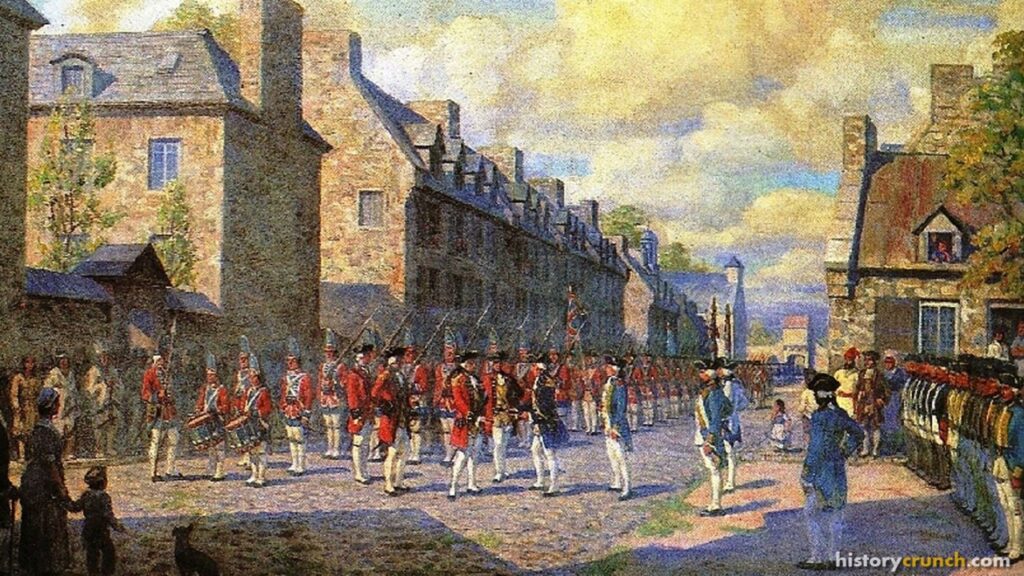
The decisive battle of the French and Indian War was fought on September 13th, 1759, outside the city of Quebec on a plateau known as the Plains of Abraham. Quebec was the capital of New France and the most important city in French Canada. British General James Wolfe had been besieging the city for months without breaking through its formidable defenses. In the early hours of September 13th, Wolfe led his force of about 4,800 soldiers up a steep, almost vertical cliff path in the darkness, reaching the plains above Quebec before the French defenders realized what was happening.
The French commander, the Marquis de Montcalm, chose to march his forces out of the city to meet the British on the open plains rather than waiting behind Quebec’s walls, a decision that proved fatal. The two armies exchanged volleys in a battle that lasted less than an hour. Both Wolfe and Montcalm were fatally wounded during the fighting. The British won decisively. Quebec fell to the British on September 18th, 1759. Montreal surrendered the following year in September of 1760, effectively ending French resistance in Canada.
The Treaty of Paris of 1763
The formal conclusion of the war came with the Treaty of Paris, signed on February 10, 1763. Under its terms, France ceded all of its territory east of the Mississippi River to Britain, including Canada and the Ohio Valley. France gave its territory west of the Mississippi, known as Louisiana, to Spain to compensate its ally for entering the war on the French side in 1762. Spain, which had also been defeated by Britain, ceded Florida to Britain. Britain now controlled virtually the entire eastern half of North America, the largest territorial gain any European power had achieved in the region.
France retained only the small islands of Saint-Pierre and Miquelon off the coast of Newfoundland and some sugar islands in the Caribbean. French power in North America was effectively finished. As a result, Native American nations that had depended on the French as trading partners and allies now faced British expansion with no European counterweight to restrain it.
Pontiac’s Rebellion and the Proclamation of 1763
The removal of French power from North America alarmed many Native American nations in the Great Lakes and Ohio Valley regions. In May of 1763, a pan-tribal uprising known as Pontiac’s Rebellion broke out, led by Ottawa chief Pontiac. Native warriors attacked and captured eight British forts and raided frontier settlements across a wide area. The rebellion revealed how difficult it would be for Britain to govern its vast new territory and protect its frontier settlements.
The British government responded with the Proclamation of 1763, which drew a boundary along the Appalachian Mountains and forbade colonial settlement west of it. The proclamation was intended to reduce conflict with Native nations and give Britain time to organize its new territories. As stated earlier in this series, it had the opposite effect on colonists, who were furious that lands they considered open to settlement were now off limits. The Proclamation of 1763 was one of the first and most direct causes of colonial resentment toward British rule.
Significance of the French and Indian War
The French and Indian War reshaped North America in ways that set the American Revolution in motion. Britain emerged from the war as the dominant power on the continent, but at an enormous financial cost. The national debt nearly doubled as a result of the war, and Britain looked to the colonies to help pay for it. The taxes Parliament imposed in the years that followed, beginning with the Sugar Act of 1764 and the Stamp Act of 1765, were rooted directly in the need to recover the costs of the French and Indian War. Colonists, who believed they had no obligation to pay taxes imposed without their consent, resisted every step of the way.
The war also ended the era of what historians call salutary neglect, the long period during which Britain had allowed the colonies to largely govern themselves. After 1763, Britain tightened its control over colonial affairs in ways that colonists experienced as a direct threat to their freedom. The combination of new taxes, new enforcement bodies, and new restrictions on westward expansion transformed the relationship between Britain and its colonies in ways from which it never recovered. In this sense, the French and Indian War was not just a prelude to the American Revolution. It was one of its root causes.