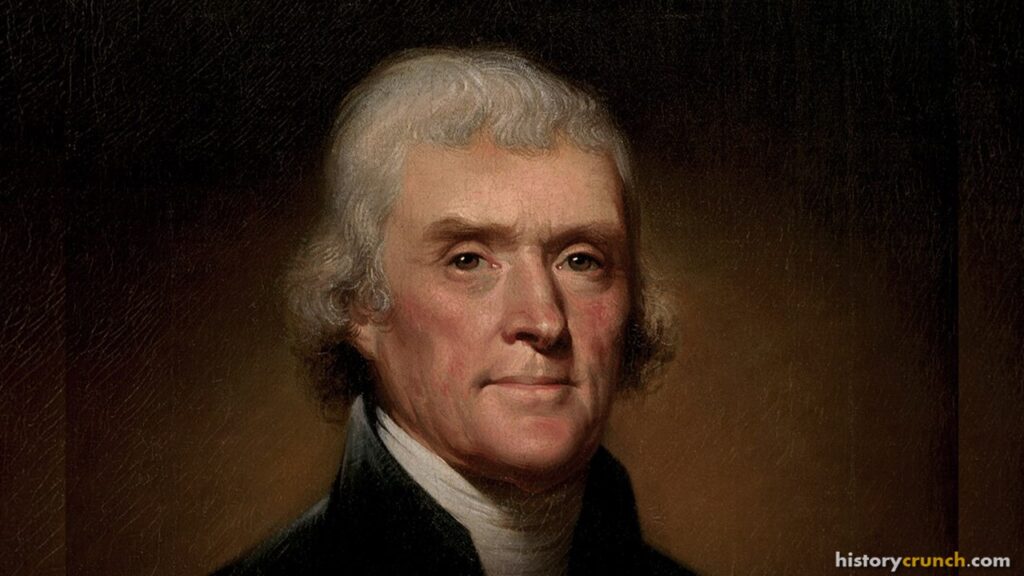
Thomas Jefferson was a Virginia planter, lawyer, writer, and statesman who served as the primary author of the Declaration of Independence and as the third President of the United States. Born on April 13th, 1743, and dying on July 4th, 1826, Jefferson spent nearly five decades in public service and left a legacy as one of the most important and most contradictory figures in American history. He was a passionate advocate for human freedom and individual rights who simultaneously enslaved more than 600 people over the course of his life, a contradiction that has defined how Americans have remembered and argued about him ever since.
Early Life and Education
Thomas Jefferson was born on April 13th, 1743, at Shadwell plantation in Albemarle County, in the British colony of Virginia. His father, Peter Jefferson, was a planter and surveyor of moderate wealth. His mother, Jane Randolph, came from one of Virginia’s most distinguished families. When Jefferson was 14 years old, his father died, leaving him some property and responsibility for helping to manage the family’s affairs.
From the age of nine, Jefferson studied away from home with local teachers, excelling in classical languages. In 1760, he enrolled at the College of William and Mary in Williamsburg, where he studied science, mathematics, philosophy, literature, and law. He was a strong reader who found his greatest intellectual inspiration in the writings of John Locke, Francis Bacon, and Isaac Newton. After college he studied law under George Wythe, one of the finest legal minds in Virginia, and was admitted to the bar in 1767. He began construction of Monticello, his mountaintop home in Albemarle County, in 1769 and spent the rest of his life designing and perfecting it.
Early Political Career
By 1769, Jefferson was serving in the Virginia House of Burgesses. He proved a more effective writer than public speaker, and quickly developed a reputation for producing influential political documents. In 1772, he married Martha Wayles Skelton, a widow whose considerable inherited wealth of land and enslaved people significantly expanded his own holdings. They had six children, though only two daughters survived to adulthood.
In 1774, Jefferson wrote A Summary View of the Rights of British America, a bold pamphlet arguing that Parliament had no authority over the colonies and that Americans owed their allegiance to the Crown alone. The pamphlet was published without his permission but circulated widely and established Jefferson as a leading voice for colonial rights beyond Virginia.
The Declaration of Independence
The Virginia legislature appointed Jefferson as a delegate to the Second Continental Congress in the spring of 1775. He arrived at 32 years old, one of the youngest members, with a reputation John Adams described as a remarkable ability to write. When Congress appointed a Committee of Five in June of 1776 to draft a formal declaration of independence, the other members chose Jefferson to produce the first draft, both because he was a Virginian and because his writing was simply better than anyone else’s.
Jefferson wrote the draft in seventeen days, drawing on Enlightenment philosophy and the Virginia Declaration of Rights. Congress debated and revised it over three days, making approximately 86 changes, including removing a passage blaming King George III for the Atlantic Slave Trade. Jefferson was unhappy with the revisions but accepted them. Congress adopted the Declaration on July 4th, 1776. Jefferson considered it one of the three greatest achievements of his life, alongside the Virginia Statute for Religious Freedom and his founding of the University of Virginia. He did not include the presidency on that list.
Governor of Virginia and Minister to France
Jefferson returned to Virginia after the Declaration and was elected governor in 1779. His two terms were difficult. British forces raided Virginia repeatedly, and Jefferson was accused of fleeing before the advancing British rather than organizing effective resistance. When Tarleton’s cavalry nearly captured him at Monticello in June of 1781, he escaped with minutes to spare. Though formally cleared of any wrongdoing, the episode damaged his reputation for a time.
In 1782, Martha Jefferson died after a difficult childbirth. Jefferson was devastated and threw himself into writing, producing his only book, Notes on the State of Virginia, which covered geography, natural history, and politics. In 1784, Congress appointed him as a diplomat to France, where he served until 1789. He helped the Marquis de Lafayette draft the Declaration of the Rights of Man and of the Citizen, drawing directly on the language of the American Declaration. He also began a sexual relationship with Sally Hemings, an enslaved woman he brought from Monticello. Hemings was the half-sister of Jefferson’s late wife and was approximately sixteen years old when the relationship began.
Secretary of State and Vice President
Jefferson returned to Virginia in 1789 and was appointed by Washington as the first Secretary of State. His time in the cabinet was marked by deep conflict with Treasury Secretary Alexander Hamilton. Jefferson believed Hamilton’s vision of a powerful central government and close ties to Britain was fundamentally at odds with the principles of the American Revolution. The two men’s hostility shaped the development of the country’s first political parties, with Jefferson and Madison founding the Democratic-Republican Party in opposition to Hamilton’s Federalists. Jefferson resigned as Secretary of State in December of 1793.
In the presidential election of 1796, Jefferson lost narrowly to John Adams and, under the constitutional rules of the time, became Adams’s vice president. He used the position to study parliamentary procedure and to organize opposition to the Federalist administration. In the election of 1800, Jefferson defeated Adams in a bitterly contested race that was thrown to the House of Representatives after Jefferson and his running mate Aaron Burr tied in the Electoral College. After 36 rounds of balloting, Jefferson was chosen as president.
The Presidency
Jefferson was inaugurated on March 4th, 1801, the first president inaugurated in Washington, D.C. His presidency was defined above all by the Louisiana Purchase of 1803. When Napoleon Bonaparte offered to sell France’s entire Louisiana Territory to the United States for $15 million, Jefferson moved quickly despite doubts about whether the Constitution gave him the authority. The deal doubled the size of the country in a single transaction, adding roughly 828,000 square miles of territory and opening the continent to westward expansion. Jefferson sent Meriwether Lewis and William Clark to explore the new lands, and their expedition returned in 1806 with the first detailed knowledge of the American west.
Jefferson also waged an undeclared naval war against the Barbary States of North Africa, which had been seizing American merchant ships. He sent naval squadrons to the Mediterranean from 1801 to 1805, forcing the Barbary States to stop demanding tribute. His second term was more troubled. Britain and France both seized American merchant ships during their ongoing war, and Jefferson’s response, the Embargo Act of 1807, which banned American ships from trading with foreign ports, devastated the American economy and was widely ignored. It was repealed just before he left office in 1809.
Later Life and Death
Jefferson’s retirement lasted 17 years and was marked by both intellectual richness and serious financial difficulty. He had spent far beyond his means throughout his life and was forced to sell his personal library of roughly 6,500 volumes to the federal government to help fund the Library of Congress. Despite his debts, he designed and founded the University of Virginia, chartered in 1819 and opened in 1825, which he considered one of the three greatest achievements of his life. He also maintained a remarkable correspondence with John Adams that has become one of the most celebrated exchanges of letters in American history.
Jefferson died on July 4th, 1826, the 50th anniversary of the adoption of the Declaration of Independence, at the age of 83. John Adams died later the same afternoon, his last words being “Thomas Jefferson survives,” spoken without knowing Jefferson had already gone. Jefferson was buried at Monticello under a stone marker inscribed, at his own instruction, with only three achievements: author of the Declaration of Independence, author of the Virginia Statute for Religious Freedom, and father of the University of Virginia. His will freed Sally Hemings’s two youngest sons. The remaining enslaved people at Monticello were sold at public auction in 1827 to pay his debts.
Significance of Thomas Jefferson
Thomas Jefferson occupies a unique and deeply contested place in American history. As the primary author of the Declaration of Independence, he gave voice to the most powerful statement of democratic principles in the modern world, a document whose opening lines have been invoked by reformers and revolutionaries across centuries and continents. The Louisiana Purchase alone transformed the physical shape of the country and set in motion a century of westward expansion.
At the same time, Jefferson’s life was defined by a contradiction he acknowledged but never resolved. The man who wrote that all men are created equal enslaved more than 600 people and profited from their labor every day of his adult life. He expressed private doubts about slavery throughout his career but never acted publicly to challenge it. Future generations of Americans, from abolitionists to civil rights leaders, drew on Jefferson’s words while confronting the society he helped build. That tension between his ideals and his practice remains one of the most important and unresolved questions in American history.