The Catholic Church was the most powerful institution in Europe during the Middle Ages, influencing nearly every aspect of life from the way people worshipped to the way kings governed their kingdoms. At a time when almost everyone in western Europe was Christian, the Church provided people with spiritual guidance, education, and a sense of shared identity that connected communities across different kingdoms and languages.
What Was the Catholic Church?
The Catholic Church is a Christian religious organization based in Rome, Italy, and headed by the Pope, who is considered to be the leader of all Catholics and the successor of Saint Peter, one of the original twelve apostles of Jesus Christ. The word Catholic comes from a Greek word meaning universal, reflecting the Church’s belief that it was the one true Church for all Christians everywhere. During the Middle Ages, the Catholic Church was the dominant religious institution in western Europe, and virtually everyone living in this region was a member of the Church from birth. As such, it is impossible to understand the Middle Ages without understanding the role that the Church played in the lives of ordinary people and in the political affairs of kingdoms and empires.
The structure of the Catholic Church was hierarchical, meaning that it was organized in layers of authority from top to bottom. At the very top was the Pope in Rome, who had supreme authority over the entire Church. Below the Pope were cardinals, archbishops, and bishops, who oversaw the Church’s activities in particular regions and cities. At the local level were the priests, who ran individual parish churches and were the main point of contact between the Church and ordinary people in their daily lives.
How the Catholic Church Rose to Power
The Catholic Church had not always been as powerful as it became during the Middle Ages. Much of its enormous power grew out of the collapse of the Western Roman Empire in 476 CE. When the empire fell, the political and social structures that had held western Europe together collapsed along with it. In this environment, the Catholic Church became one of the only stable and organized institutions that continued to function across all of western Europe. As such, people turned to the Church not only for spiritual support but also for practical help, education, shelter, and protection in times of crisis.
Furthermore, the Church had something that no king or noble could offer which was the promise of eternal life or eternal punishment in the afterlife. People in the Middle Ages genuinely and deeply believed that the Catholic Church held the keys to heaven and hell. For example, the Pope had the power to excommunicate a person, which meant cutting them off from the Church and from the sacraments believed to be necessary for salvation. This was an extraordinarily powerful tool because even the most powerful kings and emperors in Europe were terrified of being excommunicated. In fact, the Church used excommunication against kings and emperors multiple times throughout the Middle Ages to force them to comply with its wishes.
Political Power of the Catholic Church
One of the most striking features of the Catholic Church in the Middle Ages was the enormous political power it exercised alongside its religious authority. The Pope and senior bishops regularly became involved in political matters, advised kings, settled disputes between nobles, and sometimes even declared wars. As well, the Church owned vast amounts of land across Europe, making it one of the largest landowners on the continent. People were required to pay a tax called the tithe to the Church, which amounted to approximately one tenth of their annual income or produce. This meant that the Church collected enormous wealth from across all of western Europe, wealth that it used to build great cathedrals, support monasteries, and fund schools. In fact, during some periods of the Middle Ages, the Catholic Church was wealthier and more powerful than many of the kings of Europe.
The relationship between the Church and political rulers was not always cooperative, however. Some of the most dramatic conflicts of the Middle Ages were between popes and kings fighting over who had the right to appoint bishops and other senior church officials. For example, the Investiture Controversy of the 11th century was a long and bitter dispute between Pope Gregory VII and the German King Henry IV over this very question. The conflict became so serious that Pope Gregory excommunicated Henry IV in 1076, which forced the king to stand barefoot in the snow outside the Pope’s residence for three days begging for forgiveness. More specifically, this episode shows just how powerful the Pope had become and how even the most powerful rulers in Europe feared the Church’s authority.
Role of the Church in Daily Life
For ordinary people in medieval Europe, the Catholic Church was a constant and deeply important presence in daily life. Life in the Middle Ages was characterized by religious faith in the Catholic Church and the social structure of feudalism. Feudalism was a form of government common during medieval Europe that involved society being structured in a very rigid and hierarchical way. It was popular in European society from the 9th century until the 15th century and was the form of government in which the country was dominated by an absolute monarch, in which all power was held within a single king. As such, understanding the role of the Church requires understanding the feudal world it operated in.
The local parish church was typically the most important building in any village or town, and the priest was one of the most influential figures in the community. The Church calendar organized the entire year around religious festivals and saints’ days, which provided structure and regular breaks from work for ordinary people. For instance, major life events such as baptisms, marriages, and funerals were all conducted by the Church, meaning the Church was present at every important moment in a person’s life from birth to death. As well, the Church played a vital role in education during the Middle Ages. Before the rise of universities in the 12th and 13th centuries, monasteries and cathedral schools were almost the only places in western Europe where people could receive a formal education. In fact, virtually all of the scholars, doctors, and administrators of medieval Europe had received their education through the Church in some form.
The Church and the Crusades
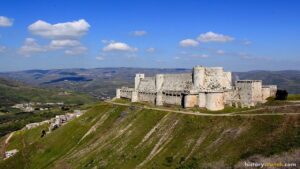
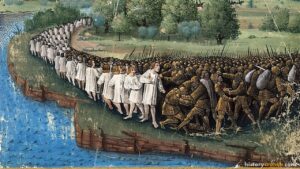
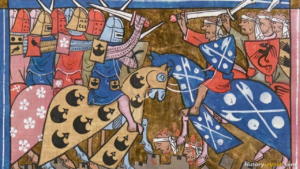
One of the most dramatic examples of the power of the Catholic Church in the Middle Ages was its role in organizing and inspiring the Crusades. The Crusades are one of the most significant events in the history of Europe and the Middle East. They were a series of religious wars carried out by Christian crusaders from Europe during the timeframe of the Middle Ages. Beginning in 1095 CE, the Crusades saw European knights and noblemen travel to the Middle East in an attempt to capture the Holy Land away from Muslim people that had controlled the region for the previous centuries. The term crusade means cross. Therefore, the Europeans that became crusaders viewed themselves as taking up the cross.
For example, Pope Urban II called for the First Crusade in 1095 CE, inspiring thousands of European knights and nobles to travel to the Middle East to fight for control of the Holy Land. He promised those who fought that their sins would be forgiven and that they would be guaranteed a place in heaven. The fact that a religious leader could mobilize the armies of multiple kingdoms for a military campaign far from home is perhaps the clearest illustration of the extraordinary power and authority of the Catholic Church during this period.
Decline of Church Power
With that said, the power of the Catholic Church was not without limits, and by the Late Middle Ages it had begun to decline significantly. The Western Schism of 1378 to 1417 was a devastating blow to the Church’s authority, as it produced two and sometimes three rival claimants to the position of Pope at the same time. The sight of competing popes excommunicating each other and competing for the loyalty of European kingdoms deeply damaged the reputation of the Church. As well, the Black Death of the 14th century weakened the Church’s standing in the eyes of many ordinary people, as the Church proved unable to explain or stop the catastrophic plague that killed approximately half of Europe’s population.
Furthermore, by the end of the Middle Ages, stronger national monarchies in France, England, and Spain were increasingly challenging the authority of the Pope and asserting their own control over Church affairs within their kingdoms. In general, these challenges to Church power laid the groundwork for the Protestant Reformation of the 16th century, which permanently broke the unity of western Christianity and ended the Catholic Church’s dominance over the religious life of Europe.
Significance of the Catholic Church in the Middle Ages
In conclusion, the Catholic Church was one of the most important institutions in the history of the Middle Ages. It provided spiritual guidance, education, political leadership, and a sense of shared identity to the people of western Europe for nearly a thousand years. As stated above, life during the Middle Ages was dominated by religious faith, the Catholic Church, feudalism, and the Crusades. Understanding the role of the Church is therefore essential to understanding almost every aspect of medieval life. In all, the Catholic Church in the Middle Ages helped shape the political, cultural, and social development of Europe in ways that can still be seen and felt in the world today.