The Gulag was a vast network of forced labor camps spread across the Soviet Union, most intensively used from 1929 until the death of Joseph Stalin in 1953. The word Gulag is actually an acronym from Russian, standing for Glavnoye Upravleniye Ispravitelno-Trudovykh Lagerey, which translates roughly as the Main Directorate of Correctional Labour Camps. Historians estimate that approximately 18 million people passed through the Gulag system during the Stalin era. The camps were used to imprison people that the Soviet government considered enemies of the state, including political opponents, ethnic minorities, ordinary criminals, and many completely innocent people. Conditions in the camps were brutal, and hundreds of thousands, possibly more than a million, prisoners died from overwork, starvation, cold, and disease.
WHAT WAS THE SOVIET UNION?
The Soviet Union was a communist state established in Russia following the Bolshevik Revolution of 1917. It was governed by the Communist Party, which controlled every aspect of political, economic, and social life. Under communism, the state owned all property and directed the entire economy. The Soviet government under Joseph Stalin used the Gulag system both as a tool of political control, to punish and silence those who challenged the regime, and as an economic resource, using the forced labor of prisoners to build factories, roads, canals, railways, and to extract coal, gold, timber, and other natural resources.
GULAGS IN THE SOVIET UNION – ORIGINS AND EARLY HISTORY
Forced labor camps were not entirely new in Russia when the Soviet Union was established. The tsarist government had used a system of exile and forced labor in Siberia for centuries, sending criminals and political prisoners to remote parts of the empire to work. However, the modern Gulag system was a creation of the Soviet era.
The first forced labor camps of the Soviet period were established by Vladimir Lenin in 1919, shortly after the Bolshevik Revolution. By 1921, the system had grown to include around 84 camps across the country. In these early years, the camps held mostly common criminals and political opponents of the new communist government. The numbers were relatively small compared to what would come later, and the camps were officially described as places of rehabilitation through labor.
It was not until Stalin came to power that the Gulag expanded into the enormous system that it became. In 1929, the secret police took control of the labor camps and began expanding them rapidly. From this point, the Gulag grew at a pace that shocked even many people within the Soviet Union.
GULAGS IN THE SOVIET UNION – EXPANSION UNDER STALIN
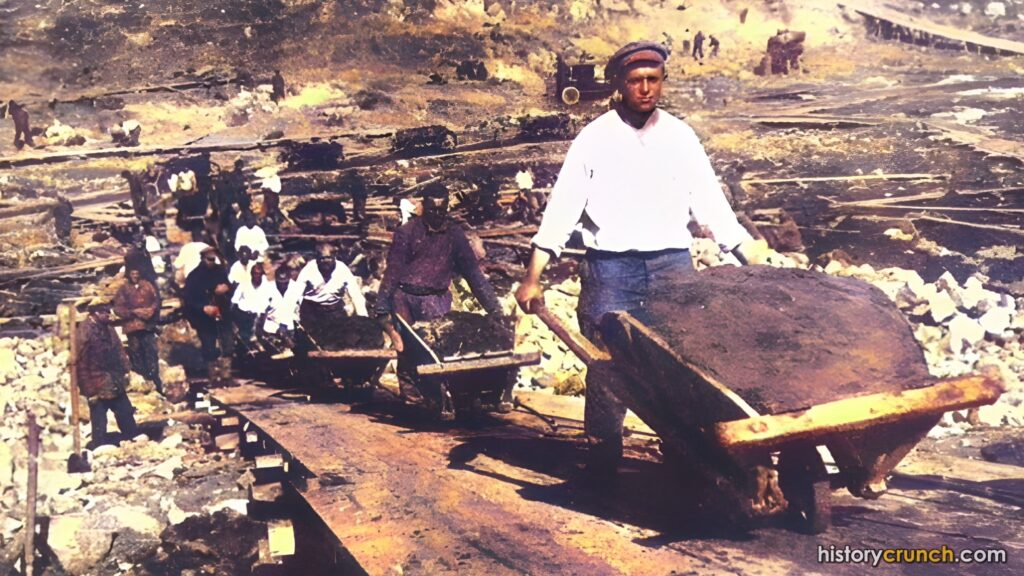
Joseph Stalin expanded the Gulag for two main reasons. First, he saw the forced labor of prisoners as a cheap way to industrialize the Soviet Union and extract natural resources from remote and harsh regions that free workers would not willingly go to. In fact, many of the major construction projects of the Stalin era were built by Gulag prisoners, including the White Sea Canal, the Moscow Metro, railways, roads, and entire cities in Siberia and the Arctic. Towns such as Norilsk, Vorkuta, and Magadan began as clusters of labor camps built and operated by prisoners.
Second, Stalin used the camps as a weapon of political terror. Anyone who was seen as a threat to his power could be arrested and sent to the Gulag. The camps were populated in three major waves. The first wave came between 1929 and 1932, when millions of peasants were arrested for resisting the forced collectivization of agriculture. In fact, the first large groups of Gulag prisoners were kulaks, the wealthier farming families who had been branded enemies of the state for opposing collectivization.
The second major wave came during the Great Purge of 1936 to 1938, when Stalin ordered the arrest of hundreds of thousands of Communist Party members, military officers, factory managers, intellectuals, and ordinary citizens on accusations of disloyalty, sabotage, or spying. Secret police officers were given arrest quotas and were required to fill them, which meant that many completely innocent people were arrested simply to meet the numbers. The third major wave came in the years after World War II, when returning Soviet soldiers and citizens who had been in contact with foreigners were arrested in large numbers on suspicion of having been influenced by the West.
GULAGS IN THE SOVIET UNION – WHO WAS SENT TO THE GULAGS?
The range of people sent to the Gulag was enormous. Political prisoners made up a large portion of the camp population. These were people accused of anti-Soviet activity, which was defined so broadly that almost anyone could be arrested on this charge. Telling a political joke, complaining about food shortages, or even being related to someone who had already been arrested could be enough to result in imprisonment.
Many prisoners were sent to the camps for very minor offenses. For instance, workers could be sent to the Gulag for being late to work three times, for accidentally damaging factory machinery, or for stealing small amounts of food from collective farms. Ethnic minorities were also targeted. Entire national groups, including Poles, Chechens, Crimean Tatars, and others, were deported to the camps on the grounds that they might be disloyal to the Soviet state.
Alongside political prisoners, the camps also held ordinary criminals, including thieves and murderers. The mixing of political and criminal prisoners was particularly difficult for political inmates, as criminal prisoners often held positions of authority within the camp hierarchy and could exploit those beneath them.
GULAGS IN THE SOVIET UNION – CONDITIONS IN THE CAMPS
The conditions in the Gulag camps were extremely harsh. The camps were deliberately placed in some of the most remote and inhospitable parts of the Soviet Union, including Siberia, the Arctic north, and the deserts of Central Asia. The extreme cold of the northern camps was particularly deadly, as prisoners were required to work outdoors for up to 14 hours a day regardless of the temperature.
Food rations in the camps were kept to a bare minimum. The amount of food a prisoner received was tied directly to how much work they produced, which created a vicious cycle in which the weakest and most malnourished prisoners received the least food and therefore became even weaker. In years of particularly severe hardship, the death rate in the camps could reach 25 percent of the camp population in a single year, as happened in 1942 during the most difficult period of World War II.
Prisoners slept in overcrowded wooden barracks, wore inadequate clothing, and worked with simple hand tools on backbreaking projects. Beatings and mistreatment by guards were common. In the worst years of the Great Purge, tens of thousands of prisoners were simply shot rather than imprisoned. The Russian author Aleksandr Solzhenitsyn, who survived eight years in the Gulag, described it as a system where people were worked to death. His book The Gulag Archipelago, published in the West in 1973, brought the true horror of the camps to international attention for the first time.
GULAGS IN THE SOVIET UNION – THE GULAG AND WORLD WAR II
World War II had a significant impact on the Gulag system. When Germany invaded the Soviet Union in June of 1941, the Soviet government faced an urgent need for soldiers. Hundreds of thousands of Gulag prisoners were released and drafted directly into the Red Army. This temporarily reduced the population of the camps considerably.
However, the war also brought new waves of prisoners. Citizens of the territories that the Soviet Union occupied in 1939 and 1940, including eastern Poland, the Baltic states, and parts of Romania, were arrested in large numbers and sent to the camps. Furthermore, Soviet soldiers who had been captured by the Germans and then freed or who had escaped were often sent to the Gulag after the war on suspicion of having collaborated with the enemy. This meant that men who had suffered as prisoners of war under the Nazis sometimes found themselves imprisoned again in their own country upon returning home. In this way, the Gulag was deeply intertwined with the experience of World War II for millions of Soviet citizens.
GULAGS IN THE SOVIET UNION – DECLINE AND END
After Stalin died in March of 1953, the Gulag system began to contract rapidly. His successor, Nikita Khrushchev, had long opposed Stalin’s methods and moved quickly to release large numbers of prisoners. Hundreds of thousands of inmates were amnestied in 1953 and 1954, and from 1956 onward Khrushchev launched a broader program of reviewing political convictions and releasing those wrongly imprisoned. In his famous Secret Speech of 1956, Khrushchev denounced Stalin’s crimes before Communist Party delegates, acknowledging for the first time at the highest level of government that the terror and the camps had been unjust.
The Gulag was officially disbanded in 1960, though labor colonies and camps for political prisoners continued to exist in a reduced form throughout the Soviet period. It was not until the late 1980s under Mikhail Gorbachev that the full history of the Gulag began to be openly discussed within the Soviet Union itself. The Soviet archives relating to the camps were sealed until the fall of the Soviet Union in 1991, which meant that for decades the true scale of the system was unknown to most of the outside world.
GULAGS IN THE SOVIET UNION – SIGNIFICANCE
The significance of the Gulag in the history of the Soviet Union and the wider world is considerable. The camps were one of the most important tools of Stalin’s system of political terror, used to silence opposition, frighten the general population into compliance, and eliminate anyone seen as a threat to the regime. In fact, the mere existence of the camps, widely known within Soviet society even if never officially discussed, was itself a powerful instrument of control. People who might otherwise have complained or resisted thought twice knowing that the consequence could be years of brutal imprisonment in Siberia.
The Gulag also played a significant economic role, providing the forced labor that built much of the infrastructure of the Soviet industrial economy. At the same time, most historians agree that the camps were economically inefficient, as starving and exhausted prisoners could not work as productively as well-fed free workers. As such, the Gulag achieved its economic goals at a far greater human cost than would have been necessary had free labor been used instead.
As a chapter in human history, the Gulag stands as a powerful example of the consequences of totalitarian government, in which the state claims the right to imprison, punish, and destroy any citizen it chooses without accountability to law or justice. As stated above, approximately 18 million people passed through the camps during the Stalin era. The suffering they endured and the lives that were lost or destroyed represent one of the great human tragedies of the 20th century.