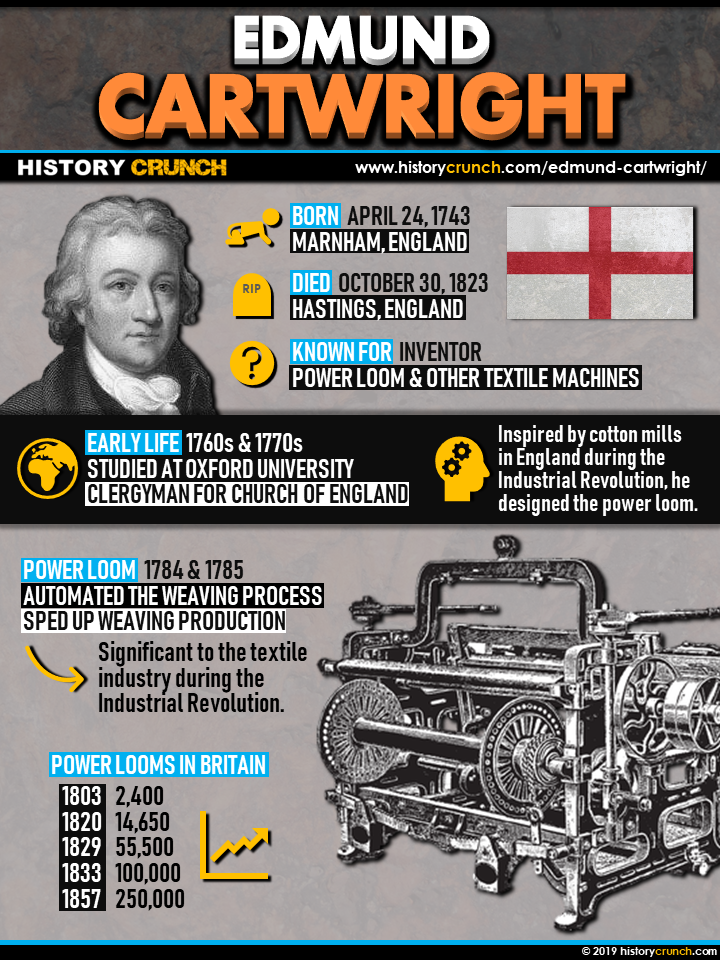
Edmund Cartwright was one of the most important inventors of the Industrial Revolution. An English clergyman turned inventor, Cartwright is best remembered for developing the power loom in 1784, a machine that mechanized the weaving process and transformed textile manufacturing forever. This infographic was designed for students to visually summarize the key aspects of Edmund Cartwright’s life and significance and is based on the History Crunch article titled Edmund Cartwright.
Edmund Cartwright – Infographic
About This Infographic
This Edmund Cartwright infographic was created by the History Crunch team to help students and teachers quickly understand the life and significance of one of the key inventors of the Industrial Revolution. It is designed as a visual learning and study tool, summarizing the essential information covered in our full article on Edmund Cartwright. Teachers may use it as a classroom display, a discussion prompt, or a study aid for students preparing for assessments.
What This Infographic Covers
Edmund Cartwright was born on April 24th, 1743 in Marnham, England. He was the son of a landowner and received a strong education, attending a grammar school in Wakefield before going on to study at Oxford University. He spent much of his early career working for the church, which made his later career as an inventor all the more unexpected.
The key moment in Cartwright’s life came when he visited the cotton spinning mills of Richard Arkwright, another major inventor of the Industrial Revolution known for developing the water frame. Seeing the spinning machines in action inspired Cartwright to wonder whether something similar could be created for weaving. He began working on designs for a weaving machine in 1784 and completed a working version in 1785. Many people at the time doubted that an automated weaving machine was even possible, but Cartwright proved them wrong.
The infographic covers the power loom, which is Cartwright’s most important contribution to the Industrial Revolution. Before the power loom, weaving fabric was a slow and labor-intensive process done largely by hand. Cartwright’s machine mechanized this process using a large rotating shaft, dramatically speeding up production and making it possible to weave textiles on a much larger scale in factories. While his first machine was simple, he continued making improvements that made it practical for widespread industrial use. The power loom became one of the defining inventions of the textile industry and played a central role in the transformation of British manufacturing.
Despite the enormous impact of his invention, Cartwright did not benefit greatly from it financially. He made very little money from the power loom itself, though in 1809 he was awarded a grant of ten thousand pounds by the British government in recognition of the national benefits his invention had produced. He was also elected as a Fellow of the Royal Society, one of the highest honors available to a scientist or inventor in Britain. Cartwright died on October 30th, 1823 in Sussex, England. Today he is remembered as one of the key figures of the Industrial Revolution whose invention helped reshape the world of manufacturing.
How to Use This Infographic in the Classroom
This infographic works well as a visual introduction to Edmund Cartwright before students read the full biography article. It can also be used as a review tool before an assessment, or as a discussion prompt asking students to consider why inventors like Cartwright often failed to profit from inventions that transformed society. Teachers may also use it alongside related articles on the power loom, textile manufacturing and other inventors of the Industrial Revolution to help students understand how individual inventions connected to form the broader story of industrialization.
H2: Related Articles
To learn more about the topics covered in this infographic, visit the following History Crunch articles: