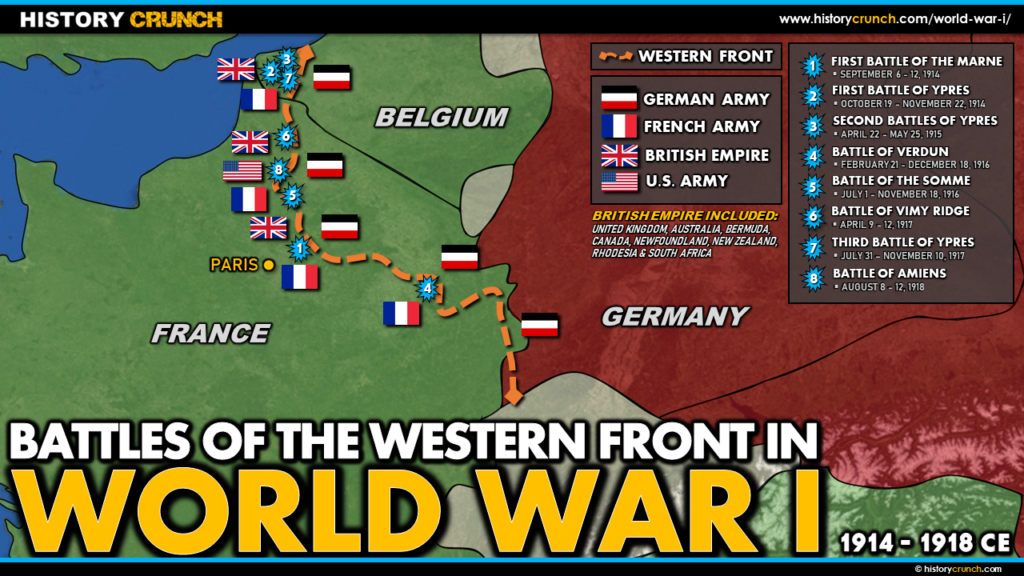
The First Battle of Ypres was one of the first significant battles in World War I. It took place from October 19th to November 22nd in 1914 and was part of the Western Front of the First World War, which was a long line of trenches across northern France. In fact, the Western Front was the site of some of the largest battles in all of World War I.
WHAT LED TO THE FIRST BATTLE OF YPRES IN WORLD WAR I?
The First Battle of Ypres resulted from the end of the Race to the Sea and saw the British, Belgian and French forces engage in battle with the German forces. The Race to the Sea was a scramble by both the Allied Powers and the Central Powers to push north following the German failure at the First Battle of the Marne. Because of the Race to the Sea, the trenches of the Western Front stretched throughout much of Northern France and Belgium. In fact, the First Battle of Ypres occurred near the town of Ypres, which is located in western Belgium. The region became known as the Ypres Salient and was the site of several major conflicts throughout World War I, including: the First Battle of Ypres, Second Battle of Ypres and the Third Battle of Ypres (Battle of Passchendaele). It should be noted that the region is also referred to as Flanders.
WHAT HAPPENED DURING THE FIRST BATTLE OF YPRES IN WORLD WAR I?
As stated above, the First Battle of Ypres was fought between the Allied Powers of France, Britain and Belgium against the Central Power of Germany. It is estimated that the Allies had a fighting force of over 4.4 million, while Germany had 5.4 million. However, most of the Allied soldiers were French, who contributed almost 4 million of the total troops. The battle occurred in a series of five stages, which did not produce any decisive results. In fact, during the First Battle of Ypres both the Allied nations and Germany carried out offensives, but neither side was able to capture any meaningful gains. In the end, the fighting was devastating for all of the nations involved and resulted in no clear victory. As such, historians consider the First Battle of Ypres to be an indecisive result because it did not lead to a positive outcome for either side. In fact, by mid to late November the armies of both sides were exhausted from the continuous assaults and deadly results. The soldiers were tired and suffering from poor morale.

WHAT WAS THE OUTCOME OF THE FIRST BATTLE OF YPRES IN WORLD WAR I?
In all, the First Battle of Ypres was deadly on all sides and led to numerous casualties. For instance, it is estimated that Britain suffered around 58,000 casualties in the battle, with nearly 8,000 deaths. Furthermore, historians estimate that France experienced approximately 50,000 casualties, while Belgium endured over 21,000. For its part, it is believed that Germany suffered about 130,000. In the end, the battle was characteristic of the conditions at the time, in that defensive fortifications ensured numerous dead and injured with little or no results. This became a recurring theme throughout the rest of World War I, and the numerous significant battles on the Western Front.