The Stamp Act was a law passed by the British Parliament on March 22nd, 1765, that required colonists in British North America to pay a tax on a wide range of printed materials. It was the first direct tax that Parliament had ever imposed on the American colonies and set off an immediate and powerful wave of protest. The colonial response to the Stamp Act, which included street protests, economic boycotts, and the first intercolonial congress in American history, helped define the central argument of the coming American Revolution, which was that the British Parliament had no right to tax the colonies without their consent.
What Was the American Revolution?
The American Revolution was the political and military struggle through which the Thirteen Colonies broke free from British rule and established the United States of America. The conflict did not begin with the first shots at Lexington and Concord in April of 1775. It grew out of more than a decade of deepening tension between Britain and its colonies over questions of taxation, trade, and self-government. The Stamp Act of 1765 was one of the earliest and most significant of those flashpoints. It pushed colonists to organize, argue, and resist in ways they never had before, and it planted ideas about rights and representation that would eventually justify independence.
Background – Britain’s Debt After the French and Indian War
The immediate cause of the Stamp Act was money. The Seven Years’ War, known in North America as the French and Indian War, had ended in 1763 with a decisive British victory. Britain had gained enormous territory, including all of Canada and lands east of the Mississippi River. But the war had also left Britain deeply in debt, with a national debt approaching 140 million pounds. Tens of thousands of British troops remained stationed in North America after the war, and Parliament needed to find ways to pay for them.
British Prime Minister George Grenville decided that the American colonies should bear part of this cost. His reasoning was that the war had been fought partly to protect the colonies from French expansion, and the troops still stationed there continued to defend the colonial frontier. From Britain’s perspective, asking the colonies to help cover these expenses seemed entirely fair. Most colonists saw it very differently.
In 1764, Parliament had passed the Sugar Act, which placed new duties on sugar, molasses, and other goods imported into the colonies. Though it caused frustrations, most colonists accepted the Sugar Act because it was framed as a trade regulation rather than a direct tax. The Stamp Act was a different matter entirely.
What the Stamp Act Required
Parliament passed the Stamp Act on March 22nd, 1765, and it went into effect on November 1st, 1765. The act required that a wide range of printed materials produced or used in the colonies carry a special tax stamp, purchased from British-appointed stamp distributors. The revenue stamp had to be paid for in British currency, not in colonial paper money.
The materials affected by the act were extensive. Legal documents of all kinds, including wills, deeds, contracts, and court papers, required a stamp. So did newspapers, pamphlets, almanacs, and diplomas. Even playing cards and dice were taxed under the act. In practice, the Stamp Act touched nearly every person in the colonies in some way. Lawyers and merchants, who dealt in legal documents constantly, faced significant new costs. Printers and newspaper publishers, who were among the most vocal and influential members of colonial society, were directly affected. Ordinary colonists who played cards or read a pamphlet felt it too.
The Colonial Argument
The core objection to the Stamp Act was not simply that it cost money. It was that Parliament had passed a direct tax on people who had no elected representatives in Parliament. Colonists had been governing themselves through their own elected assemblies for generations, and those assemblies had always been the ones to levy taxes on the people they represented. This was not just a tradition. Colonists believed it was a fundamental right as British subjects that they could not be taxed without their own consent.
Parliament’s response was that the colonists were “virtually represented,” meaning that members of Parliament represented the interests of all British subjects everywhere, even those who did not vote for them. Colonists found this argument completely unconvincing. As Patrick Henry of Virginia and others argued, virtual representation was meaningless if the people being taxed had no real say in the matter. The phrase “no taxation without representation” became the rallying cry of the resistance and was repeated in newspapers, pamphlets, and speeches across all thirteen colonies.
The Virginia Resolves
The first official political response to the Stamp Act came from the Virginia House of Burgesses in May of 1765. Patrick Henry, a newly elected delegate, introduced a set of resolutions known as the Virginia Resolves. The resolutions declared that Virginians had the same rights as any British subject born in England, including the right to be taxed only by their own elected representatives. Henry’s most forceful resolution stated that only the Virginia General Assembly had the legal authority to tax Virginia’s inhabitants. The House of Burgesses passed a modified version of the resolves, but newspapers across the colonies printed the full and more radical text, spreading Henry’s arguments to a wide audience and inspiring other colonial assemblies to take similar stands.
The Sons of Liberty
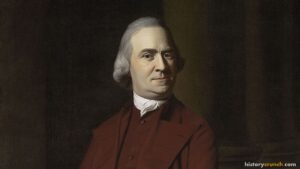
The Stamp Act also produced a more direct and sometimes violent form of resistance. In the summer of 1765, groups calling themselves the Sons of Liberty began organizing in Boston and New York City and quickly spread to other colonies. The Sons of Liberty were largely made up of artisans, printers, merchants, and tradespeople. Their leaders included some of the most prominent men in colonial society, among them Samuel Adams of Massachusetts, Patrick Henry of Virginia, Paul Revere, and John Hancock.
The Sons of Liberty used both peaceful and violent methods to oppose the Stamp Act. They organized public demonstrations, hung effigies of stamp distributors from trees, and published pamphlets attacking the law. On August 14th, 1765, a large mob in Boston hung an effigy of Andrew Oliver, the city’s stamp distributor, from a tree near Boston Common that became known as the Liberty Tree. The crowd later ransacked Oliver’s office and his home, causing extensive damage. Oliver resigned as stamp distributor the following day. Similar scenes played out in towns across the colonies. By the time the Stamp Act officially went into effect on November 1st, 1765, nearly every appointed stamp distributor in the colonies had already resigned out of fear, making enforcement almost impossible.
The Stamp Act Congress
In October of 1765, representatives from nine colonies met in New York City for what became known as the Stamp Act Congress. It was the first intercolonial assembly to meet in response to a British policy, and it marked an important step toward colonial unity. The delegates produced a document called the Declaration of Rights and Grievances, which stated that only colonial legislatures had the right to tax colonists and that the Stamp Act was a violation of their rights as British subjects. The Congress then petitioned both the king and Parliament to repeal the act.
The Stamp Act Congress did not call for independence or break from Britain. Its tone was respectful and its demands were framed in the language of loyalty. But the act of twelve colonies coming together to oppose a British law in a formal and organized way was a significant development, and it showed that the colonies could coordinate their efforts when they chose to.
Economic Boycott
Alongside the political protests, colonial merchants organized a widespread economic boycott of British goods. Merchants in New York, Boston, and Philadelphia signed agreements refusing to import goods from Britain. This hit British manufacturers and merchants hard, as the American colonies were among Britain’s most important trading partners. Sales of British goods to the colonies dropped sharply. British merchants, facing serious losses, flooded Parliament with petitions asking for the Stamp Act to be repealed. Their pressure, combined with the colonial resistance, made repeal a practical necessity for Britain.
Repeal and the Declaratory Act
Parliament repealed the Stamp Act on March 18th, 1766. The repeal was welcomed with celebrations in the colonies and was partly due to Benjamin Franklin’s testimony before the House of Commons, in which he made the case that the colonists had no objection to external trade regulations but were firmly opposed to direct internal taxes. Franklin’s calm and measured arguments helped shift opinion in Parliament and among the British public.
However, on the very same day it repealed the Stamp Act, Parliament also passed the Declaratory Act, which stated plainly that Parliament had full authority to pass laws binding on the colonies “in all cases whatsoever.” Britain was making clear that while it was willing to back down on this particular law, it was not giving up its claim to the right to tax the colonies at will. Most colonists celebrated the repeal and paid little attention to the Declaratory Act at the time. Within a few years, however, Parliament would use that claimed authority to pass new taxes, most notably the Townshend Acts of 1767, pushing the colonies closer and closer to open conflict.
Significance of the Stamp Act
The Stamp Act was a turning point in the relationship between Britain and its American colonies. Before 1765, opposition to British policies had been scattered and disorganized. The Stamp Act produced something new: a continent-wide movement united around a clear principle. The argument that people cannot be taxed without their own consent became the foundation of the colonial case against British rule and was eventually written into the Declaration of Independence.
The act also created new institutions and habits that would prove essential to the Revolution. The Sons of Liberty continued to operate and grew into one of the most important organizing forces of the revolutionary movement. The Committees of Correspondence that formed to coordinate the resistance provided the communications network that later made unified colonial action possible. And the Stamp Act Congress, as the first intercolonial body to challenge British authority, was a direct ancestor of the Continental Congress that would govern the colonies through the Revolutionary War. In this way, the Stamp Act, though repealed within a year, set the Revolution in motion in ways that could not be undone.