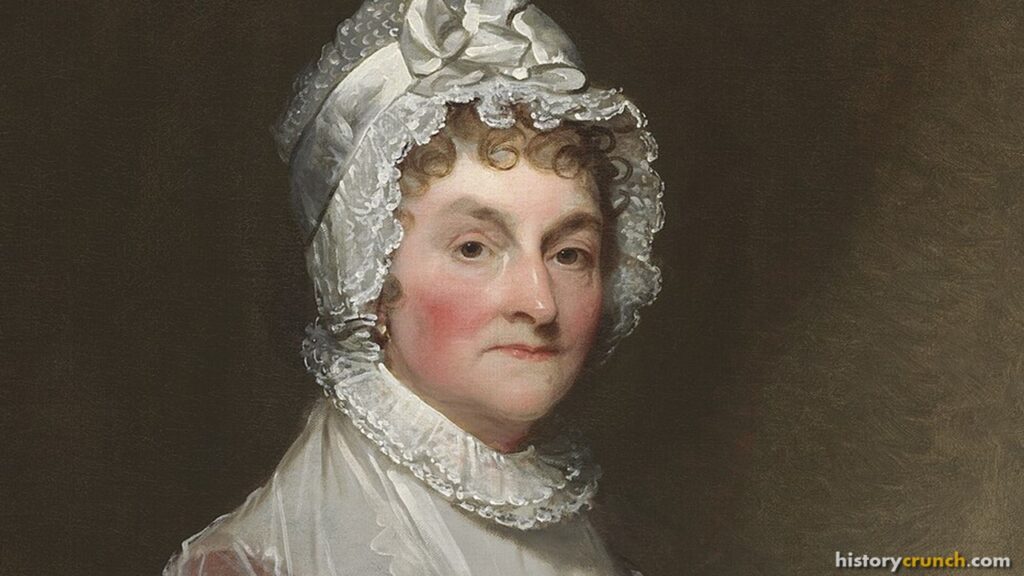
Abigail Adams was one of the most politically engaged and intellectually sharp women of the American founding era. Born on November 11th, 1744, in Weymouth, Massachusetts, and dying on October 28th, 1818, she spent decades as the closest adviser and most trusted partner of her husband, President John Adams. She managed the family’s farm and finances through years of separation while John was away at the Continental Congress and on diplomatic missions in Europe. She was a strong voice for women’s education and rights, and her more than 1,100 surviving letters with John provide one of the most detailed firsthand records of the Revolutionary era in American history. She was the second First Lady of the United States and the only woman in American history to be both the wife of a president and the mother of one.
Abigail Adams – Early Life and Education
Abigail Smith was born on November 11th, 1744, in Weymouth, Massachusetts, the second of three daughters born to the Reverend William Smith, a Congregationalist minister, and Elizabeth Quincy Smith. Her mother came from the politically prominent Quincy family, one of the most well-known families in colonial Massachusetts. Through her mother, Abigail was a cousin of Dorothy Quincy, who married Patriot leader John Hancock.
Abigail did not receive any formal schooling, which was typical for girls of her time. She was frequently ill as a child, which may have contributed to the decision not to send her to school. Instead, she was taught to read and write at home by her mother and had access to the large libraries of her father and grandfather, which she used to teach herself far beyond what most women of her era learned. She read widely in English literature, philosophy, history, and law. Her grandmother encouraged her intellectual curiosity, reportedly telling Abigail’s mother, who worried about her daughter’s strong opinions and love of books, that wild colts make the best horses.
Her brother-in-law, Richard Cranch, played an important role in her education, guiding her through the works of Shakespeare, Milton, and other classical writers, and teaching her to read French. Cranch also introduced her to his close friend John Adams, a Harvard-educated lawyer nine years her senior. Abigail first met John when she was fifteen years old, in 1759. They married on October 25th, 1764, when she was nineteen. The couple moved to John’s farm in Braintree, Massachusetts, just south of Boston. Over the following ten years, Abigail gave birth to five children, including a daughter who died in infancy. Among her surviving children was John Quincy Adams, who would later become the sixth President of the United States.
Abigail Adams – Managing the Home Front
From the earliest years of their marriage, John Adams’s career took him away from home for long stretches. As a lawyer, he rode a circuit of courts across Massachusetts. As his involvement in colonial politics grew through the late 1760s and 1770s, his absences became longer and more frequent. When John traveled to Philadelphia in 1774 as a delegate to the First Continental Congress and again to the Second Continental Congress in 1775, Abigail was left to manage the family’s farm, household, and finances entirely on her own.
She proved more than equal to the task. She oversaw the farm’s crops and livestock, hired and managed workers, handled the family’s financial affairs, educated all of her children personally, and arranged smallpox inoculations for the entire household during a smallpox outbreak. When the non-importation agreements against British goods made cloth scarce, she spun and wove fabric to make clothing for the family herself. John wrote to her from Philadelphia acknowledging that their farm had never looked better and was likely to outshine all their neighbors.
In addition to running the household, Abigail kept John closely informed about events in Massachusetts, writing detailed letters about the political mood in Boston, the movements of British troops, and the attitudes of their neighbors. John and his fellow members of Congress relied on her reports. He even quoted one of her letters in a speech to Congress. The correspondence between them, which eventually ran to more than 1,100 letters, is one of the most valuable records of the Revolutionary era, covering everything from the practicalities of running a farm to the deepest questions of government, rights, and independence.
In June of 1775, Abigail and her son John Quincy watched the Battle of Bunker Hill from nearby Penn’s Hill. She later wrote that the sound of the cannon fire shook the house and that the smoke rising over Charlestown was visible from where they stood. She also received word that day of the death of Dr. Joseph Warren, one of their close friends, who had been killed in the battle.
Abigail Adams – “Remember the Ladies”
Abigail Adams is best known outside her family circle for a letter she wrote to John on March 31st, 1776, as the Continental Congress was preparing to debate independence. In the letter, she urged him to “remember the ladies” when writing the new laws of the country, and to “be more generous and favourable to them than your ancestors.” She warned that if women were not given attention in the new system of government, they would not consider themselves bound by laws in which they had no voice or representation.
John responded in a dismissive and joking tone, saying that the men of Congress had enough trouble managing tyrants at a great distance without also having to worry about their wives. Abigail pushed back firmly, writing that she was more than half serious. The exchange, while brief, has become one of the most cited moments in the history of American women’s rights, and it reflects something real about Abigail’s character: she held strong political opinions and was not afraid to share them, even when the people she was writing to did not want to hear them.
Her views on women went beyond this single letter. Throughout her life she advocated for better education for women, arguing that a society could not produce informed and capable citizens without educating the mothers who raised them. She supported Judith Sargent Murray’s campaign to expand women’s educational opportunities and believed that women had a vital civic role to play in the new republic, even if formal political power was denied to them.
Abigail Adams – Years in Europe
When John was sent to Europe as a diplomat in 1778, Abigail stayed home in Massachusetts for six years, managing the family’s affairs alone. Their separation during this period was difficult for both of them, and their letters grew even more detailed and personal. She invested the family’s savings carefully, including buying Revolutionary War debt instruments that paid off substantially when Alexander Hamilton’s financial program as Treasury Secretary established full federal repayment of those securities. Historians credit her financial skill with helping the Adams family avoid the kind of financial ruin that destroyed Thomas Jefferson in his later years.
In 1784, Abigail finally joined John in Europe, traveling to Paris, where she found French social customs overwhelming at first, though she eventually adapted. She spent time in London as well, when John served as the first American ambassador to Britain from 1785 to 1788. Her letters from Europe describe her observations of British royalty, French customs, and the lives of ordinary people with sharp wit and a clear preference for the quiet life of a New England farm over the formality of European courts. She wrote in early 1788 that she much preferred her own little farm to the court of St. James’s.
Abigail Adams – First Lady
John Adams was elected the second President of the United States in 1796, and Abigail took on the role of First Lady with a mixture of duty and reluctance. She found the scrutiny of public life difficult. She described the role as feeling fastened hand and foot and tongue, to be shot at. Despite this, she was deeply involved in her husband’s presidency, advising him on policy, defending his decisions in public, and corresponding actively with political figures. Some political observers referred to her, not entirely with admiration, as Mrs. President, reflecting how much influence they believed she had over John’s decisions.
In November of 1800, the Adams became the first presidential family to move into the newly completed White House in Washington, D.C. Abigail found the building unfinished and drafty. She famously used the large unfinished audience room, later known as the East Room, to hang the family’s laundry. John lost his bid for a second term to Thomas Jefferson that same year, and the two returned to their farm in Quincy, Massachusetts.
Abigail Adams – Later Life and Death
The years after the presidency were generally happier for Abigail, who finally had her husband home and could spend real time with him. She remained actively engaged in politics through her correspondence, writing to former presidents, politicians, and public figures well into her final years. She was deeply hurt when her daughter Nabby, who had developed breast cancer, died in 1813. Her own health declined in the years that followed.
Abigail Adams died on October 28th, 1818, of typhoid fever, at her home in Quincy, Massachusetts. She was seventy-three years old. Her last words to John, who was at her bedside, were “Do not grieve, my friend, my dearest friend. I am ready to go. And John, it will not be long.” She was buried at the United First Parish Church in Quincy, Massachusetts, which later became the resting place of John as well when he died on July 4th, 1826. Their son John Quincy Adams and his wife were eventually buried there too, in what became a family crypt.
Significance of Abigail Adams
Abigail Adams was a genuine intellectual and political thinker who contributed directly to the founding of the United States through her influence on John Adams, her steady management of the family through years of separation, and her sharp firsthand observations of one of the most important periods in American history.
Her advocacy for women’s education and rights, expressed most memorably in the “remember the ladies” letter but visible throughout her entire correspondence, placed her decades ahead of most of her contemporaries. She did not live to see women gain formal political rights, but the ideas she put into words helped lay the groundwork for the arguments that later generations of women’s rights advocates would build on. She is remembered today as one of the most important and capable women of the American founding era, and her letters remain among the most vivid and insightful documents of the Revolutionary period.