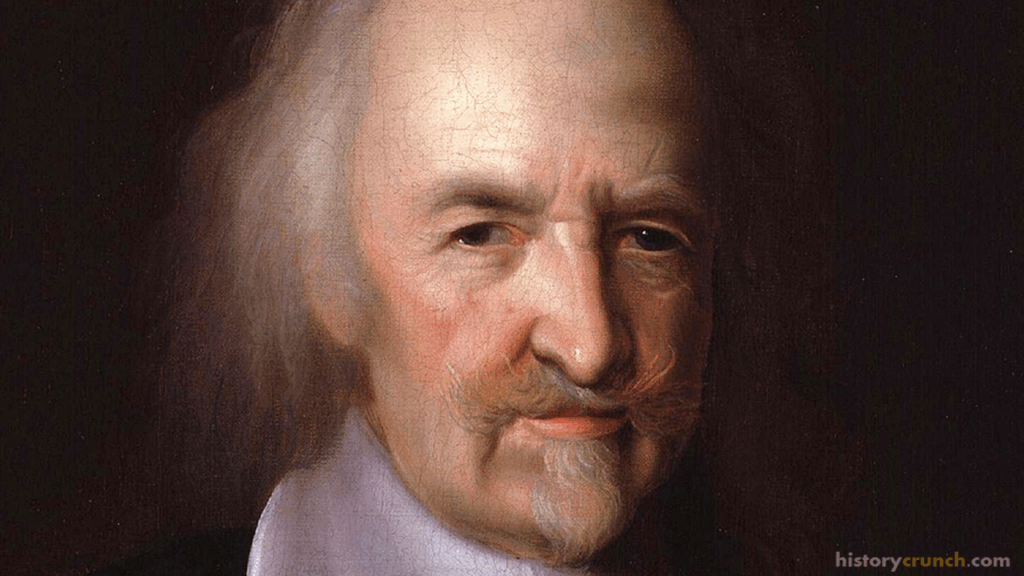
Thomas Hobbes was an important English philosopher and is best known for his ideas that centered on political theory. In fact, Hobbes was one of the most significant thinkers of his time, and had a profound impact on the Age of Enlightenment. With that said, he was not fully aligned with later Enlightenment thinkers such as John Locke, Jean-Jacques Rousseau, or Voltaire. Regardless, Hobbes laid foundational ideas that deeply influenced the Age of Enlightenment, especially through his influential work ‘Leviathan’, which was published in 1651.
THOMAS HOBBES – EARLY LIFE
Thomas Hobbes was born on April 5th, 1588 in the small village of Malmesbury in Wiltshire, England. His father was a clergyman, but did not make that much of an impact on Hobbes’ life as he left the family in 1608, and never returned. The reasons for the untimely disappearance of Thomas’ father are unknown. Regardless, Hobbes went to Oxford University, where his education was sponsored by a wealthy uncle.
He studied at Magdalen Hall, Oxford, where he received a classical education. His interest in science, mathematics, and philosophy deepened while working as a private tutor to noble families. Through his travels across Europe, Hobbes became acquainted with many leading intellectuals of the time, including Galileo, whose ideas would influence his own rationalist approach.
In the same year that his father left, Hobbes became tutor to William Cavendish who later became the Earl of Devonshire. Hobbes and Cavendish travelled to mainland Europe to discover new things, and explore countries such as Germany and France. William died not long after they returned from Europe, but Hobbes continued to work for the Cavendish family as a tutor, mainly working with William’s son.
As stated above, Hobbes travelled to Europe a number of times whilst tutoring, and on his travels he met influential thinkers of the time such as Rene Descartes and Galileo Galilei. He started writing philosophically, and when England was on the brink of civil war in 1640, Hobbes travelled back to Europe out of fear. In fact, he stayed in Paris, France for over 11 years because he was afraid of what the English parliament would make of his writing. While in Paris, Hobbes tutored Charles, Prince of Wales who was also in Paris in exile.
THOMAS HOBBES – ‘LEVIATHAN’
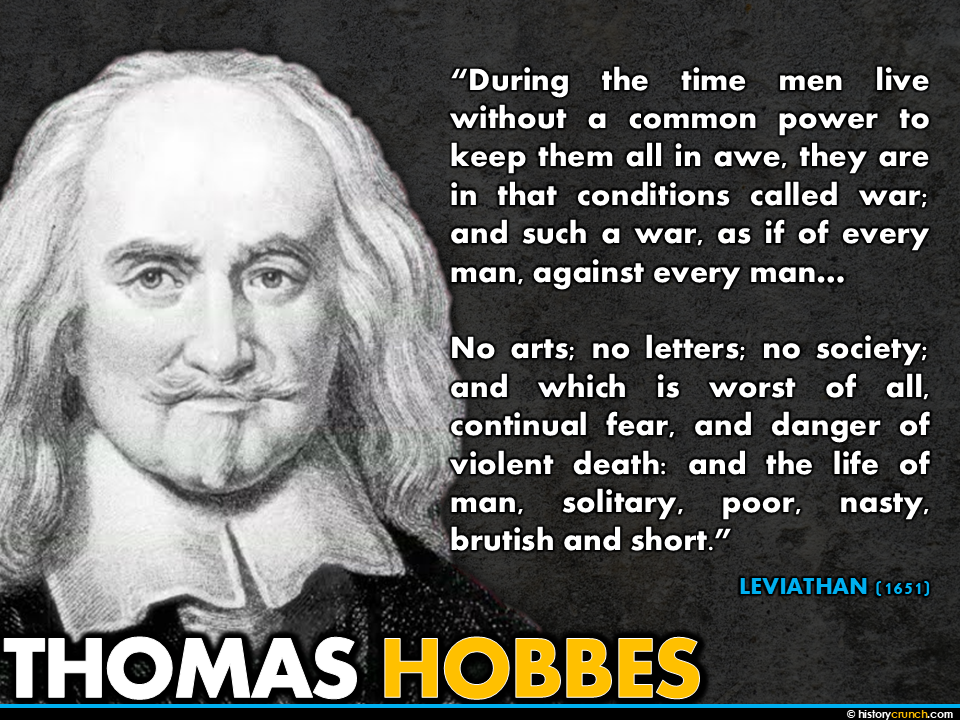
Also while still in France, Hobbes wrote and published his best known work, ‘The Matter, Form and Power of a Commonwealth Ecclesiastical and Civil’, or ‘Leviathan’. The premise of the work was that Hobbes believed that the only way for people to rid themselves of fear was to accept a central authority, and give up their freedom. He believed that an absolute monarchy was the best form of central authority, and that the king or queen should also be the head of the church. His ideas on authority are generally discussed today in relation to the Age of Enlightenment and the differing views expressed by thinkers, such as: John Locke and Jean-Jacques Rousseau.
Hobbes lived through the English Civil War, which took place from 1642 to 1651. It was a brutal conflict between the monarchy and Parliament that profoundly shaped his worldview. Witnessing the collapse of order and rise of political violence, he concluded that humans, left to their own devices, would descend into chaos and warfare. As a result, his political philosophy was built on the conviction that strong, centralized authority was essential to prevent disorder and preserve peace. In fact, he argued that life would be ‘nasty, brutish and short’ without the the guidance of a central authority, such as an absolute monarchy.
THOMAS HOBBES – AGE OF ENLIGHTENMENT
Although Thomas Hobbes preceded the height of the Age of Enlightenment, his work still directly influenced its development in several key ways. First, was the concept of the social contract. In fact, Hobbes was one of the first to explain the idea of a social contract, which became central to Enlightenment political thought. Later philosophers such as John Locke and Jean-Jacques Rousseau built on or reacted against Hobbes’s ideas.
Hobbes also helped lay the groundwork for secular political theory by removing divine right and religious authority from his explanation of government. This rational, human-centered view became a cornerstone of Enlightenment philosophy. Finally, Hobbes treated politics as a science, governed by predictable laws of human behavior. This empirical method influenced Enlightenment thinkers’ broader belief in reason, progress, and the possibility of improving society. As a result, historians consider the views and ideas of Thomas Hobbes to be significant in terms of understanding the impact of the Age of Enlightenment.
With that said, while Hobbes’s ideas aligned with Enlightenment rationalism, his conclusions were often at odds with its core ideals, and the main arguments of later Enlightenment thinkers. For instance, Hobbes supported absolute authority, while thinkers such as John Locke argued instead for limited government and individual rights. As well, Hobbes saw people as fundamentally selfish and violent, whereas Jean-Jacques Rousseau believed in the natural goodness of man. Finally, Hobbes prioritized order and security in society, while later Enlightenment thinkers emphasized freedom and the protection of rights.

THOMAS HOBBES – LATER LIFE AND DEATH
Hobbes continued to write into his old age, producing works on history, theology, mathematics, and translation, including a version of Homer’s epics. He also faced criticism from religious authorities and the royal court for his secular views and challenges to Church power. In fact, many influential people at the time, especially those in the church, thought that Hobbes’ works were against religion. Such comments scared Hobbes, and as a result he burned many of his papers in order to prevent being labelled a heretic, or punished.
However, King Charles supported Hobbes, and prevented any further action against Hobbes from being taken. Despite having the king’s support, Hobbes was obviously scared for his safety and never published any political works again. His last publication was his autobiography which he wrote in Latin.
He died on December 4th, 1679, at the age of 91, in Derbyshire, England.
THOMAS HOBBES – SIGNIFICANCE
Thomas Hobbes was one of the most significant thinkers of his time. More specifically, his significance lies in his revolutionary approach to understanding government, human nature, and society. Furthermore, he played a crucial role in the Enlightenment by influencing other thinkers who agreed or disagreed with him. In fact, many influential philosophers from the Age of Enlightenment argued their famous positions in response to the ideas of Hobbes.
His ideas helped build the intellectual foundation of modern states and stimulated the debates that fueled democratic revolutions in the centuries that followed. For instance, his ideas challenged traditional views of political power and religion, and introduced rational and secular arguments into political debate.