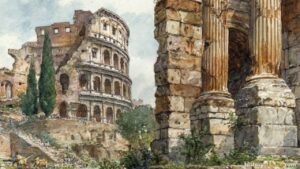
War and warfare were central to the history and identity of Ancient Rome. From its earliest days as a small city-state on the Italian peninsula, Rome used military power to defend itself, expand its territory, and build one of the largest empires in the ancient world. The Roman army became the most effective fighting force of its time, combining strict discipline, flexible tactics, and remarkable engineering skill to defeat enemies across Europe, North Africa, and the Middle East. War shaped Roman society, culture, and politics in ways that touched nearly every aspect of life.
WHAT WAS ANCIENT ROME?
Ancient Rome was one of the most powerful civilizations in world history. It began as a small city-state on the Italian peninsula and grew over many centuries into a vast empire that stretched from Britain in the northwest to Egypt in the southeast. At its height, the Roman Empire controlled much of Europe, North Africa, and parts of the Middle East. Roman civilization is remembered for its contributions to law, government, architecture, language, and culture. Behind all of this growth lay the Roman military, which conquered new territories, protected the empire’s borders, and enforced Roman authority across an enormous area. Understanding war and warfare in Ancient Rome is essential to understanding how the civilization developed and why it became so powerful.
WAR AND WARFARE IN ANCIENT ROME – THE ROMAN ARMY
In the early years of the Roman Republic, the army was made up of citizen soldiers who owned property and were called up to serve during the campaign season. Soldiers provided their own weapons and armor, so the quality of equipment depended heavily on wealth. The earliest Roman army used a formation called the phalanx, borrowed from the Greeks, in which soldiers stood in tight rows with overlapping shields. Over time the Romans developed a more flexible system called the maniple, which divided the legion into smaller units that could maneuver across different kinds of terrain.
The most important reform of the Roman army came under the general Gaius Marius around 107 BCE. Marius opened the legions to all Roman citizens regardless of property ownership, dramatically increasing the pool of available soldiers. He standardized equipment across the army for the first time, with the state providing weapons and armor rather than requiring each man to supply his own. He reorganized the legion around a unit called the cohort and introduced a new type of heavy javelin called the pilum, designed so its iron tip bent on impact and could not be thrown back by the enemy. After Marius, soldiers served for set terms of around 20 years, making the Roman army a professional standing force rather than a seasonal militia.
WAR AND WARFARE IN ANCIENT ROME – LEGIONS AND SOLDIERS
The basic unit of the Roman army was the legion. In the imperial period, a standard legion consisted of approximately 5,000 to 5,500 men divided into ten cohorts, each cohort further broken into centuries of around 80 soldiers. The officer commanding each century was called a centurion, who was responsible for the training, discipline, and battlefield leadership of his men. Each legion also carried a sacred standard called the aquila, or eagle, and losing it in battle was considered a catastrophic disgrace.
The Roman army also included auxiliary units recruited from non-citizen peoples across the empire, who served for 25 years and received Roman citizenship at the end of their service. At the height of the empire, legions and auxiliaries together gave Rome an army estimated at over 400,000 men protecting roughly 7,000 kilometers (4,300 miles) of frontier.
WAR AND WARFARE IN ANCIENT ROME – WEAPONS, ARMOR, AND TACTICS
A standard Roman legionary in the imperial period carried three main pieces of equipment into battle. The scutum was a large curved rectangular shield made from layered wood and leather. The pilum was a heavy javelin thrown at the enemy just before close combat to disrupt their formation. The gladius was a short double-edged sword, roughly 60 to 80 centimeters (24 to 31 inches) long, used for thrusting and stabbing at close range. Legionaries also wore iron armor, typically the lorica segmentata, a suit of overlapping iron strips that offered good protection while allowing freedom of movement, along with iron helmets that protected the head and neck.
Roman battle tactics were built around the flexibility and discipline of the cohort system. Unlike the rigid Greek phalanx, Roman formations could maneuver to respond to threats from multiple directions. One of the most famous Roman formations was the testudo, or tortoise, in which soldiers locked their shields together above and around them to form a protective shell against missile fire. Soldiers on the front line were regularly rotated with fresh troops from behind, keeping the fighting line at full strength throughout a battle. Roman armies also used artillery, including catapults and bolt-throwers, both on the battlefield and during sieges.
WAR AND WARFARE IN ANCIENT ROME – SIEGE WARFARE
Roman engineering skill made the army exceptional at siege warfare. Roman engineers could construct a fully fortified camp at the end of every day’s march, and on larger operations they built elaborate systems of walls, ditches, and towers to surround and starve out enemy fortifications. The most famous example was the siege of Alesia in 52 BCE, during Julius Caesar’s Gallic Wars, where Roman engineers built a double ring of walls around a Gallic hilltop fortress, one to keep the defenders trapped and one to hold off a relief army. Both walls, totaling roughly 38 kilometers (24 miles) of fortifications, were completed in a matter of weeks.
WAR AND WARFARE IN ANCIENT ROME – MAJOR WARS
Rome fought many significant wars throughout its history. The Samnite Wars, fought from 343 to 290 BCE, gave Rome control of most of the Italian peninsula. The Punic Wars, three conflicts fought against the North African city of Carthage between 264 and 146 BCE, were among the most important wars in Roman history. The Second Punic War saw the Carthaginian general Hannibal invade Italy with war elephants and defeat several Roman armies, including destroying a force of roughly 70,000 men at the Battle of Cannae in 216 BCE. Rome refused to surrender, rebuilt its forces, and ultimately defeated Carthage. The Third Punic War ended in 146 BCE with the complete destruction of Carthage and the enslavement of its surviving population.
The Gallic Wars, fought from 58 to 50 BCE under Julius Caesar, brought the territory of modern-day France and Belgium under Roman control. Later, the Jewish-Roman Wars of 66 to 135 CE, the Dacian Wars of 101 to 106 CE under Emperor Trajan, and the many campaigns along the Rhine and Danube frontiers kept the Roman military active across its entire history.
SIGNIFICANCE OF WAR AND WARFARE IN ANCIENT ROME
War and warfare made Rome what it was. Without the effectiveness of the Roman army, there would have been no empire, no Pax Romana, no vast network of roads and aqueducts, and no spread of Roman law and culture across the known world. At the same time, constant warfare came at an enormous cost. Hundreds of thousands of soldiers died in Rome’s campaigns, and the populations of conquered territories often suffered terribly. The growing political influence of the army, particularly after the Marian reforms, contributed to the instability of the late Republic and the eventual fall of the empire.
The legacy of Roman warfare extends well beyond the ancient world. The organization of the legions, their tactics, and their engineering achievements were studied and imitated by armies across Europe for centuries, and the word “legion” itself remains a lasting symbol of disciplined military power.