The Battles of Lexington and Concord, fought on April 19th, 1775, were the opening military engagements of the American Revolutionary War. On that single day, a column of roughly 700 British soldiers marched from Boston to seize colonial weapons stored in Concord, Massachusetts, and found themselves confronted first by militiamen on the Lexington town green, then by a growing force of armed colonists who harassed and attacked them across the countryside during the long retreat back to Boston. The first shots fired that morning marked the beginning of a conflict that would last eight years and end with the birth of the United States of America.
What Was the American Revolution?
The American Revolution was the political and military struggle through which the Thirteen Colonies broke free from British rule and established the United States of America. Years of escalating tension over taxation, self-government, and colonial rights had brought Massachusetts to the brink of open conflict by the spring of 1775. The Battles of Lexington and Concord were the moment that conflict crossed the line from political dispute into armed rebellion. No single event did more to transform the colonial protest movement into a full-scale revolution.
Background – The Situation in Massachusetts
By early 1775, Massachusetts was in a state of near-open revolt. The Massachusetts Provincial Congress, a shadow government operating outside British authority, had been organizing and training colonial militias across the colony in response to the Intolerable Acts of 1774. Arms and ammunition were being stockpiled in towns throughout the region, including a significant cache in the town of Concord, about 18 miles (29 km) west of Boston.
General Thomas Gage, the British royal governor of Massachusetts and commander of British forces in the colonies, knew a confrontation was coming. He had been operating under orders from London to suppress the rebellion and arrest its leaders. By April of 1775, he decided he could wait no longer. His plan was to send a force of about 700 soldiers to Concord to seize or destroy the weapons and ammunition stored there, and to capture Patriot leaders Samuel Adams and John Hancock, who were believed to be staying in Lexington on the way to Concord.
Patriot intelligence networks, centered around the Sons of Liberty and the Committees of Correspondence, were aware of British intentions weeks in advance and had already moved most of the supplies at Concord to other locations. But they still needed to warn their militias and their leaders that a British column was on the move.
Paul Revere and the Midnight Riders
On the evening of April 18th, 1775, Dr. Joseph Warren, a Patriot leader in Boston, received intelligence that the British troops would march that night. He sent two riders by separate routes to alert the countryside: silversmith Paul Revere and tanner William Dawes. They rode by different paths in case one was captured.
Revere crossed the Charles River by boat to Charlestown, where fellow Patriots had arranged a signal system. Two lanterns briefly appeared in the steeple of Boston’s Old North Church, the prearranged signal meaning the British were crossing the harbor rather than marching out over the Boston Neck peninsula. Revere then mounted a horse and rode northwest toward Lexington, alerting households and militia commanders along the way. He arrived in Lexington around midnight and warned Adams and Hancock, who fled to safety. Revere and Dawes then set out toward Concord but encountered a British patrol on the road. Revere was captured and held for several hours before being released without his horse. Dawes was thrown from his horse and turned back. A third rider, Samuel Prescott, who had joined them earlier in the night, slipped past the patrol and completed the ride to Concord alone.
The Battle of Lexington
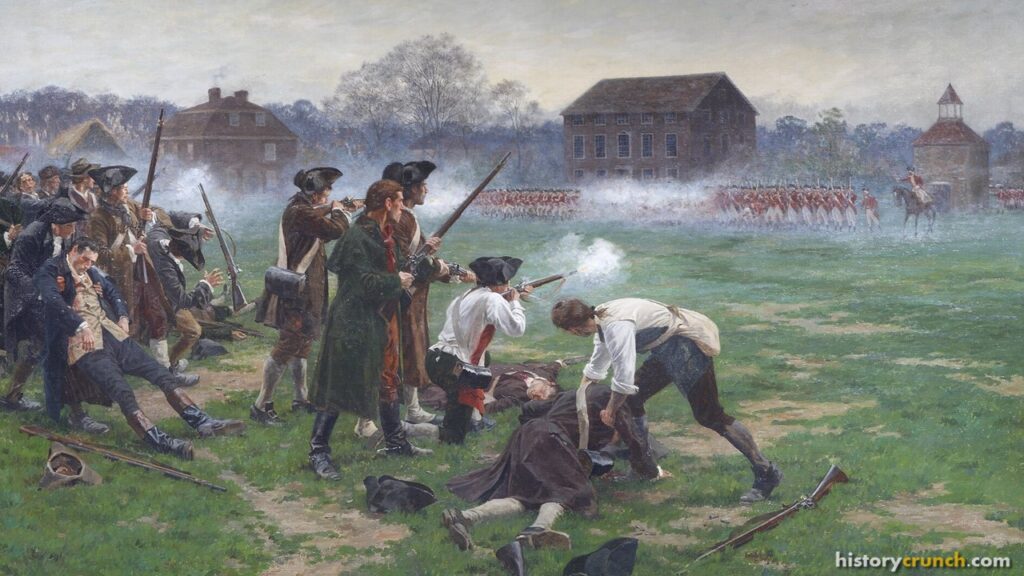
As dawn approached on April 19th, 1775, the British advance guard under Major John Pitcairn approached Lexington Green. Waiting for them were approximately 77 militiamen under Captain John Parker, a veteran of the French and Indian War who was himself suffering from tuberculosis. Parker’s force was badly outnumbered. He reportedly told his men to hold their ground but not to fire unless fired upon.
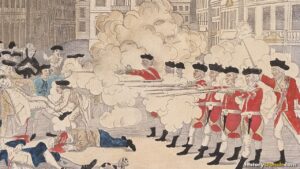
Pitcairn ordered the militiamen to disperse and lay down their arms. The situation was tense and chaotic. Then a shot rang out. No one has ever determined with certainty who fired first. Both sides blamed the other, and firsthand accounts conflict. The British soldiers fired a volley, and a brief skirmish followed. When it was over, eight militiamen lay dead on the green and ten more were wounded. One British soldier was slightly wounded. The outnumbered colonists scattered, and the British column reformed and continued its march toward Concord.
Among the American dead on Lexington Green was Jonathan Harrington, who reportedly crawled to his own front door and died at the feet of his wife. The eight men killed at Lexington were the first casualties of the Revolutionary War.
The Battle at Concord’s North Bridge
The British column reached Concord around seven in the morning. Most of the military supplies that had been stored there had already been hidden or moved by the time the soldiers arrived, thanks to the overnight warning. The British fanned out to search the town, finding and destroying what little remained, including some gun carriages and a small amount of supplies. When they set the gun carriages alight, smoke drifted over the town. Colonial militiamen watching from a ridge north of town saw the smoke and, fearing the British were burning Concord, advanced.
At Concord’s North Bridge, a force of roughly 400 militiamen confronted a smaller British covering party. The militiamen crossed the bridge and opened fire. Two British soldiers were killed and several wounded in the first volley, making this the first time colonial forces killed British soldiers in the Revolutionary War. The British covering party fell back toward the town and the main column.
Lieutenant Colonel Francis Smith, commanding the British force, recognized that the situation was deteriorating. Militiamen were arriving from towns throughout the surrounding countryside, and his soldiers were becoming vulnerable. He ordered the column to begin the march back to Boston.
The Long Retreat to Boston
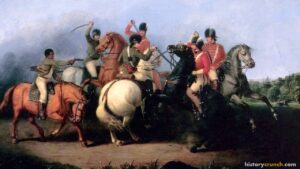
The march back to Boston became the most punishing episode of the day. The 16-mile (26-km) route was lined with stone walls, barns, trees, and farm buildings that offered cover to colonial marksmen. Militia companies from dozens of towns, having been alerted by the overnight riders and the sounds of fighting, converged on the road from all directions. They sniped at the British column from concealed positions, picking off soldiers throughout the long march.
The British column was near collapse when a relief force of roughly 1,000 soldiers under Brigadier General Hugh Percy arrived from Boston and allowed Smith’s men to regroup. Percy’s force continued the retreat under the same relentless fire. The column finally reached the safety of Charlestown, across the harbor from Boston, after sunset. The day’s fighting had cost the British 73 killed, 174 wounded, and 26 missing, for total casualties of 273. American losses were 49 killed, 41 wounded, and 5 missing, a total of 95.
Aftermath
The day after the battle, roughly 15,000 to 20,000 militia from across New England converged on the area around Boston and began what became the Siege of Boston, trapping the British garrison in the city. This force became the foundation of the Continental Army that Congress formally established in June of 1775.
News of the battles spread rapidly through the colonies and across the Atlantic. The Massachusetts Provincial Congress rushed its account of the day to London by schooner, determined to get the Patriot version of events into the British newspapers before General Gage’s official report arrived. Their account reached London on May 28, weeks before Gage’s dispatch. Public opinion in Britain was divided, with some Members of Parliament condemning the government’s handling of the colonies, while others supported a firm military response. In the colonies, the news of Lexington and Concord galvanized Patriot sentiment across all thirteen colonies and made it clear that the conflict with Britain had moved beyond politics.
Significance of the Battles of Lexington and Concord
The Battles of Lexington and Concord were the spark that started the American Revolution. They transformed a political dispute into an armed conflict and demonstrated to both sides that a real war had begun. For the Patriot cause, the battles proved something crucial: that colonial militia, despite being untrained and disorganized, could stand up to professional British soldiers and inflict significant losses on them. That knowledge, combined with the outrage generated by the deaths on Lexington Green, drove recruitment and support for the Revolutionary cause across all thirteen colonies.
The battles also set important patterns for how the war would be fought. The militia’s use of cover and concealment, firing from behind walls and trees rather than standing in open formation, became a hallmark of American tactics and proved extremely effective against a professional army trained to fight on open ground. The events of April 19th, 1775, ensured that the conflict between Britain and its American colonies would be resolved not at a negotiating table, but on a battlefield.