The Boston Massacre was a violent confrontation on the evening of March 5th, 1770, in which British soldiers fired into a crowd of colonists on King Street in Boston, Massachusetts, killing five people and wounding six others. The incident took place against a backdrop of deep tension between Boston’s civilian population and the British troops who had occupied the city since 1768. Patriots quickly seized on the killings to rally colonial opposition to British rule, and the event became one of the most powerful and widely publicized episodes in the years leading up to the American Revolution.
What Was the American Revolution?
The American Revolution was the political and military struggle through which the Thirteen Colonies broke free from British rule and established the United States of America. The conflict grew out of more than a decade of escalating disputes over taxation, self-government, and the rights of colonists as British subjects. The Boston Massacre was one of the most important flashpoints in that escalation. Though it involved only a handful of soldiers and a street crowd, the way it was publicized and remembered by Patriots transformed it into a symbol of British tyranny that helped push the colonies toward revolution. John Adams later wrote that the events of that night were more important to American independence than any battle of the Revolutionary War.
Background – British Troops in Boston
The roots of the Boston Massacre lay in the Townshend Acts of 1767, which placed import duties on goods such as glass, paint, paper, and tea and created a new customs board in Boston to enforce them. When Boston merchants organized a boycott and customs officials faced harassment attempting to do their jobs, the British government sent two regiments of regular soldiers to the city in October of 1768 to restore order and protect royal authority.
The presence of armed soldiers in a civilian city immediately created friction. Bostonians resented the occupation deeply, viewing the troops as a standing army quartered among them against their will, which they believed violated their rights as British subjects. Soldiers and townspeople clashed regularly in the streets, with soldiers subjected to constant insults, taunting, and occasional physical attacks. Off-duty soldiers competed with local workers for scarce jobs at the city’s ropewalks and other workshops, which added economic resentment to political grievance. In the days immediately before the massacre, a series of fights had broken out between soldiers and ropemakers at one of Boston’s ropewalks, and the atmosphere in the city was explosive.
On February 22nd, 1770, 11 year old Christopher Seider was killed when a customs informer fired into a crowd of boys who had been harassing him outside a loyalist merchant’s shop. Thousands of Bostonians attended Seider’s funeral, and Patriots used the boy’s death to intensify anger against the British presence.
The Events of March 5, 1770
On the evening of March 5th, Private Hugh White of the 29th Regiment stood sentry duty outside the Custom House on King Street. A young wigmaker’s apprentice named Edward Garrick began insulting a British officer passing nearby, accusing him of failing to pay a debt. White intervened, words were exchanged, and White struck Garrick on the side of the head with his musket. The boy cried out, and a crowd quickly began to gather.
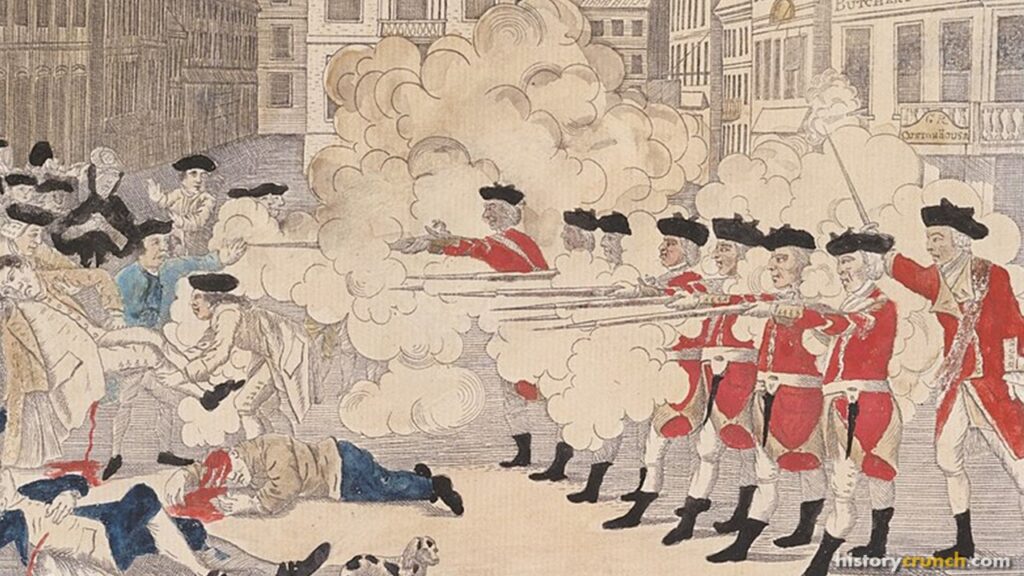
The crowd grew and became increasingly hostile, surrounding White and pelting him with snowballs, ice, and other debris while shouting insults and daring him to fire. White sent a runner for help. Captain Thomas Preston arrived with a relief party of seven soldiers, bayonets fixed. Rather than quieting the situation, the arrival of more armed soldiers drew an even larger crowd. Estimates suggest that between 300 and 400 people had gathered on King Street by the height of the confrontation. The crowd pressed close to the soldiers, throwing objects and shouting. Some witnesses later reported that colonists were daring the soldiers to fire. Someone, it has never been established who, shouted the word “fire.”
The soldiers discharged their muskets. Three men died at the scene: Crispus Attucks, Samuel Gray, and James Caldwell. Two others, Samuel Maverick and Patrick Carr, died of their wounds in the days that followed. Six more were wounded. Captain Preston had given no order to fire, and it remained disputed throughout the subsequent trial whether any order was given at all.
Crispus Attucks
The first and most remembered of the five victims was Crispus Attucks, a man of African and Native American descent who had escaped enslavement decades earlier and had been working as a sailor and laborer in Boston. Attucks became the most famous of the Boston Massacre victims almost immediately after his death, adopted by Patriots as a symbol of colonial resistance. In later generations, he was celebrated as a hero by the abolitionist movement as the first person killed in the events leading to American independence. A monument to Attucks and the other victims was erected on Boston Common in 1888.
Propaganda and Public Reaction
Patriots moved immediately to shape the public narrative of the event. Samuel Adams organized a large funeral procession for the five victims, which drew thousands of participants and turned into a powerful public demonstration. The Boston Gazette published a dramatic account of the killings along with images of four black coffins in its next edition. The description “Boston Massacre” was quickly attached to the event by Patriot writers, framing it as a deliberate slaughter of innocent civilians by a brutal occupying army.
The most influential piece of propaganda to emerge from the massacre was an engraving produced by Paul Revere, based on an illustration by Henry Pelham. The image depicted a disciplined line of British soldiers firing in unison into a helpless crowd while a commanding officer gave the order. The image was inaccurate in almost every detail of what had actually happened, but it was widely reproduced and distributed throughout the colonies and became one of the most recognizable images of the entire pre-revolutionary period. It fixed the Patriot interpretation of events in the public mind and fueled outrage far beyond Boston.
The Trial
The eight British soldiers, including Captain Preston, were arrested and put on trial for murder. In a remarkable development, John Adams, one of the most prominent Patriots in Boston and a future president of the United States, agreed to serve as the defense attorney for the soldiers. Adams believed that even the most unpopular defendants deserved a fair trial, and he recognized that demonstrating the colonies could conduct justice fairly would itself be a powerful statement against British accusations of mob rule.
Preston was tried first in October of 1770. Adams argued that Preston had never ordered the soldiers to fire, and the jury found Preston not guilty. The eight soldiers were tried separately beginning in November. Adams described the crowd as a threatening mob that had given the soldiers genuine cause to fear for their lives, and he conceded that the soldiers had fired but argued they had done so under extreme provocation in self-defense. Six of the eight soldiers were acquitted. The two who were found to have clearly fired into the crowd were convicted of manslaughter rather than murder and were sentenced to branding of the thumb, escaping the death penalty.
Patriots were outraged by the acquittals. Samuel Adams attempted to keep public anger alive through a series of newspaper articles, and beginning in 1771, Boston observed March 5th each year as Massacre Day, with annual commemorative speeches that kept the memory of the killings fresh until 1784, when the date was merged with Independence Day celebrations.
Aftermath
In the immediate aftermath of the massacre, Boston’s lieutenant governor agreed to move the British troops out of the city center to a fort in the harbor. This temporary removal of soldiers from the streets helped reduce tensions, and the partial repeal of the Townshend Acts in March of 1770 further quieted the outward conflict for a time. But the underlying anger had not been resolved, and the memory of the massacre continued to fuel Patriot sentiment throughout the following years.
The Boston Massacre demonstrated the danger of stationing armed soldiers in the middle of a civilian population already primed for conflict. It gave Patriots a concrete and emotionally powerful grievance to point to, one that made the abstract arguments about taxation and representation suddenly personal and deadly real. The killings on King Street on the night of March 5th, 1770, did not start the Revolution, but they helped create the emotional conditions in which revolution became possible.
Significance of the Boston Massacre
The Boston Massacre was one of the most important events in the years leading up to the American Revolution. It gave the Patriot movement a powerful symbol of British oppression, accelerated the radicalization of colonial opinion in Massachusetts and beyond, and demonstrated how skillfully Patriot leaders such as Samuel Adams and Paul Revere could shape public perception of events to serve the revolutionary cause.
The five men who died on King Street became the first celebrated martyrs of the American independence movement. Their deaths, and the anger those deaths generated, kept the flame of resistance alive during the quieter years that followed and helped ensure that when the next major provocation came, as it did with the Boston Tea Party in 1773, the colonies were ready to respond.