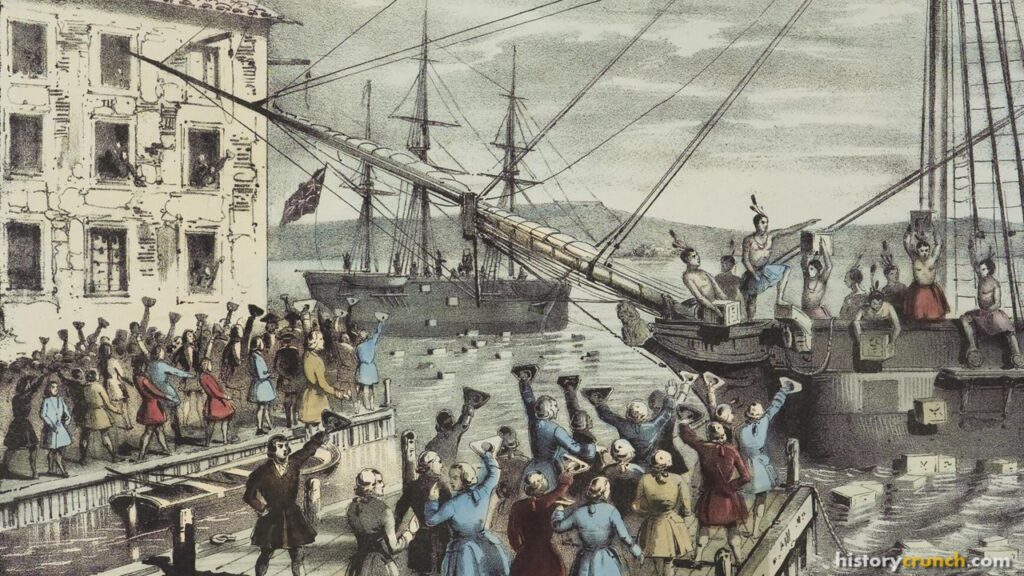
The Boston Tea Party was an act of political protest that took place on the night of December 16, 1773, when a group of American colonists boarded three British ships in Boston Harbor and dumped 342 chests of tea into the water. Organized by the Sons of Liberty and carried out under the cover of darkness, the protest was directed against the Tea Act of 1773 and the principle of taxation without representation. The destruction of tea worth an estimated £18,000 provoked a furious response from the British government that ultimately united the colonies and helped set the American Revolution in motion.
What Was the American Revolution?
The American Revolution was the political and military struggle through which the Thirteen Colonies broke free from British rule and established the United States of America. By 1773, tensions between the colonies and Britain had been building for a decade. Disputes over taxation, self-government, and colonial rights had already produced the Stamp Act crisis, the Townshend Acts, and the Boston Massacre. The Boston Tea Party was the flashpoint that made the final break inevitable. Britain’s harsh response to the tea destruction drove the colonies together in opposition, leading directly to the First Continental Congress and, within eighteen months, to armed conflict at Lexington and Concord.
Background – The Tea Act of 1773
The immediate cause of the Boston Tea Party was the Tea Act, passed by Parliament on May 10, 1773. To understand why the act provoked such anger, it helps to know what had come before. Following widespread colonial boycotts, Parliament had repealed the Townshend Acts in 1770, but kept the tax on tea in place specifically to maintain the principle that it had the right to tax the colonies. Colonists responded by continuing to boycott British tea and buying smuggled Dutch tea instead. The British East India Company, one of Britain’s most important commercial institutions, found itself with millions of pounds of surplus tea it could not sell and was facing serious financial difficulties.
The Tea Act was Parliament’s solution. It gave the East India Company a monopoly on tea sales in the colonies and allowed it to sell tea directly to colonial merchants at prices even lower than smuggled Dutch tea, even with the Townshend tax still applied. On the surface, colonists would be paying less for their tea than before. In practice, many colonists saw through the arrangement immediately. The act cut out independent colonial merchants who had previously profited from the tea trade, and it retained the tea tax, which meant accepting the principle of taxation without representation.
Colonial Resistance
When news of the Tea Act and the pending tea shipments reached the colonies in the autumn of 1773, protests broke out across all thirteen colonies. In New York, Philadelphia, and Charleston, colonists successfully pressured tea consignees to resign their appointments and forced tea ships to turn back to England without unloading. Samuel Adams and the Sons of Liberty in Boston attempted the same approach, demanding that the appointed tea agents resign and that the ships be sent back.
In Boston, however, the colonial governor Thomas Hutchinson refused to allow the ships to leave without paying their duties. Three tea ships, the Dartmouth, Eleanor, and Beaver, sat in Griffin’s Wharf under this standoff. Under colonial law, any goods that remained in port for twenty days without paying customs duties could be seized by the customs house. The deadline for the first ship, the Dartmouth, fell on December 17th, 1773. If the tea was not sent back and the deadline passed, the customs house would seize it, the duties would be paid, and the tea would enter the colony whether the colonists wanted it or not.
The Night of December 16
On the morning of December 16, 1773, thousands of colonists packed into the Old South Meeting House in Boston for a final attempt to persuade Governor Hutchinson to let the ships depart. A messenger was sent to Hutchinson’s home outside the city seeking his agreement. When the messenger returned with Hutchinson’s refusal, Samuel Adams reportedly told the crowd that he could think of nothing more that could be done to save the country. His words were taken by many in the room as a prearranged signal.
That evening, a group of between 30 and 130 men, most of them members of the Sons of Liberty, assembled near the wharf. Many disguised themselves with blankets and face paint in a loose imitation of Mohawk warriors, partly to conceal their identities and partly as a symbolic gesture rejecting British authority. They marched to Griffin’s Wharf, boarded all three ships, and set to work. Working efficiently and largely in silence over the course of about three hours, the men pried open 342 chests of tea with axes and dumped the contents into the harbor. The destroyed tea weighed roughly 92,000 pounds and was worth approximately £18,000, equivalent to roughly 1.7 million dollars in today’s money. The men made a point of damaging nothing else on the ships. When they were finished, they swept the decks clean and departed.
Despite the large number of participants and witnesses, only one man, Francis Akeley, was ever arrested and imprisoned for taking part. The identities of most participants were kept secret for years. Paul Revere rode through the night to carry news of the event to New York and Philadelphia.
Reaction in Britain
The British government’s response was swift and severe. King George III and Prime Minister Lord North were furious. Parliament passed the Coercive Acts, known in the colonies as the Intolerable Acts, in the spring of 1774. These laws closed the port of Boston until the colonists paid for the destroyed tea, stripped Massachusetts of significant elements of its self-government, allowed British officials to be tried in Britain rather than colonial courts, and required colonists to house British troops. The message from Parliament was unmistakable: the destruction of property would not be tolerated, and Massachusetts would pay a heavy price.
Even some Americans who had sympathized with the colonial cause were troubled by the destruction of private property. Benjamin Franklin, then in London, offered to pay for the tea himself out of his own funds if Britain would repeal the Tea Act. His offer was refused.
The Road to Revolution
The Intolerable Acts had precisely the opposite effect of what Britain intended. Rather than isolating Massachusetts and forcing submission, the punishing legislation alarmed colonists across all thirteen colonies who recognized that if Parliament could strip Massachusetts of its self-government, it could do the same to any colony. Food, money, and supplies poured into Boston from other colonies in solidarity. In September of 1774, twelve colonies sent delegates to the First Continental Congress in Philadelphia to coordinate a response. Within eighteen months of the Boston Tea Party, fighting had broken out at Lexington and Concord and the Revolutionary War had begun.
Significance of the Boston Tea Party
The Boston Tea Party was one of the most important acts of civil disobedience in American history. It demonstrated that colonists were willing to take direct and dramatic action against British authority, destroying valuable private property rather than accepting a law they considered unjust. It forced both sides into positions from which they could not easily retreat. The British government could not ignore the destruction without appearing weak, and the harsh response it chose made moderate reconciliation increasingly impossible.
The event has remained one of the most powerful symbols in American political culture. Its legacy stretches forward through American history as a reminder that the country was founded in part on the willingness of ordinary people to take extraordinary risks in defense of the principle that government derives its authority from the consent of the governed.