The legacy of Ancient Rome is one of the most far-reaching in all of human history. Even though the Western Roman Empire fell in 476 CE, the influence of Roman civilization never disappeared. It lived on in the languages people spoke, the laws that governed them, the buildings they built, the religions they practiced, and the way they organized their governments. Much of what we consider the foundation of Western civilization, from European legal systems and democratic government to the Latin alphabet and the spread of Christianity, traces directly back to Rome. Understanding the legacy of Ancient Rome helps explain why so much of the modern world looks and functions the way it does.
WHAT WAS ANCIENT ROME?
Ancient Rome was one of the most powerful civilizations in world history. It began as a small city-state on the Italian peninsula and grew over many centuries into a vast empire that stretched from Britain in the northwest to Egypt in the southeast. At its height, the Roman Empire controlled much of Europe, North Africa, and parts of the Middle East, governing an estimated 70 million people. Roman civilization is remembered for its contributions to law, government, architecture, language, and culture. The legacy it left behind has shaped the history of the world in ways that continue to be felt every day.
LEGACY OF ANCIENT ROME – LANGUAGE
One of the most far-reaching legacies of Rome is the Latin language. Latin was the official language of the Roman Empire and was spread across Europe, North Africa, and the Near East through centuries of Roman administration, trade, and military presence. Over time, Latin evolved differently in different regions, eventually producing the Romance languages: Italian, French, Spanish, Portuguese, and Romanian. These five languages are spoken today by roughly one billion people around the world as their first language.
Even in languages that did not descend directly from Latin, the Roman influence is enormous. English, which is a Germanic language, contains an enormous proportion of Latin-derived vocabulary, particularly in formal, scientific, legal, and academic writing. Words like “republic,” “senate,” “census,” “justice,” “military,” and “emperor” all come directly from Latin. Scientific naming systems, medical terminology, and legal phrases used across the world are predominantly Latin. Whenever a doctor writes a prescription or a scientist names a species, they are working in a tradition that traces directly back to Rome.
LEGACY OF ANCIENT ROME – LAW AND GOVERNMENT
Roman law is one of the most significant contributions Rome made to the modern world. The Romans developed over many centuries a sophisticated legal system built on written codes, precedent, the principle of innocent until proven guilty, and the concept that laws should apply equally to all citizens. The greatest codification of Roman law was the Corpus Juris Civilis, compiled under the Eastern Emperor Justinian in the sixth century CE, which gathered centuries of Roman legal thinking into a systematic whole.
This body of law became the foundation on which the legal systems of most of continental Europe were built during the medieval and early modern periods. The legal codes of France, Italy, Spain, Germany, and most of Latin America are rooted in Roman law. The very concept of having written, codified laws that apply consistently to all people, rather than decisions made by rulers on a case-by-case basis, is a Roman inheritance.
Roman ideas about government also had an enormous influence on the modern world. The Roman Republic, with its elected officials, representative Senate, checks and balances between branches of government, and concept of citizenship, served as a direct model for the founders of the United States and France when they designed their new governments in the late eighteenth century. The words “republic,” “senate,” and “constitution” all come from the Roman political tradition. The architecture of the United States Capitol Building in Washington, D.C., is modeled explicitly on Roman public buildings, a visual statement of the connection between American democracy and its Roman predecessors.
LEGACY OF ANCIENT ROME – ARCHITECTURE AND ENGINEERING
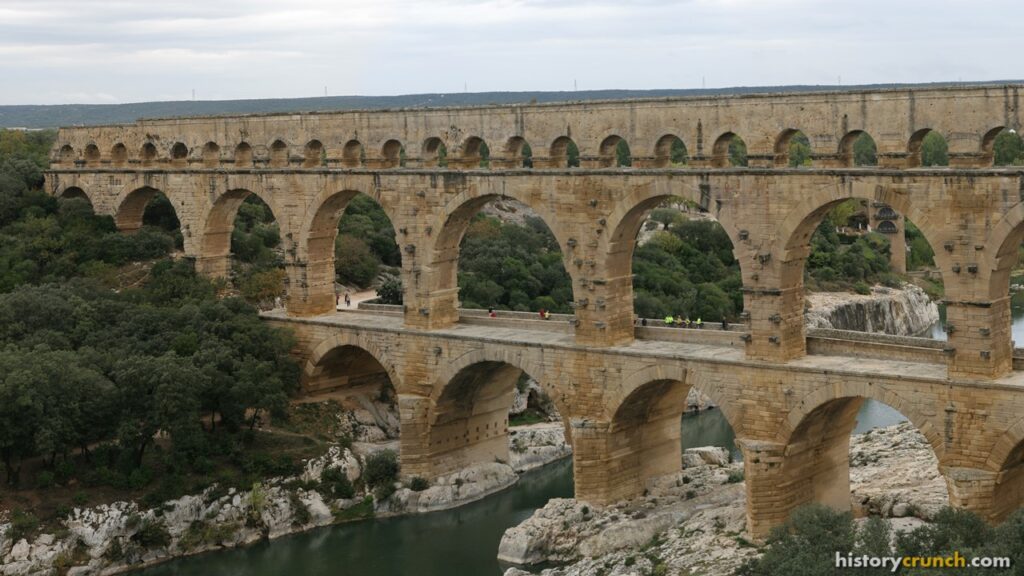
Roman architecture and engineering left a mark on the physical landscape of Europe that is still visible to this day. Roman roads, built in a layered structure of gravel, sand, and stone paving, defined many of the major routes across Europe that are still used by modern highways. Roman bridges, some of which are still in use, crossed rivers throughout Europe. Roman aqueducts, several of which still stand in France, Spain, and Turkey, demonstrated a mastery of hydraulic engineering that was not matched again until the modern era.
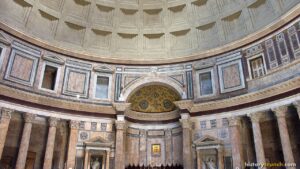
Roman architectural forms have been copied and adapted throughout Western history. The arch, the dome, and the vault, developed and perfected by Roman engineers, became the basic vocabulary of European architecture for over a thousand years. Medieval cathedrals, Renaissance palaces, Baroque churches, and neoclassical government buildings all drew directly on Roman architectural traditions. The dome of the Pantheon in Rome, completed around 125 CE, directly inspired the dome of Brunelleschi’s Florence Cathedral in the fifteenth century, Christopher Wren’s St. Paul’s Cathedral in London, and the dome of the United States Capitol.
In engineering, Roman innovations in concrete, described in detail in other articles in this series, produced materials and techniques that are still being studied for their durability and sustainability. Roman underfloor heating systems, public sanitation infrastructure, and urban planning principles all influenced later European societies.
LEGACY OF ANCIENT ROME – RELIGION
Christianity, the religion that shaped Western civilization for the past two thousand years, spread through the Roman Empire and owes much of its early growth to Roman infrastructure and communications networks. The Roman roads and sea routes that allowed soldiers and merchants to move quickly across the empire also allowed missionaries to carry the new faith from Jerusalem to Rome, North Africa, and eventually the whole of Europe.
The Roman Empire’s eventual adoption of Christianity as its official religion under Emperor Theodosius in 380 CE gave the religion a political and institutional framework that enabled it to survive the fall of the Western Empire and spread further. The Roman Catholic Church, whose headquarters remain in Rome to this day, inherited much of the organizational structure of the Roman Empire, with its hierarchy of bishops corresponding to Roman provincial governors and the Pope in Rome claiming authority over the whole Church just as the emperor had claimed authority over the whole empire. Latin remained the official language of the Catholic Church for over fifteen centuries, another direct Roman inheritance.
LEGACY OF ANCIENT ROME – CULTURE AND IDEAS
Rome transmitted to later ages not just its own cultural achievements but also the knowledge and culture of ancient Greece, which Rome had absorbed and preserved. Greek philosophy, literature, mathematics, and science survived into the medieval and Renaissance periods largely through Latin translations and Roman-era copies. When Renaissance scholars in Italy in the fourteenth and fifteenth centuries set out to revive classical learning, it was primarily through Roman texts and Roman ruins that they reconnected with the ancient world.
The Roman calendar, reformed by Julius Caesar in 45 BCE as the Julian calendar, was used throughout Europe and the Christian world for over 1,600 years before being adjusted into the Gregorian calendar still in use today. The names of the months in English, July and August, come from Julius Caesar and Augustus respectively. The names of the planets in our solar system, Mercury, Venus, Mars, Jupiter, and Saturn among them, are all names of Roman gods.
Roman literature shaped the European literary tradition profoundly. Virgil’s Aeneid, Ovid’s Metamorphoses, Cicero’s speeches and philosophical writings, and the histories of Livy and Tacitus were core texts in European education for centuries and remain important works of world literature today.
SIGNIFICANCE OF THE LEGACY OF ANCIENT ROME
The legacy of Ancient Rome is not a matter of distant historical curiosity. It is woven into the fabric of daily life across much of the world. Every time someone uses a Romance language, reads a legal document, votes in a democratic election, walks across a Roman bridge, enters a domed building, practices Christianity, or looks up at the night sky and names a planet, they are in some way connected to the civilization that Rome built.
Rome was not a perfect civilization. It was built on slavery, maintained through military conquest, and governed often by deeply flawed individuals. Its history contains episodes of terrible violence and injustice. But its contributions to human civilization, in law, language, government, architecture, engineering, and religion, were so fundamental and so enduring that it is impossible to understand the modern world without understanding Ancient Rome. That is the true measure of its legacy.