The Declaration of Independence was a document adopted by the Second Continental Congress on July 4th, 1776, that formally announced the separation of the thirteen American colonies from Great Britain. Written primarily by Thomas Jefferson and edited by a committee of five delegates, the Declaration did far more than announce independence. It set out a philosophical argument for why people have the right to overthrow a government that violates their natural rights, listed specific grievances against King George III to justify the colonies’ decision, and proclaimed a set of universal truths about human equality and freedom that have influenced political thought around the world ever since.
What Was the American Revolution?
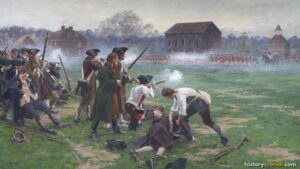
The American Revolution was the political and military struggle through which the Thirteen Colonies broke free from British rule and established the United States of America. Open fighting had been underway since April of 1775, but for more than a year after the first shots at Lexington and Concord, most delegates to the Continental Congress still hoped for some form of reconciliation with Britain. By the summer of 1776, that hope had almost entirely faded. The Declaration of Independence was the moment the colonies made their break official and irreversible, committing themselves to a course from which there was no turning back.
Background – The Road to Independence
Several developments in late 1775 and early 1776 pushed the Congress decisively toward independence. In August of 1775, King George III had declared the colonies to be in open rebellion, effectively closing the door on negotiation. In December of 1775, Parliament passed the Prohibitory Act, which declared American ships and goods forfeit to the Crown and was widely seen as an act of war against the colonies. In January of 1776, Thomas Paine published Common Sense, a pamphlet arguing directly and plainly that independence from Britain was not just justified but necessary. The pamphlet sold hundreds of thousands of copies and shifted public opinion across the colonies more quickly than almost any previous publication.
By the spring of 1776, several colonial assemblies had instructed their delegates in Congress to support independence. Virginia led the way when its convention formally instructed its delegates to propose independence in May of 1776.
The Lee Resolution and the Committee of Five
On June 7th, 1776, Virginia delegate Richard Henry Lee stood before the Continental Congress and introduced a resolution stating that the colonies “are, and of right ought to be, free and independent States.” John Adams of Massachusetts seconded the motion. Some delegates were not yet ready to vote, and Congress postponed the matter for three weeks to give the more hesitant colonies time to receive new instructions from home. Before recessing, however, Congress appointed a Committee of Five on June 11 to draft a formal declaration of independence in preparation for what now seemed inevitable.
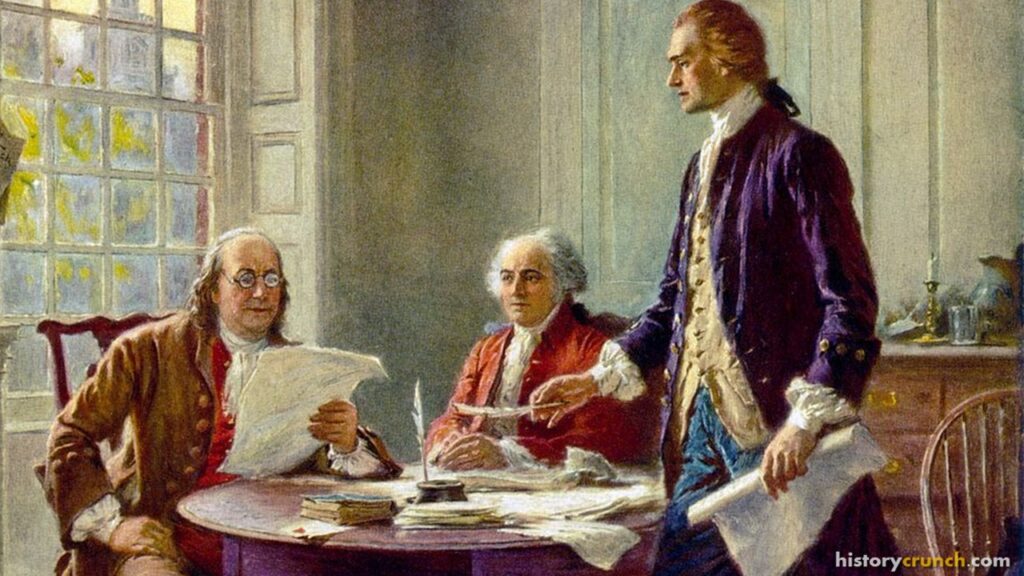
The five men chosen were Thomas Jefferson of Virginia, John Adams of Massachusetts, Benjamin Franklin of Pennsylvania, Roger Sherman of Connecticut, and Robert R. Livingston of New York. Adams pushed for Jefferson to write the first draft, partly because Jefferson was from Virginia, the largest colony, and partly because Adams recognized his exceptional skill as a writer. Jefferson later said he was simply trying to express what was already in the minds of most Americans, drawing on ideas from Enlightenment thinkers such as John Locke, as well as from the Virginia Declaration of Rights, written by George Mason just weeks earlier.
Jefferson wrote the draft largely in isolation over seventeen days, working from his rented rooms at 700 Market Street in Philadelphia. Franklin and Adams suggested some changes, and the committee presented the revised draft to Congress on June 28th, 1776.
The Vote and the Revisions
On July 1st, 1776, Congress began debating the Lee Resolution in earnest. Nine colonies voted in favor, two opposed, one was divided, and one abstained. Overnight, the Pennsylvania and South Carolina delegations changed their votes. Delaware’s divided delegation was resolved when Caesar Rodney rode through the night to arrive and cast the deciding vote in favor. New York abstained, waiting for new instructions from home. On July 2nd, 1776, Congress voted to adopt the Lee Resolution. John Adams wrote to his wife Abigail that July 2nd would be celebrated forever as the great anniversary of American independence. He was wrong only about the date.
Congress then spent July 3rd and most of July 4th debating and revising Jefferson’s draft. Delegates made approximately 86 changes to the text, cutting roughly one quarter of Jefferson’s original draft. Jefferson was unhappy with the revisions, particularly the removal of a passage blaming King George III for the Atlantic Slave Trade, which had been struck out to avoid offending delegates from South Carolina and Georgia. On the afternoon of July 4th, 1776, Congress formally adopted the revised Declaration of Independence. New York added its approval on July 19th, making the vote unanimous across all thirteen colonies.
The Declaration was first printed on the night of July 4th by Philadelphia printer John Dunlap and distributed as a broadside. It was read publicly in Philadelphia on July 8th, and word spread rapidly through the colonies. The formal engrossed copy on parchment was signed by most delegates on August 2nd, 1776. In all, 56 delegates signed the document. John Hancock, as president of the Congress, signed first with a notably large and bold signature. The other delegates signed by state, from New Hampshire in the upper right to Georgia at the lower left.
Main Parts of the Declaration of Independence
The Declaration of Independence is organized into four main parts.
The preamble opens the document by explaining its purpose: to declare to the world why the colonies were taking the step of independence.
The philosophical statement, which contains the most famous language in the document, sets out the core principles on which the Declaration rests. It declares that all men are created equal, that they are endowed with certain rights that cannot be taken away, including life, liberty, and the pursuit of happiness, and that governments exist to protect those rights. When a government fails to do so, the people have the right to change or abolish it and to establish a new one. These ideas drew directly on the writing of John Locke and the broader tradition of Enlightenment political philosophy.
The list of grievances forms the longest section of the document. It lists 27 specific charges against King George III, including imposing taxes without consent, dissolving colonial legislatures, blocking colonial laws, keeping standing armies in peacetime, cutting off colonial trade, and waging war against the colonies. By addressing these charges against the king personally rather than Parliament, the Declaration made a precise legal argument: the king had broken the social contract that bound him to his subjects, and the colonies were therefore justified in dissolving their allegiance to him.
The conclusion formally declares the colonies to be free and independent states, absolved of all allegiance to the British Crown, with full power to make war, conclude peace, and conduct foreign affairs as independent nations.
Reaction to the Declaration
In the colonies, the Declaration was celebrated with bonfires, ringing church bells, and public readings in towns and cities across all thirteen states. When it was read aloud in New York City on July 9th, crowds tore down a large statue of King George III and melted it down for musket balls. In Britain, the government dismissed the document as the product of disgruntled radicals and commissioned pamphlets to rebut its claims. Many in Parliament were more sobered, recognizing that the Declaration was a clear signal the colonies would not negotiate a return to the empire.
The Declaration also had important diplomatic effects. By formally declaring themselves an independent nation, the colonies made it possible for France to recognize them and enter into an alliance. France had been unwilling to commit to a formal alliance with a group of rebellious subjects, but could do so with a declared nation. The Declaration cleared the path for the diplomatic efforts that eventually produced the French alliance of 1778.
Significance of the Declaration of Independence
The Declaration of Independence was one of the most important political documents in human history. Its opening philosophical principles, particularly the claim that all men are created equal and possess certain rights that no government can take away, went far beyond the immediate dispute with Britain. They proclaimed a set of ideas about the relationship between governments and the people they govern that has shaped democratic thought and political movements around the world for nearly 250 years.
The document was not without its contradictions. The man who wrote that all men are created equal himself enslaved more than 600 people over the course of his life. The Declaration’s promises of liberty and equality were not extended to enslaved people, women, or Native Americans at the time of its writing. Future generations of Americans, from abolitionists to suffragists to civil rights leaders, drew on the Declaration’s language to hold the country accountable to principles it had proclaimed but not yet honored. In this way the Declaration has functioned not just as a founding document but as an ongoing challenge, a standard against which the nation has measured and argued about itself across the centuries.