Daily life in Ancient Rome was shaped by a person’s social class, wealth, and whether they lived in a city or the countryside. Rome was a society of enormous contrasts, where wealthy patricians lived in spacious homes attended by slaves while the majority of ordinary people squeezed into crowded apartment blocks and worked long, hard days to make ends meet. Despite these differences, certain features of daily life, including religion, public baths, food, and entertainment, touched Romans at every level of society and helped bind the empire together.
WHAT WAS ANCIENT ROME?
Ancient Rome was one of the most powerful civilizations in world history. It began as a small city-state on the Italian peninsula and grew over many centuries into a vast empire that stretched from Britain in the northwest to Egypt in the southeast. At its height, the Roman Empire controlled much of Europe, North Africa, and parts of the Middle East. Roman civilization is remembered for its contributions to law, government, architecture, language, and culture. Understanding how ordinary Romans lived from day to day is an important part of understanding how this civilization actually functioned and what made it last as long as it did.
DAILY LIFE IN ANCIENT ROME – HOUSING
Housing in Ancient Rome varied greatly depending on wealth and social class. Wealthy Romans lived in large private homes called domus, which were typically built around a central open courtyard called the atrium. The atrium served as the main reception area and was often decorated with mosaics, statues, and a shallow pool to collect rainwater. Wealthier families had additional rooms surrounding the atrium, including a formal dining room called the triclinium, private bedrooms, and gardens at the rear. Some very wealthy Romans also owned large country estates called villas, where they retreated from the heat and noise of the city.
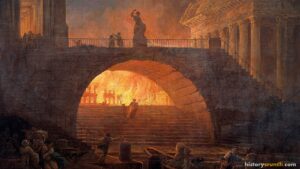
The majority of Romans who lived in cities, however, did not have private homes. They lived in multi-story apartment buildings called insulae, which means islands in Latin. Insulae ranged from two to six or more stories tall and were typically poorly built, noisy, and crowded. The poorest families lived on the upper floors, which were cheaper to rent but more dangerous in a fire and harder to reach by water carriers. Most insulae had no running water or private toilets. Residents carried water up from public fountains and used public latrines, which were communal toilet facilities shared by many people. Fires were a constant danger, since residents used open flames for cooking and heating. The city of Rome experienced several catastrophic fires, including the Great Fire of 64 CE during the reign of Emperor Nero, which destroyed large areas of the city.
DAILY LIFE IN ANCIENT ROME – FOOD AND MEALS
Romans typically ate three meals a day. The first meal, called the ientaculum, was a light breakfast eaten shortly after sunrise. It usually consisted of bread, olives, cheese, and sometimes fruit. The second meal, the prandium, was a simple midday meal of bread, cold meats, vegetables, or leftovers from the previous evening.
The main meal of the day was the cena, eaten in the late afternoon. For poor Romans, the cena was a simple affair of bread, beans, lentils, porridge, and occasionally a small amount of fish or pork. Many poor urban Romans did not have kitchens in their apartments and instead bought ready-made food from shops and food stalls called thermopolia, which lined the streets of Roman cities. Thermopolia were essentially small fast-food counters with ceramic containers set into stone counters, keeping food warm for customers.
For wealthy Romans, the cena was a very different experience. Dinner parties were major social events that could last for hours, with multiple courses served by enslaved attendants. Wealthy Romans reclined on couches to eat, propped on cushions with small tables beside them. They ate with their fingers, rinsing their hands frequently between courses. Wealthy dinner menus could include shellfish, roasted meats, exotic game, pastries, and fine wines from across the empire. Wine was the main drink for Romans at every level of society, though it was almost always diluted with water before drinking.
DAILY LIFE IN ANCIENT ROME – CLOTHING
Clothing in Ancient Rome served as a clear signal of a person’s social status. The most recognizable item of Roman dress was the toga, a large piece of wool fabric that was draped around the body in a specific way. Only freeborn male Roman citizens were allowed to wear the toga, and its color and markings indicated rank. Ordinary citizens wore plain white togas. A toga with a purple border indicated a senator or senior magistrate. The emperor himself wore an entirely purple toga, since purple dye was extraordinarily expensive and was reserved as a symbol of imperial power.
In practice, togas were uncomfortable and difficult to wear, and many Romans preferred simpler clothing for everyday life. Both men and women commonly wore a tunic, a simple garment sewn from two pieces of cloth and worn belted at the waist. Women also wore a longer outer garment called a stola and a draped shawl called a palla over the top. Poor men typically wore a simple tunic and a rough cloak in cold weather. Shoes ranged from simple sandals worn by the poor to leather boots worn by wealthier Romans outdoors. Enslaved people wore simple undecorated clothing made from rough wool.
DAILY LIFE IN ANCIENT ROME – THE FAMILY
The Roman family was organized around the authority of the paterfamilias, the male head of the household. The paterfamilias held legal power over every member of his household, including his wife, children, and enslaved workers. He made major decisions about marriages, property, and finances. Roman mothers, particularly in wealthier families, managed the practical running of the household and played an active role in raising children and overseeing enslaved domestic workers.
Children were highly valued in Roman society. Wealthy families hired private tutors for their children’s education, while boys from middle-class families attended fee-paying schools. Children from poor families typically did not receive formal schooling and instead learned practical skills from their parents. Boys from all classes were expected to eventually take on work or military service, while girls were prepared for their roles as wives and mothers. Romans marked childhood milestones with religious ceremonies, and children wore a protective pendant called a bulla around their neck from birth until the age at which they were considered adults.
DAILY LIFE IN ANCIENT ROME – PUBLIC BATHS
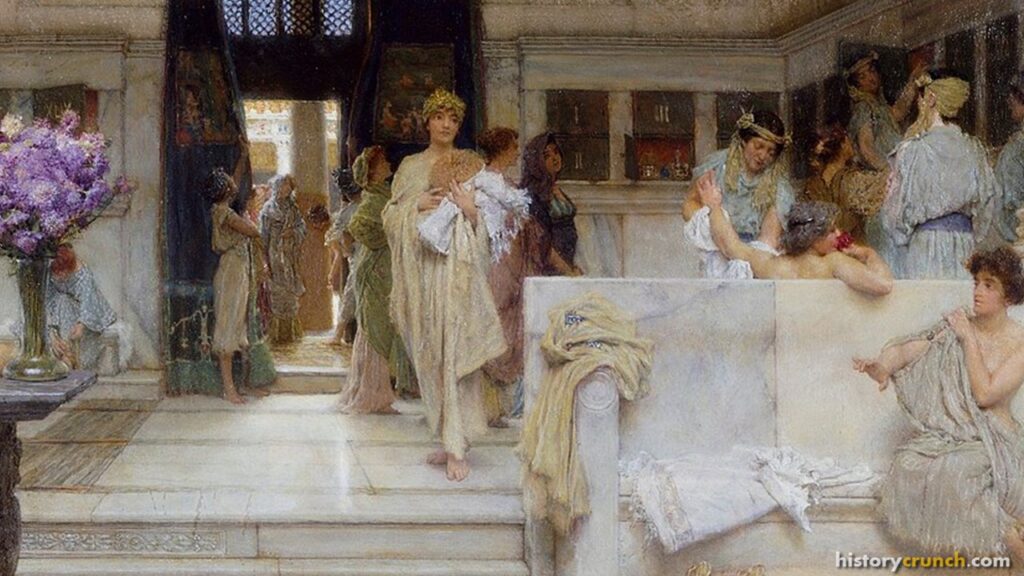
One of the most distinctive features of Roman daily life was the public bath, known as the thermae. Public baths were found in almost every Roman city and town across the empire and were much more than places to wash. They were community centers where Romans of different classes could socialize, exercise, conduct business, and relax. Entry fees were low, and some baths were free on public holidays or by imperial decree, making them accessible to people of nearly every economic level.
A typical visit to the baths followed a set sequence. Bathers moved from a changing room to a warm room called the tepidarium, then to a hot room called the caldarium, and finally to a cold plunge pool called the frigidarium. Many bath complexes also included exercise areas, libraries, gardens, shops, and spaces for socializing. The city of Rome itself had hundreds of smaller bath houses, as well as enormous imperial complexes. The Baths of Caracalla, completed around 217 CE, could accommodate around 1,600 bathers at a time in a complex covering a huge area decorated with marble, mosaics, and sculptures.
DAILY LIFE IN ANCIENT ROME – ENTERTAINMENT AND LEISURE
Romans enjoyed a wide range of entertainment, and the Roman state invested heavily in providing public spectacles that kept the population entertained. The most famous form of entertainment was gladiatorial combat, held in large amphitheaters. The Colosseum in Rome, completed in 80 CE, could hold up to 80,000 spectators who watched gladiatorial contests, animal hunts, and other spectacles, often for free thanks to imperial sponsorship.
Chariot racing was equally popular and drew enormous crowds to the Circus Maximus, which could hold an estimated 150,000 to 250,000 spectators. Fans were passionately loyal to one of four racing teams, identified by their colors, the Blues, Greens, Reds, and Whites. Theater performances were also popular, though they were generally seen as less prestigious than the arena events. Across the empire, Romans also enjoyed dice games, board games, and betting on the outcomes of races and gladiatorial contests. Hunting was a popular leisure activity for wealthy Romans with country estates. For most ordinary Romans, daily socializing at the baths, the forum, and neighborhood taverns called popinae provided the main opportunities for relaxation.
SIGNIFICANCE OF DAILY LIFE IN ANCIENT ROME
Daily life in Ancient Rome reveals the complexity and the contradictions of one of history’s greatest civilizations. Rome was a society capable of building remarkable public infrastructure, including baths, aqueducts, and roads, that improved the lives of millions of people across the empire. At the same time, it was a society in which a large proportion of the population lived in poverty, hundreds of thousands of people were held in slavery, and daily life was shaped almost entirely by the accident of the family and class a person was born into. Understanding how Romans actually lived, what they ate, where they slept, how they dressed, and how they spent their time, brings the ancient world to life in a way that no account of emperors and battles alone ever fully can.