The Domesday Book was a comprehensive written survey of England commissioned by King William the Conqueror and completed in 1086. It recorded details about land ownership, the value of land, livestock, and the people who lived and worked across the kingdom. The survey covered more than 13,000 settlements in England and parts of Wales, making it the most detailed record of a medieval society ever produced. It was written in Medieval Latin by royal commissioners who traveled across the country collecting information from local courts. The Domesday Book was created primarily to help William understand the wealth of his kingdom and to establish a firm basis for taxation and the enforcement of feudal obligations. Today it is considered the oldest surviving public record in England and remains one of the most important historical documents in the history of the British Isles.
What Was the Middle Ages?
The Middle Ages was a period in European history lasting roughly from the fall of the Western Roman Empire in the 5th century to the beginning of the Renaissance in the 15th century. It was a time of feudal government, powerful kings and nobles, the dominance of the Catholic Church, and frequent conflict over land and power. The Domesday Book was produced at an important moment in medieval English history, just twenty years after the Norman Conquest of 1066, when William the Conqueror was working to consolidate his control over his new kingdom. In fact, it stands as one of the clearest expressions of the power and ambition of the Norman monarchy in the Middle Ages.
Domesday Book – Background and William’s Reasons
William the Conqueror ordered the Domesday survey in December of 1085, at a time when England was facing both internal instability and external threats. There was growing pressure from King Canute IV of Denmark, who was planning an invasion of England, and William needed money urgently to pay for soldiers and defenses. He also needed a clearer picture of who owned what land in his kingdom, since the Norman Conquest of 1066 had involved the widespread confiscation and redistribution of estates from Anglo-Saxon nobles to Norman lords, creating a great deal of confusion and dispute over property rights.
Historians have identified several main reasons why William commissioned the survey. First, he wanted to know how much tax he could raise from his kingdom and whether the existing system of taxation was capturing the full value of England’s wealth. Second, he wanted to know exactly who owned which land, so that he could resolve disputes and ensure that his Norman lords were paying the obligations they owed him. Third, by documenting all landholdings in a single authoritative record, William created a powerful political tool. In fact, as one historian has noted, the Domesday Book gave the king a weapon with which he could threaten any single rebellious lord, since in an instant he could order the confiscation of everything that lord was recorded as holding in the book.
Domesday Book – How the Survey Was Conducted
The survey was organized with remarkable efficiency. William divided England into seven circuits, or regions, and appointed royal commissioners to each one. These commissioners traveled through their assigned circuit and convened local courts in each county. At these courts, they put a fixed set of questions to a jury made up of local people including both Norman lords and English villagers. The questions covered what each settlement was called, who owned it, how many people lived there, how much land it contained, how many animals it had, what it was worth, and what it had been worth in the time of King Edward the Confessor before the Conquest.
For each property, the questions were asked at three points in time. What was the situation in the reign of Edward the Confessor before 1066? Who did William give the land to after the Conquest? And what was the situation at the time of the survey in 1086? This approach allowed the king to see at a glance how land ownership had changed as a result of the Norman Conquest and to identify cases where Norman lords were not fulfilling their obligations or had seized land without proper authority.
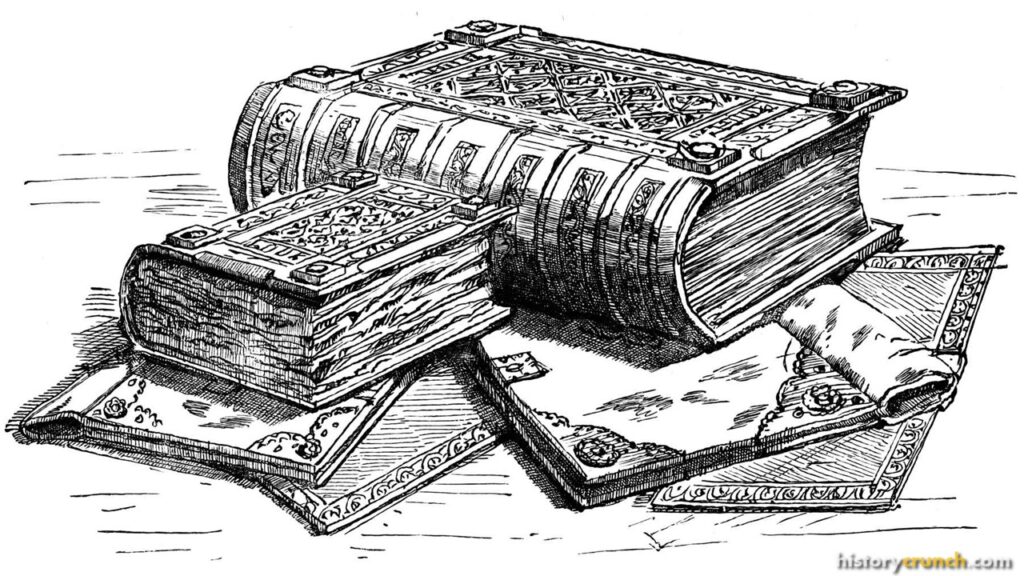
The survey was completed with extraordinary speed. The entire exercise took less than a year. This was a remarkable logistical achievement given the size of England, the primitive state of communication, and the enormous volume of information involved. The results were compiled into two volumes. The larger volume, known as Great Domesday, covered most of England. The smaller volume, known as Little Domesday, covered the counties of Essex, Norfolk, and Suffolk in greater detail. Little Domesday was never reduced to the condensed format of the larger volume, possibly because William died unexpectedly in September of 1087 before the work could be completed.
Domesday Book – What It Recorded
The Domesday Book recorded an enormous range of information about English society in the 11th century. At its heart it was a survey of land and the people who worked it. For each settlement it recorded the name of the lord who held it, the name of the person who had held it before the Conquest, the amount of arable land, the number of plough teams working the land, the number of villagers, smallholders, and slaves living there, the number and type of animals, the presence of any mills, churches, fisheries, or woodland, and the monetary value of the estate both before and at the time of the survey.
The information reveals a great deal about life in medieval England. For instance, the survey shows that by 1086 most of the land that had been owned by approximately 2,000 Anglo-Saxon landholders before the Conquest was now concentrated in the hands of around 200 Norman barons. This dramatic shift in land ownership illustrates just how completely the Norman Conquest had transformed the English ruling class in less than a generation. The survey also records the presence of slaves in significant numbers, and it provides detailed information about the condition of the English peasantry under the feudal system.
Some notable places were not included in the survey. London and Winchester were among the most important omissions, possibly because records of these cities were lost, though the exact reasons are not fully understood. Parts of northern England including Northumberland, Durham, and Cumbria were also excluded because they were not yet fully under Norman control.
Domesday Book – The Name
The name Domesday Book was not used until the 12th century, approximately 100 years after the survey was completed. The original name for the document was the Book of Winchester, since it was stored in the royal treasury at Winchester. The name Domesday, which is a medieval spelling of Doomsday, was adopted because the book’s judgments about land ownership and value were considered final and without appeal, just as the Last Judgment described in the Bible was final and without appeal. As a contemporary observer noted, there was no single piece of land, no ox, no cow, and no pig that was left out of the record, which gave it the all-encompassing character of a final accounting. The name stuck and has been used ever since.
Domesday Book – Significance
The significance of the Domesday Book in the history of England and the Middle Ages is considerable. For William the Conqueror, it was an extraordinarily powerful tool for asserting and maintaining royal authority. By creating a definitive written record of who owned what land and on what terms, he gave himself an instrument for settling disputes, enforcing feudal obligations, and raising taxation that no previous English king had possessed. As stated above, it also helped him secure the personal loyalty of his barons by requiring all significant landholders to swear a new oath of allegiance at Salisbury in August of 1086 after the survey was complete.
For historians, the Domesday Book is an invaluable source of information about life in medieval England. It provides a detailed picture of the economy, the structure of landownership, the size and distribution of the population, and the condition of the peasantry at a specific moment in time, a kind of snapshot of an entire society that has no equivalent in medieval European history. In fact, no survey approaching its scope was attempted again in England until 1873, nearly 800 years later.
Furthermore, the Domesday Book stands as evidence of the remarkable administrative capacity of the Norman monarchy. The ability to organize and complete such a comprehensive national survey within a single year, using teams of commissioners working across the entire country, reflected a level of governmental organization that was unusual for its time. As such, the Domesday Book stands as one of the most important and extraordinary documents in the history of the Middle Ages and of the British Isles, a record that continues to be studied and valued by historians to the present day.