Social classes in the Middle Ages were a central feature of medieval European society. During the medieval period, European society was organized into a rigid hierarchy in which a person’s social class determined almost every aspect of their life, including their work, their legal rights and their relationship with the Church. This social hierarchy was closely connected to the feudal system, which was the dominant form of social and political organization in Europe throughout the Middle Ages. In general, social classes in the Middle Ages were divided into three main groups, known as the three estates, including: the clergy, the nobility and the peasants.
What Were the Middle Ages?
The Middle Ages, also known as the Medieval Period, refers to the period of European history that stretched from the 5th century to the 15th century. More specifically, historians generally place the beginning of the Middle Ages at 476 CE, with the fall of the Western Roman Empire, and its end at approximately 1500 CE, with the start of the Renaissance. Due to its length, the Middle Ages is divided into three smaller periods, including: the Early Middle Ages, the High Middle Ages and the Late Middle Ages. Social classes in the Middle Ages were a defining feature of medieval European society throughout all three of these periods, though the social structure of the medieval world did change and evolve over time, particularly toward the end of the Middle Ages.
The Three Estates
Medieval European society was traditionally divided into three broad social groups known as the three estates. The first estate was the clergy, which included all members of the Catholic Church, from parish priests and monks to bishops, cardinals and the Pope. The second estate was the nobility, which included kings, lords, knights and other members of the ruling class who held land and political power. The third estate was the peasants, who made up the vast majority of the population and worked the land under the feudal system.
It is important to note that the three estates system was not a simple or uniform arrangement across all of Europe. For instance, England developed a two-estate system that combined the nobility and clergy into a single lordly estate, with commoners as the second estate, which eventually produced the two houses of parliament known as the House of Lords and the House of Commons. As well, the three estates were not formally theorized until the 11th and 12th centuries, when thinkers began to argue that human society was naturally divided into those who pray, those who fight and those who labour. With that said, the three estates framework is the most commonly used model for understanding social class in the Middle Ages and provides a useful way of thinking about the social structure of medieval European society.
Each of the three estates had its own distinct legal status, rights and obligations within medieval society. For instance, different laws applied to different estates, and a nobleman or cleric could not be sentenced by an ordinary court in the way that a peasant could. A person was generally born into their estate and remained there for the rest of their life, as social mobility was uncommon and difficult throughout the Middle Ages. As such, the social class system of the Middle Ages was deeply unequal and placed enormous restrictions on the lives and opportunities of the majority of people.
First Estate – Clergy
The first estate in medieval European society was the clergy, which included all members of the Catholic Church. The clergy occupied a unique and privileged position in the social hierarchy of the Middle Ages because they were seen as the intermediaries between God and ordinary people. As such, the clergy were exempt from many of the taxes and legal obligations that applied to other members of society and were subject to the authority of the Church rather than the secular law of the land.
The clergy itself was divided into two main groups. The regular clergy were monks and nuns who lived in monasteries and convents and followed a strict religious rule of life. The secular clergy were priests, bishops and other Church officials who lived and worked among the general population. Within both groups there was a clear hierarchy, ranging from the Pope at the top to ordinary parish priests and monks at the bottom. For instance, bishops and cardinals held enormous wealth and political power in medieval society, while ordinary parish priests were often poor and had little more wealth or influence than the peasants they served.
It is important to note that the highest positions within the Church, such as bishops, archbishops and heads of religious orders, were typically reserved for members of the nobility rather than commoners. Commoners who entered the Church could generally advance only to positions such as abbot or vicar general. As such, even within the clergy, social class and family background played an important role in determining how far a person could rise. With that said, the Church did offer one of the few genuine paths to social advancement available to talented commoners during the Middle Ages, and this made it an important institution for social mobility in medieval European society.
Second Estate – Nobility
The second estate in medieval European society was the nobility, which included kings, lords, knights and other members of the ruling class. The nobility held land and political power under the feudal system and were responsible for governing their territories, administering justice and providing military service to their king. In exchange for these responsibilities, nobles were entitled to the labor and taxes of the peasants who lived on their lands. As such, the nobility enjoyed a privileged and comfortable way of life that was entirely dependent on the work of the peasant class below them.
The nobility itself was divided into several levels of rank and status. At the top was the king, who was the most powerful ruler in the kingdom and held authority over all other nobles. Below the king were the great lords and nobles, such as dukes, earls and barons, who controlled large territories and commanded significant military forces. Below them were the lesser lords and knights, who held smaller estates and were expected to provide military service to their lord in exchange for the land they held. Knights occupied the lower end of the noble hierarchy and were trained and armored soldiers who served a lord or monarch in exchange for land and protection under the feudal system. They were expected to follow the code of chivalry, which was a set of values and rules of behavior that emphasized bravery, loyalty and respect for the Church.
As well, the nobility enjoyed significant legal privileges that were not available to the peasant class. For instance, nobles were generally subject to different laws than ordinary people and could not be tried in an ordinary court. This legal distinction between the estates was one of the most concrete expressions of the inequality of the social class system in the Middle Ages.
Third Estate – Peasants
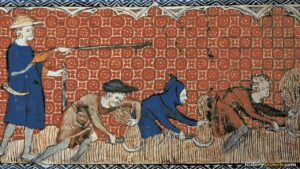
The third estate in medieval European society was the peasants, who made up the vast majority of the population and worked the land under the feudal system and the Manor System. Historians estimate that the peasant class made up around 90 percent or more of the population of medieval Europe. Peasants were the lowest class in the social hierarchy of the Middle Ages and had very little power, wealth or freedom. Their lives were defined by hard work, limited opportunities and the constant obligation to provide labor, taxes and other services to their local lord and the Catholic Church.
The peasant class itself was divided into several different groups. Freemen were peasants who were not fully bound to the land and had somewhat greater freedom of movement than serfs, though they were still subject to the authority of their local lord. Serfs, on the other hand, were peasants who were bound to the land of their local lord under the system of serfdom. Serfs were not free to leave the land without their lord’s permission and were required to provide a fixed amount of labor and other services to the lord in exchange for the right to live and work on the manor. As such, serfdom was a form of debt-bondage that severely limited the freedom and opportunities of a large portion of the population in medieval European society.
At the very bottom of the social hierarchy were slaves, who had no legal rights and were the property of their owners. With that said, slavery was relatively rare in western Europe during the High and Late Middle Ages, having largely declined following the fall of the Western Roman Empire. As such, serfs rather than slaves represented the lowest and most oppressed group within the peasant class for much of the Middle Ages.
Women and Social Class in the Middle Ages
It is important to note that the three estates system was largely defined by what a man did for a living and the social class into which he was born. Women were classified differently within the social structure of the Middle Ages. Like men, women were born into either the nobility or the peasant class, and could become members of the clergy by entering a convent as a nun. However, women generally had fewer legal rights and less social power than men of the same class. For instance, a noblewoman’s legal identity was largely tied to the men in her life, whether her father before marriage or her husband afterward. As such, gender was an important additional factor in shaping the experience of social class in the Middle Ages, and the lives of women within each estate were shaped by both their social class and the expectations placed on women in medieval European society.
Rise of the Merchant Class
While the three estates of the clergy, nobility and peasants were the traditional social divisions of medieval European society, the growth of trade and towns during the High and Late Middle Ages led to the emergence of a new social group known as the merchant class. The merchant class was made up of traders, craftsmen and other urban workers who did not fit neatly into the traditional feudal hierarchy of nobles and peasants. For instance, successful merchants could accumulate significant wealth through trade and commerce, which gave them a degree of economic power that was not reflected in their low social status within the traditional three estates.
The rise of the merchant class was an important development in the social history of the Middle Ages because it began to challenge the rigid social hierarchy of the feudal system. For instance, wealthy merchants used their economic power to gain political influence in the growing towns and cities of medieval Europe and to challenge the monopoly on power held by the clergy and the nobility. As well, the growth of guilds in the Middle Ages provided merchants and craftsmen with organized associations that gave them collective economic power and social status. As such, the rise of the merchant class during the High and Late Middle Ages was one of the most significant social developments of the medieval period and helped lay the groundwork for the broader social changes that accompanied the end of the Middle Ages and the beginning of the Renaissance.
Social Mobility in the Middle Ages
In general, social mobility, which is the ability to move from one social class to another, was very limited in the Middle Ages. A person was usually born into their social class and remained there for the rest of their life. Furthermore, when social advancement did occur, it generally took the form of a gradual increase in status over several generations of a family rather than within a single lifetime. For instance, a peasant born into serfdom had very little prospect of improving their social status, as the feudal system was designed to maintain the existing social hierarchy rather than to allow movement between classes.
With that said, there were some limited opportunities for social mobility during the Middle Ages. The Catholic Church offered one of the few genuine paths to advancement for talented commoners, though as stated above, commoners could generally only rise to mid-level positions within the Church hierarchy. As well, a successful merchant could accumulate enough wealth to purchase land and eventually gain acceptance into the lower ranks of the nobility, though this was rare. Military valor could also occasionally earn a commoner a degree of noble status. As such, while social mobility was not impossible in the Middle Ages, it was uncommon and difficult, and the vast majority of people lived and died in the same social class into which they were born.
Changes to Social Classes at the End of the Middle Ages
Toward the end of the Middle Ages, the rigid social class system of the medieval period began to break down as a result of several major developments. For instance, the Black Death, which devastated Europe in the 14th century, killed large numbers of peasants and created a severe shortage of workers across the continent. This gave surviving peasants greater bargaining power and allowed many to demand better wages and conditions from their lords, which weakened the hold of the feudal system over the lower classes. As well, the growth of trade and the rise of the merchant class created new sources of wealth and power that existed outside the traditional feudal hierarchy.
Furthermore, events such as the Peasants’ Revolt of 1381 CE in England showed that ordinary people were increasingly willing to challenge the authority of the ruling class and demand greater rights and freedoms. While the Peasants’ Revolt was ultimately suppressed, it was a sign of the growing frustration of the lower classes with the restrictions of the feudal social hierarchy. As such, the social class system of the Middle Ages was already beginning to transform by the time the medieval period came to an end, and the changes that began in the Late Middle Ages helped lay the groundwork for the more open and mobile social structures of the modern world.
Significance of Social Classes in the Middle Ages
In conclusion, social classes in the Middle Ages were a defining feature of medieval European society that shaped the lives and opportunities of people across all levels of the social hierarchy. The three estates of the clergy, nobility and peasants, along with the emerging merchant class of the High and Late Middle Ages, together formed the social structure of a world that was very different from the one we live in today. As such, understanding social classes in the Middle Ages is important for gaining a complete picture of how medieval European society was organized and for understanding the major social and economic changes that helped bring the Middle Ages to an end and shape the modern world.