Saladin was one of the most important and celebrated rulers of the Middle Ages. He was the Muslim sultan of Egypt and Syria who captured the city of Jerusalem from the Christian Crusaders in 1187 CE and went on to lead his forces against the Third Crusade. He was admired by both Muslims and Christians for his skill as a military leader and his reputation for fairness and generosity.
Saladin – Early Life
Saladin was born in 1137 or 1138 CE in the city of Tikrit, in what is now modern-day Iraq. His full name was Salah al-Din Yusuf ibn Ayyub, and the name Saladin is a shortened Western version of part of that name. His family was of Kurdish descent. His father, Najm al-Din Ayyub, and his uncle, Asad al-Din Shirkuh, were both important military commanders who served under Imad al-Din Zangi, a powerful ruler who governed northern Syria at the time.
When Saladin was a young boy, his family moved to Damascus in Syria. He grew up there and received a thorough education in religious studies, mathematics, philosophy and the arts of war. As a young man, he was reportedly more interested in religious studies than in military training. Regardless, around the age of fourteen, he began his military career by joining the staff of his uncle Shirkuh, who served as a military commander under Nur al-Din, the son and successor of Zangi. As such, Saladin’s early life was shaped by both deep religious faith and the military world in which his family operated.
Saladin – Rise to Power
Saladin’s rise to power began in earnest when he accompanied his uncle Shirkuh on a series of military campaigns in Egypt in the 1160s CE. At the time, Egypt was ruled by the Fatimid Caliphate, a Shia Muslim dynasty that was weakened by internal conflict. Shirkuh’s campaigns in Egypt were aimed at preventing the Christian Crusaders, who controlled much of the Holy Land, from taking control of the country. For instance, the crusaders and the Fatimids were both competing for influence in Egypt at this time. After several years of complex military and political maneuvering, Shirkuh succeeded in establishing himself as the most powerful figure in Egypt. When Shirkuh died in 1169 CE, Saladin was appointed to succeed him as commander of the Syrian forces in Egypt. He was also given the title of vizier, which was the most powerful political position under the Fatimid caliph.
Saladin quickly used his new position to consolidate his power. In 1171 CE, he abolished the Fatimid Caliphate and restored Sunni Islam as the official faith of Egypt. This was an important religious and political move that strengthened his authority. After the death of Nur al-Din in 1174 CE, Saladin declared himself the independent ruler of Egypt. He then set about uniting the Muslim territories of Egypt, Syria, northern Mesopotamia and Palestine under his rule. He achieved this through a mix of military force and careful diplomacy. By 1186 CE, he had succeeded in uniting these territories into a powerful Muslim empire. As such, Saladin’s rise from a young military commander to the ruler of a vast empire was one of the most remarkable stories of the Middle Ages.
Saladin – Battle of Hattin
With the Muslim territories now united under his rule, Saladin turned his attention to the Crusader states that controlled the Holy Land. The Crusades were a series of religious wars carried out by Christian crusaders from Europe during the timeframe of the Middle Ages. Beginning in 1095 CE, the Crusades saw European knights and noblemen travel to the Middle East in an attempt to capture the Holy Land from Muslim control. Saladin saw the removal of the Crusaders from the Holy Land as a central goal of his reign and spent years preparing his forces for a major campaign against them.
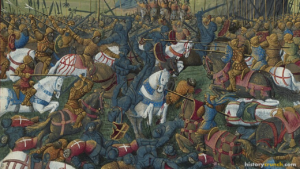
The decisive moment came at the Battle of Hattin on July 4th, 1187 CE. Saladin lured a large Crusader army into a trap in the hills near the Sea of Galilee in northern Palestine. The Crusaders ran out of water in the summer heat and were surrounded by Saladin’s forces. The battle was a complete victory for Saladin and a catastrophe for the Crusaders. For instance, the losses were so terrible for the Christians that Saladin gained control over the vast majority of the Holy Land. As a result, the way was now open for Saladin to capture the most important city in the Holy Land.
Saladin – Capture of Jerusalem
Following the victory at Hattin, Saladin’s forces moved quickly to capture the remaining Crusader cities in the Holy Land. On October 2nd, 1187 CE, the city of Jerusalem surrendered to Saladin after eighty-eight years under Christian control. This event shocked the Christian world and had a profound impact on the history of the Middle Ages. The capture of Jerusalem by the First Crusade in 1099 CE had been marked by a massacre of the Muslim and Jewish population. In contrast, Saladin’s capture of the city was notably different. For instance, he allowed the Christian population to leave safely in exchange for a ransom payment and treated the city’s population with respect. As such, his behavior after the capture of Jerusalem added greatly to his reputation for generosity and fairness, a reputation that was admired by both Muslims and many Christians of the time.
Saladin – Third Crusade
The fall of Jerusalem caused an enormous reaction in Christian Europe. Pope Gregory VIII called for a new crusade and three of the most powerful kings in Europe responded, including: King Richard I of England, known as Richard the Lionheart, King Philip II of France and Holy Roman Emperor Frederick Barbarossa of Germany. This was the Third Crusade, which took place from 1189 to 1192 CE.
The Third Crusade proved to be one of the most difficult military challenges of Saladin’s reign. For instance, Richard the Lionheart proved to be an exceptionally skilled military commander. Richard’s forces won important victories at the siege of Acre, which fell on July 12th, 1191 CE, and at the Battle of Arsuf on September 7th, 1191 CE. With that said, despite twice leading his forces close to Jerusalem, Richard ultimately decided not to attempt a direct assault on the city. The Third Crusade ended with the Treaty of Jaffa on September 2nd, 1192 CE. Under the terms of the treaty, Jerusalem remained under Muslim control, but Christian pilgrims were allowed to visit the city freely. As such, the Third Crusade ended without the Crusaders retaking Jerusalem, which was seen as a significant achievement for Saladin.
Saladin – Death and Legacy
Saladin died on March 4th, 1193 CE in Damascus, Syria, just a few months after the signing of the Treaty of Jaffa. He was approximately fifty-five or fifty-six years old. He had spent most of his life on military campaigns and was exhausted by the time of his death. In fact, by the time he died, he had given away so much of his personal wealth to his subjects that his treasury contained barely enough to pay for his own funeral.
Saladin is remembered as one of the most significant figures of the Middle Ages. He is admired across the world for his military skill, his religious devotion and his reputation for generosity and fairness. For instance, even his enemies among the Christian Crusaders respected him deeply. Richard the Lionheart is said to have praised him as the greatest Muslim prince of his time. As such, Saladin’s legacy crossed religious boundaries in a way that was unusual for the medieval period. His Ayyubid dynasty continued to rule in Egypt and Syria for several generations after his death. Today, Saladin remains one of the most celebrated figures in the history of the Islamic world and of the Middle Ages as a whole.