Navigation technology in the Age of Exploration was one of the most important factors that made the major voyages of discovery possible. The Age of Exploration, also known as the Age of Discovery, began in the early 15th century and continued until the end of the 17th century, and involved European explorers using improved navigational skills and technologies to travel the world. Before the improvements in navigation technology that occurred in the 15th century, European sailors had largely been confined to sailing close to coastlines and within familiar waters. The development of new navigational tools and the improvement of ship design gave explorers the ability to venture out into open oceans and navigate vast distances.
WHAT WAS THE AGE OF EXPLORATION?
The Age of Exploration, or Age of Discovery, is one of the most important events in the history of the western world. As stated above, it began in the early 15th century and continued until the end of the 17th century, and involved European explorers using their navigational skills to travel the world. In general, the Age of Exploration occurred for several different reasons, particularly in the countries of Portugal, Spain, France, and England. For instance, European countries were seeking new trade routes to distant trading partners in the Far East, including: China, India, and Japan. As well, the fall of Constantinople in 1453 and the rise of the Ottoman Empire had disrupted traditional overland trade routes such as the Silk Road, pushing European nations to seek new sea routes to Asia. It was in this context that improvements in navigation technology played a central role, making longer sea voyages possible for the first time.

NAVIGATION TECHNOLOGY – MAGNETIC COMPASS
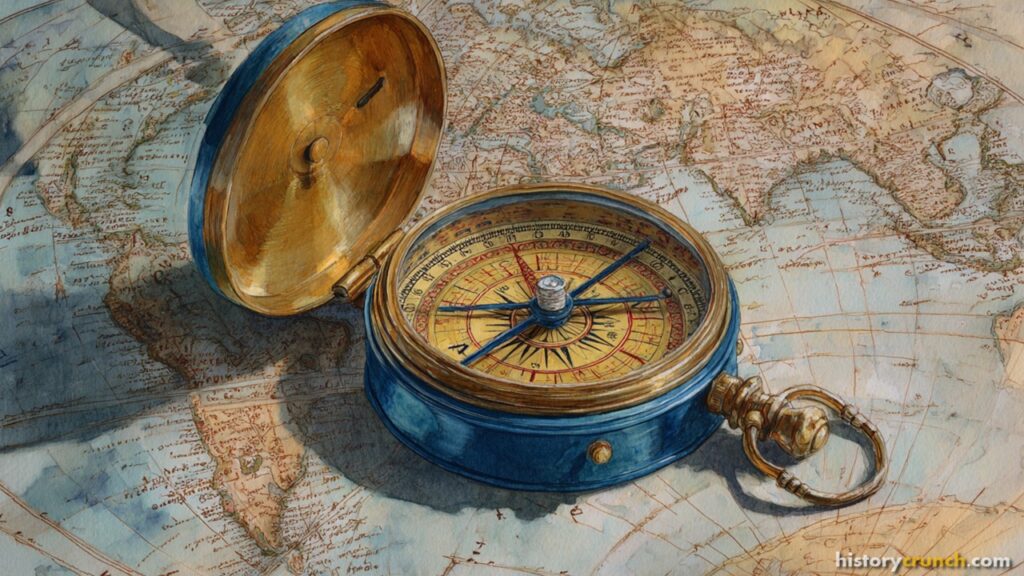
One of the most important navigation tools of the Age of Exploration was the magnetic compass. The magnetic compass works by using the Earth’s magnetic field to point toward magnetic north, providing sailors with a reliable means of determining direction regardless of weather conditions or time of day. The compass had originally been developed in China and was later adopted by Arab navigators before passing into use in Europe. The true mariner’s compass, using a pivoting needle mounted in a dry box, was in use in Europe by no later than 1300 AD.
Before the magnetic compass became widely available, European sailors had relied primarily on the position of the sun and stars to determine direction. This meant that cloudy weather or poor visibility could make navigation extremely difficult and dangerous. The magnetic compass solved this problem by providing a reliable directional reference that worked independently of visibility conditions. For instance, the famous Portuguese explorer Ferdinand Magellan reportedly made extensive use of the compass on his voyages.
NAVIGATION TECHNOLOGY – ASTROLABE
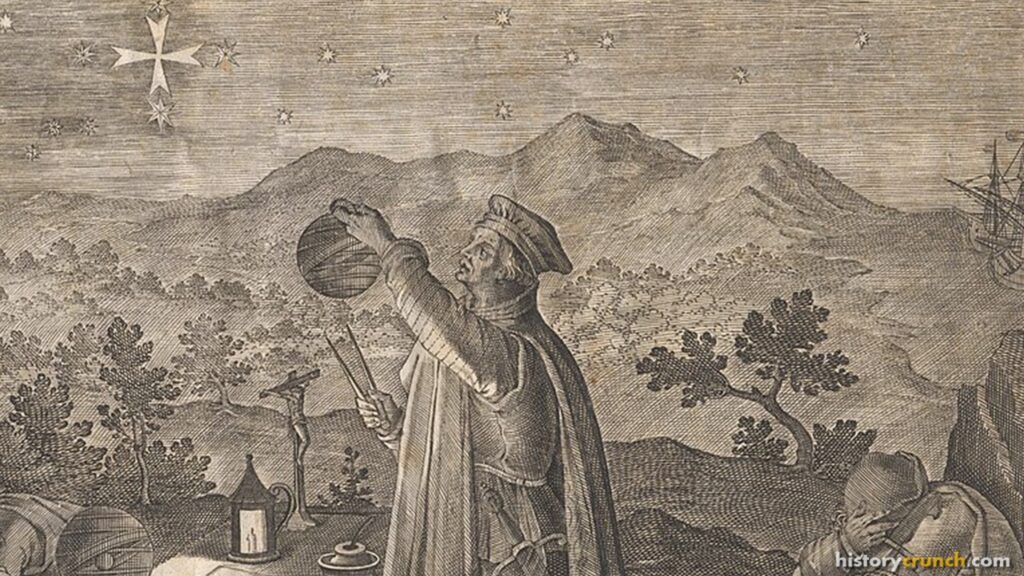
Another critically important navigation tool of the Age of Exploration was the astrolabe. The astrolabe was a circular instrument that allowed navigators to determine their latitude, which is their position north or south of the equator, by measuring the angle of the sun or a star above the horizon. The instrument originated in the ancient world and had been used in astronomy for centuries, but it was the development of the mariner’s astrolabe in the 15th century, which was specifically designed for use on a ship at sea, that made it a practical tool for ocean navigation.
The astrolabe was used extensively by some of the most famous explorers of the Age of Exploration, including Christopher Columbus and Ferdinand Magellan. As such, the astrolabe was one of the most important scientific instruments of the era and played a central role in making long-distance ocean navigation possible.
NAVIGATION TECHNOLOGY – QUADRANT
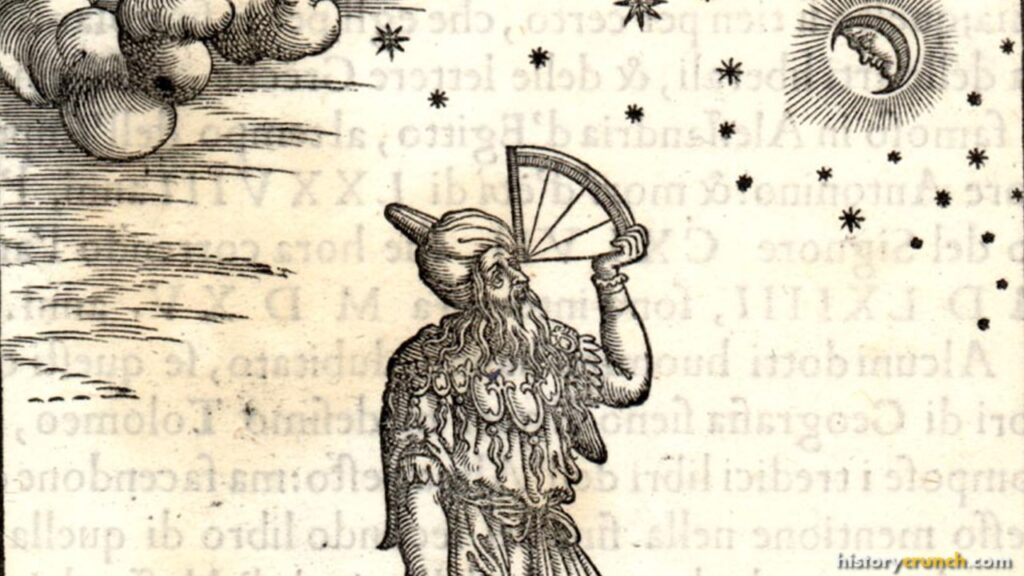
The quadrant was another important instrument used for celestial navigation during the Age of Exploration. In its basic form, the quadrant was a heavy metal plate shaped like a quarter circle, graduated in degrees like a protractor. The navigator would hang the quadrant in the ship’s rigging and sight along its straight edge at the sun or the North Star. The quadrant was originally developed for use in astronomy and was later adapted for maritime navigation. It was one of the most widely used navigational instruments among European sailors in the 15th and 16th centuries, alongside the astrolabe.
NAVIGATION TECHNOLOGY – CARTOGRAPHY AND NAUTICAL CHARTS
The development of more accurate maps and nautical charts was another essential component of navigation technology during the Age of Exploration. Before the Age of Exploration, European knowledge of the geography of the world beyond the Mediterranean and the coastlines of Europe and North Africa was extremely limited and often inaccurate. Nautical charts, known as portolan charts, had begun to appear in Italy at the end of the 13th century and showed coastlines, ports, and sea routes in considerable detail for the Mediterranean and Black Sea regions. However, the charts available to early explorers were largely inaccurate for regions beyond these familiar waters.
As European explorers ventured further into the Atlantic and beyond, the information gathered on each voyage was gradually incorporated into new and more accurate charts. For instance, each successive voyage down the coast of Africa by Portuguese explorers in the early 15th century added new detail to the charts available to later sailors. This was a central component of the importance of Henry the Navigator and his contributions to the Age of Exploration

NAVIGATION TECHNOLOGY – SHIP DESIGN
Improvements in ship design was possibly one of the most important technologies to help with the voyages of the Age of Exploration. Before the 15th century, European ships were generally not suited for long-distance ocean voyaging, as they were designed primarily for coastal or Mediterranean sailing rather than crossing vast open oceans.
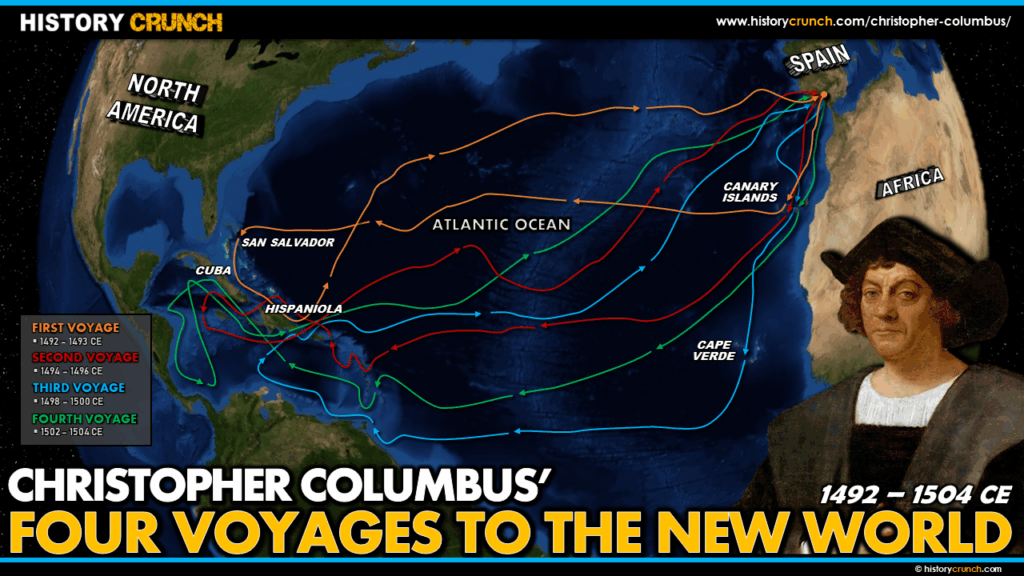
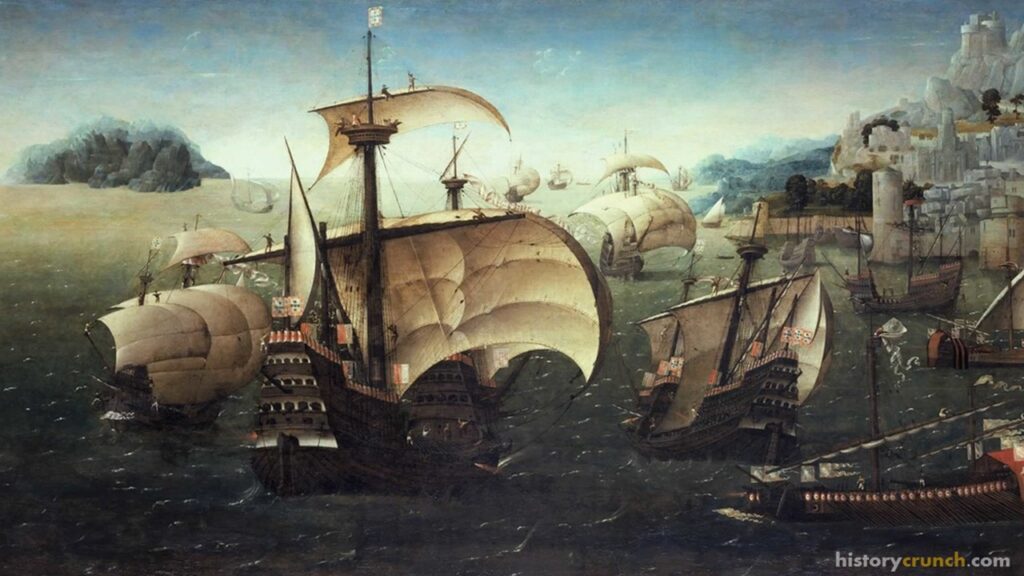
The most important new ship design of the Age of Exploration was the caravel. The caravel was developed by Portuguese shipbuilders in the 15th century, with significant investment and encouragement from Henry the Navigator of Portugal. It was a relatively small, lightweight, and highly maneuverable vessel with two or three masts carrying triangular sails. This was important, because unlike the square sails used on earlier European ships, it allowed the vessel to sail more directly into the wind. This made it possible for sailors to navigate effectively in a much wider range of wind conditions and to return home against prevailing winds. For instance, Christopher Columbus used caravels, specifically the Niña and the Pinta, on his first voyage to the Americas in 1492.
For longer voyages requiring more cargo capacity, European sailors also used the carrack. The carrack was a larger vessel than the caravel, with three or four masts carrying a combination of square and triangular sails. While the carrack was slower and less maneuverable than the caravel, it was sturdier in rough seas and could carry far more supplies and trade goods. For instance, Columbus’s flagship on his first voyage, the Santa María, was a carrack. In the 16th century, the even larger galleon began to replace the carrack on major ocean trade routes, as it combined cargo capacity with the ability to carry heavy cannons for defense.
NAVIGATION TECHNOLOGY – SIGNIFICANCE
Navigation technology in the Age of Exploration was significant for several important reasons. First, the development and improvement of navigational instruments such as the magnetic compass, the astrolabe, and the quadrant gave European explorers the ability to determine their position at sea with sufficient accuracy to make long-distance ocean voyages possible. Without these tools, the voyages of Columbus, Magellan, Vasco da Gama, and the other great explorers of the era would not have been achievable.
Second, improvements in ship design, particularly the development of the caravel, gave European sailors vessels that were capable of sailing efficiently in a wide range of wind conditions and over the vast distances of the open ocean. It was the combination of improved instruments and improved ships that together made the Age of Exploration possible.
Third, navigation technology had profound and lasting consequences for world history. The voyages that these technologies made possible led to the European discovery and colonization of the Americas, the establishment of new sea trade routes between Europe, Africa, and Asia, and a period of major cultural exchange, economic growth, and also significant harm and exploitation for the indigenous peoples of the regions that Europeans encountered.