The American Revolutionary War came to an end in 1783, after more than eight years of conflict between the thirteen colonies and Great Britain. The final phase of the war was shaped by a decisive military victory at Yorktown, Virginia, in October of 1781, followed by two years of diplomatic negotiations in Paris that produced a peace treaty formally recognizing the United States as an independent nation. The end of the Revolution was the result not just of American military effort, but of the crucial alliance with France and the growing exhaustion of Britain’s will to fight a war it could no longer afford to win.
What Was the American Revolution?
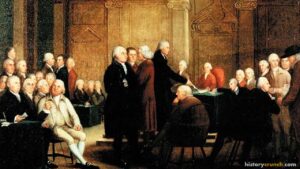
The American Revolution was the political and military struggle through which the Thirteen Colonies broke free from British rule and established the United States of America. Open fighting began in April of 1775 at Lexington and Concord in Massachusetts, and the colonies formally declared independence on July 4th, 1776. For the following years, the Continental Army under General George Washington fought the British across the eastern seaboard, struggling with limited supplies, unreliable funding, and a far more experienced enemy. The tide of the war began to shift after the American victory at Saratoga in 1777, which brought France into the conflict as a formal American ally. By 1781, the combined pressure of American resilience and French military power had pushed the British toward a reckoning from which they would not recover.
The War in the South and Cornwallis’s Campaign
By the time the war entered its final phase, much of the fighting had shifted to the southern colonies. Britain had launched a major campaign in the south beginning in 1778, hoping to exploit Loyalist support in Georgia and the Carolinas and cut the colonies in two. British forces achieved significant successes early on, capturing Savannah, Georgia, in December of 1778 and Charleston, South Carolina, in May of 1780 in one of the worst American defeats of the entire war.
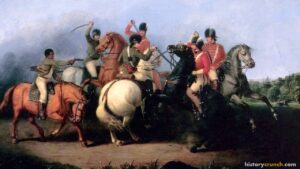
General Lord Charles Cornwallis commanded British forces in the south and won a major victory over American forces at Camden, South Carolina, in August of 1780. He then launched an invasion of North Carolina. However, his campaign ran into serious difficulties. American forces won an important victory at Kings Mountain in October of 1780, and another at Cowpens in January of 1781, both of which dealt significant blows to British strength in the region. Cornwallis found himself unable to pacify the south, and his army had been worn down by months of difficult campaigning through unfamiliar terrain against a determined enemy that refused to give up.
In the spring of 1781, Cornwallis moved his battered army northward into Virginia, conducting raids on towns and plantations across the state. By August of 1781, he had settled his force of roughly 9,000 men at Yorktown, a port town on the Virginia coast, where he expected to receive supplies and reinforcements by sea from British forces in New York.
The Trap at Yorktown
The decision by Washington and his French counterpart, General Comte de Rochambeau, to strike at Cornwallis at Yorktown rather than attack the British in New York City was one of the most important strategic choices of the entire war. When word reached them that French Admiral Comte de Grasse was sailing north from the Caribbean with a large fleet, Washington and Rochambeau saw an opportunity they could not pass up.
To keep the British in New York off guard, Washington staged an elaborate deception, constructing large camps with bread ovens visible to British observers and allowing false plans for an attack on New York to fall into British hands. While the British prepared to defend New York, Washington and Rochambeau marched their combined force of nearly 8,000 men south in a rapid and secret movement, covering hundreds of miles to reach Virginia.
On September 5, 1781, de Grasse’s French fleet met a British naval force at the mouth of the Chesapeake Bay in what is known as the Battle of the Capes. The French won decisively, forcing the British fleet to return to New York and cutting off any chance of Cornwallis receiving reinforcements or escaping by sea. It was a turning point of enormous importance. Without control of the water, Cornwallis was trapped.
By the end of September of 1781, approximately 17,000 American and French troops had arrived at Yorktown and begun laying siege to the British position. The French held the left flank and the Americans the right. Working at night, the allied forces dug trenches closer and closer to the British lines, dragging heavy artillery into position to bombard the British defenses. By October 9, the first Allied guns opened fire, and within days most of the British artillery had been silenced.
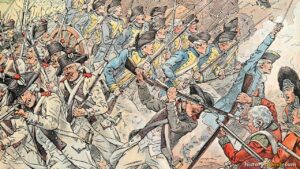
On the night of October 14, American and French forces launched simultaneous assaults on two key British defensive positions called redoubts. A force of 400 light infantry under the command of Alexander Hamilton stormed Redoubt 10 with bayonets fixed and muskets unloaded, relying on speed and silence rather than firepower. The redoubt fell quickly. The French assault on Redoubt 9 succeeded at the same time. With artillery now placed on three sides of his position, Cornwallis attempted a desperate counterattack on October 15, which failed. On the morning of October 17, a lone British drummer boy appeared on the parapet of the British lines, beating a signal for a truce. A British officer followed, waving a white handkerchief to signal the desire to negotiate surrender.
The Surrender at Yorktown
On October 19, 1781, the formal surrender took place in a field outside Yorktown. Cornwallis, claiming to be ill and reportedly too humiliated to attend in person, sent his second-in-command, Brigadier General Charles O’Hara, to carry out the ceremony on his behalf. More than 8,000 British and Hessian soldiers marched out between the lines of American and French troops with their flags furled and cased. The British bands reportedly played a tune called “The World Turned Upside Down” as the soldiers laid down their weapons.
O’Hara attempted to surrender Cornwallis’s sword to Rochambeau, but the French general declined, directing him to Washington. As O’Hara was not the commanding general, Washington in turn directed him to surrender to his own second-in-command, General Benjamin Lincoln. In all, Cornwallis surrendered 7,087 officers and men, 900 seamen, 144 cannons, 15 galleys, and 30 transport ships. A British relief fleet carrying 7,000 men sailed from New York but arrived five days too late to help.
When news of the defeat reached London, British Prime Minister Lord Frederick North reportedly collapsed upon hearing it, exclaiming, “Oh God, it is all over!” Parliament and King George III recognized that continuing the war would require far more men, money, and resources than Britain was prepared to commit. Though minor fighting continued in other parts of the world and some skirmishes took place in America over the following months, Yorktown effectively ended the war.
Peace Negotiations in Paris
Following the British defeat at Yorktown, the British government began the process of seeking peace. Lord North resigned as prime minister in March of 1782, and informal talks between American and British representatives began in Paris in April of that year. Representing the United States in the negotiations were three experienced diplomats: Benjamin Franklin, John Adams, and John Jay. The British representative was Richard Oswald, later replaced by David Hartley.
The negotiations were complicated by the involvement of France and Spain, both of which had their own interests in the outcome. France, which had helped finance and fight the American war, had obligations to its ally Spain, which was still hoping to capture Gibraltar from the British and refused to agree to peace until that goal was achieved. The American negotiators, concerned that France might pressure them into accepting unfavorable terms, chose to negotiate directly with the British without consulting the French, despite their treaty obligations to do so. French Foreign Minister Vergennes was irritated when he discovered this, but accepted the outcome.
Two months of intensive negotiations produced a preliminary peace agreement, signed on November 30th, 1782. The final Treaty of Paris was signed on September 3rd, 1783, at the Hotel d’York in Paris, by Franklin, Adams, Jay, and Hartley for their respective governments. Congress ratified the treaty on January 14th, 1784, formally and officially ending the Revolutionary War.
Terms of the Treaty of Paris
The terms of the Treaty of Paris were widely regarded as very generous to the United States, more so than many observers had expected. The key provisions of the treaty were as follows.
Britain formally recognized the United States as a free, sovereign, and independent nation, acknowledging the legitimacy of American independence for the first time. The treaty set the boundaries of the new nation, granting the United States all territory from the Atlantic coast west to the Mississippi River, and from the Great Lakes in the north down to the northern border of Florida in the south. This effectively doubled the size of the new country and opened up vast territory for future westward expansion.
The United States gained valuable fishing rights in the waters off the coast of Canada, including on the Grand Banks. Both sides agreed to allow navigation of the Mississippi River freely. American debtors were expected to honor debts owed to British creditors, and the United States agreed not to prevent British subjects from attempting to recover those debts. The treaty also called for the fair treatment of American Loyalists, those colonists who had sided with Britain during the war, and promised that their confiscated property would be restored. In practice, this last provision was largely ignored by the individual states.
Britain also signed separate treaties with France and Spain at the same time, collectively known as the Peace of Paris. France, which had spent enormous sums supporting the American war effort, emerged from the conflict financially exhausted. Spain recovered Minorca and the Floridas from Britain, but failed to obtain Gibraltar, which it had sought throughout the war.
The British Departure
After the treaty was signed, the process of British withdrawal from American territory took some time. The last British troops did not evacuate New York City until November of 1783, a full two months after the formal signing of the peace. Washington and his Continental Army marched into the city shortly after the British departed. It was one of the final acts of Washington’s command. On December 4th, 1783, Washington gathered his officers at Fraunces Tavern in New York City and said farewell to them in an emotional ceremony. He then traveled to Annapolis, Maryland, where Congress was meeting, and formally resigned his commission as Commander-in-Chief on December 23rd, 1783. Most of the Continental Army had already been disbanded by this point, with the last units formally mustered out in June of 1784.
Significance of the End of the American Revolution
The end of the American Revolution was far more than the conclusion of a military conflict. It was the moment at which a new nation was formally born, recognized by the most powerful empire in the world as a legitimate and independent state. The Treaty of Paris gave the United States territory and fishing rights that set it up for rapid growth, and the withdrawal of British forces removed the last obstacle to American self-governance.
The circumstances of the war’s end also had major effects beyond American borders. The financial strain that France took on to support the American war contributed directly to the economic crisis that helped trigger the French Revolution in 1789. Britain, having lost its most populous American colonies, was forced to rethink its imperial strategy entirely. And for the first time in modern history, a colonial population had successfully fought for and won its independence from a European empire, setting a powerful example for reform and independence movements around the world for generations to come.